
Alignment between Brains and AI: Evidence for Convergent Evolution across Modalities, Scales and Training Trajectories
Abstract
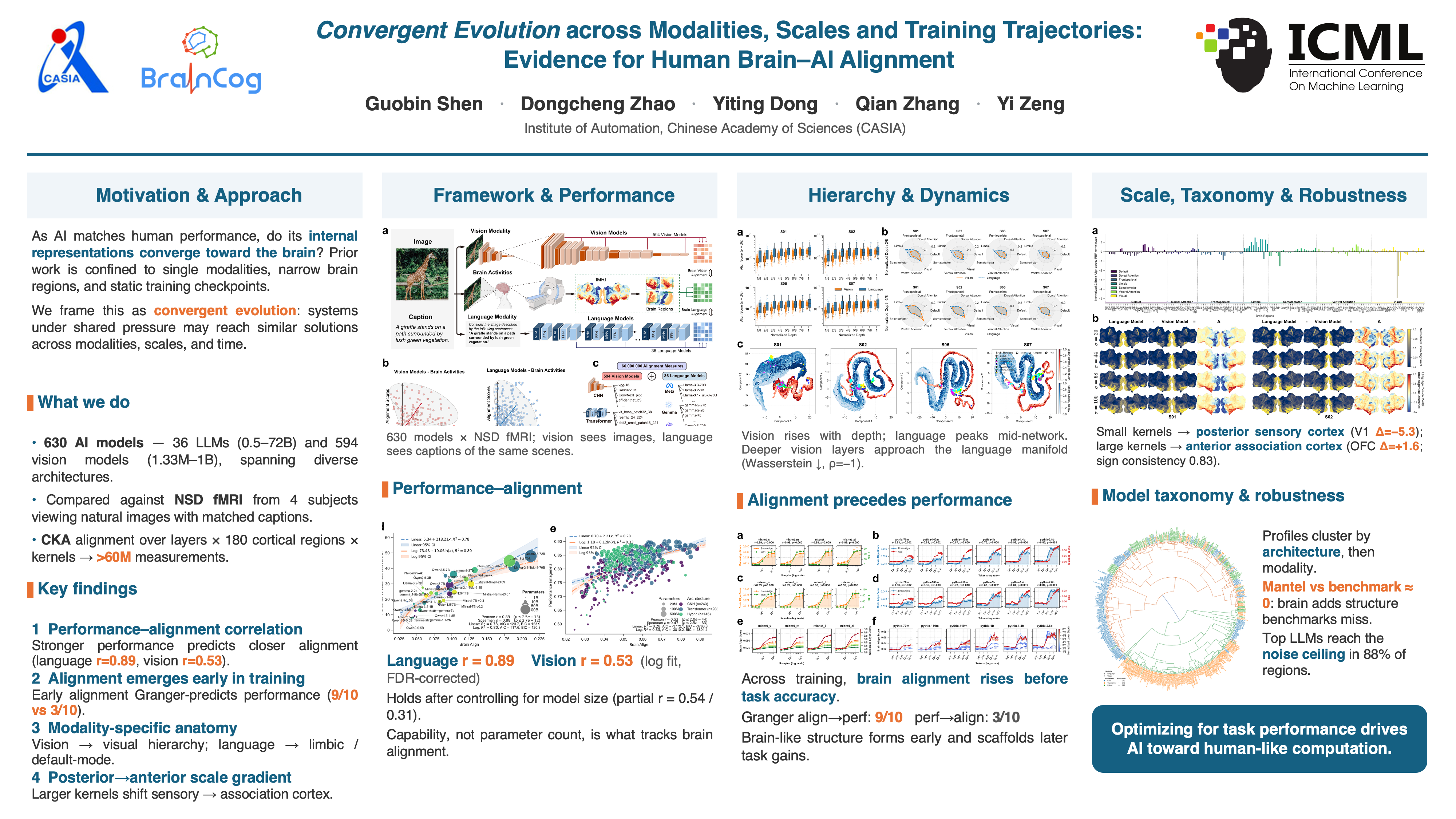
Artificial and biological systems may converge on similar computational strategies despite different architectures and learning mechanisms—a form of convergent evolution. We test this at scale by comparing internal representations of 630 AI models (language and vision; 1.33M–72B parameters) against fMRI from the Natural Scenes Dataset, producing over 60 million alignment measurements. Within each modality, higher-performing models spontaneously develop stronger brain correspondence (language: r = 0.89; vision: r = 0.53); because the inputs are image-evoked, the language results reflect visual-semantic alignment rather than a direct cross-modal comparison. Longitudinal analysis combined with bidirectional Granger tests further shows that past alignment predicts future performance more reliably than the reverse, identifying brain-like representations as a robust early-emerging correlate of learning. Modality-specific organization also emerges: language models align with limbic and integrative regions, vision models with visual cortical hierarchies.
Lay Summary
AI systems and the human brain are built very differently, yet a long-standing question is whether they end up solving problems in similar ways. We compared the internal activity of 630 modern AI models—language models like LLaMA and vision models like ResNet—against brain scans of people viewing natural images. We find that the better an AI performs, the more its internal patterns resemble brain activity, even though none of these systems were trained to mimic the brain; this resemblance appears early in training, before the AI becomes good at its task; and different kinds of AI line up with different brain regions in sensible ways—vision models with areas that process what we see, language models with areas involved in meaning and memory. Together, the results provide large-scale evidence that artificial and biological intelligence can converge on similar computational strategies despite very different origins.