
Artemis: Structured Visual Reasoning for Perception Policy Learning
Abstract
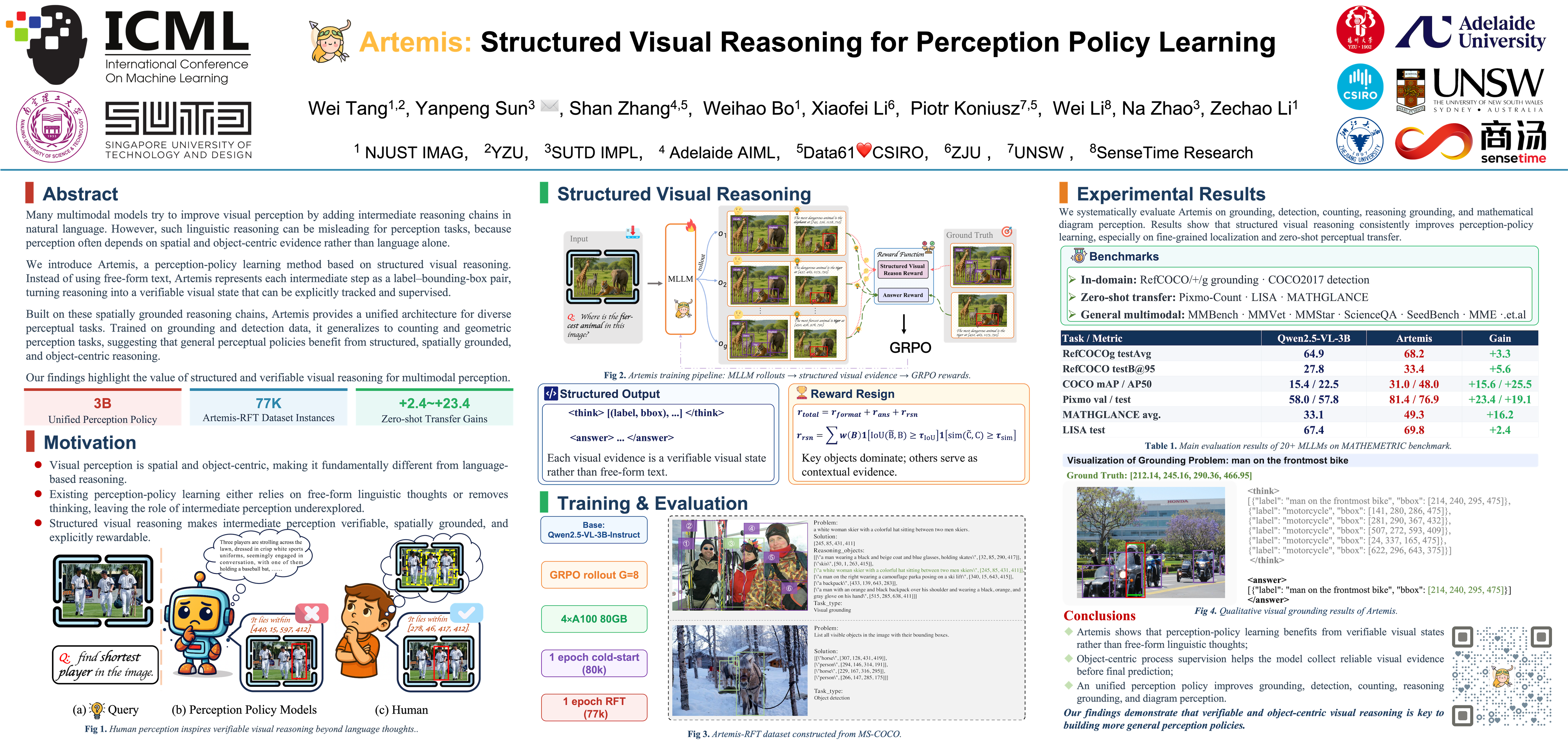
Recent reinforcement-learning frameworks for visual perception policy usually incorporate intermediate reasoning chains expressed in natural language. Empirical observations indicate that such purely linguistic intermediate reasoning often reduces performance on perception tasks. We argue that the core issue lies not in reasoning per se but in the form of reasoning: while these chains perform semantic reasoning in an unstructured linguistic space, visual perception requires reasoning in a spatial and object-centric space. In response, we introduce Artemis, a perception-policy learning method that performs structured visual reasoning, where each intermediate step is represented as a (label, bounding-box) pair capturing a verifiable visual state. This design enables explicit tracking of intermediate states, direct supervision for proposal quality, and avoids ambiguity introduced by language-based reasoning. Building upon verifiable and spatially grounded reasoning chains, Artemis provides a unified architecture for diverse perceptual tasks, without requiring the task-specific designs relied upon by prior perceptual policy models. Trained using grounding and detection sampeles in natural image domains, Artemis generalizes to counting and geometric perception tasks. At its core, a spatially grounded, object-centric chain rule provides a principled foundation for scalable and general perceptual policies.
Lay Summary
Many multimodal models try to improve visual perception by adding intermediate reasoning chains in natural language. However, such linguistic reasoning can be misleading for perception tasks, because perception often depends on spatial and object-centric evidence rather than language alone. We introduce Artemis, a perception-policy learning method based on structured visual reasoning. Instead of using free-form text, Artemis represents each intermediate step as a label–bounding-box pair, turning reasoning into a verifiable visual state that can be explicitly tracked and supervised. Built on these spatially grounded reasoning chains, Artemis provides a unified architecture for diverse perceptual tasks. Trained on grounding and detection data, it generalizes to counting and geometric perception tasks, suggesting that general perceptual policies benefit from structured, spatially grounded, and object-centric reasoning.