
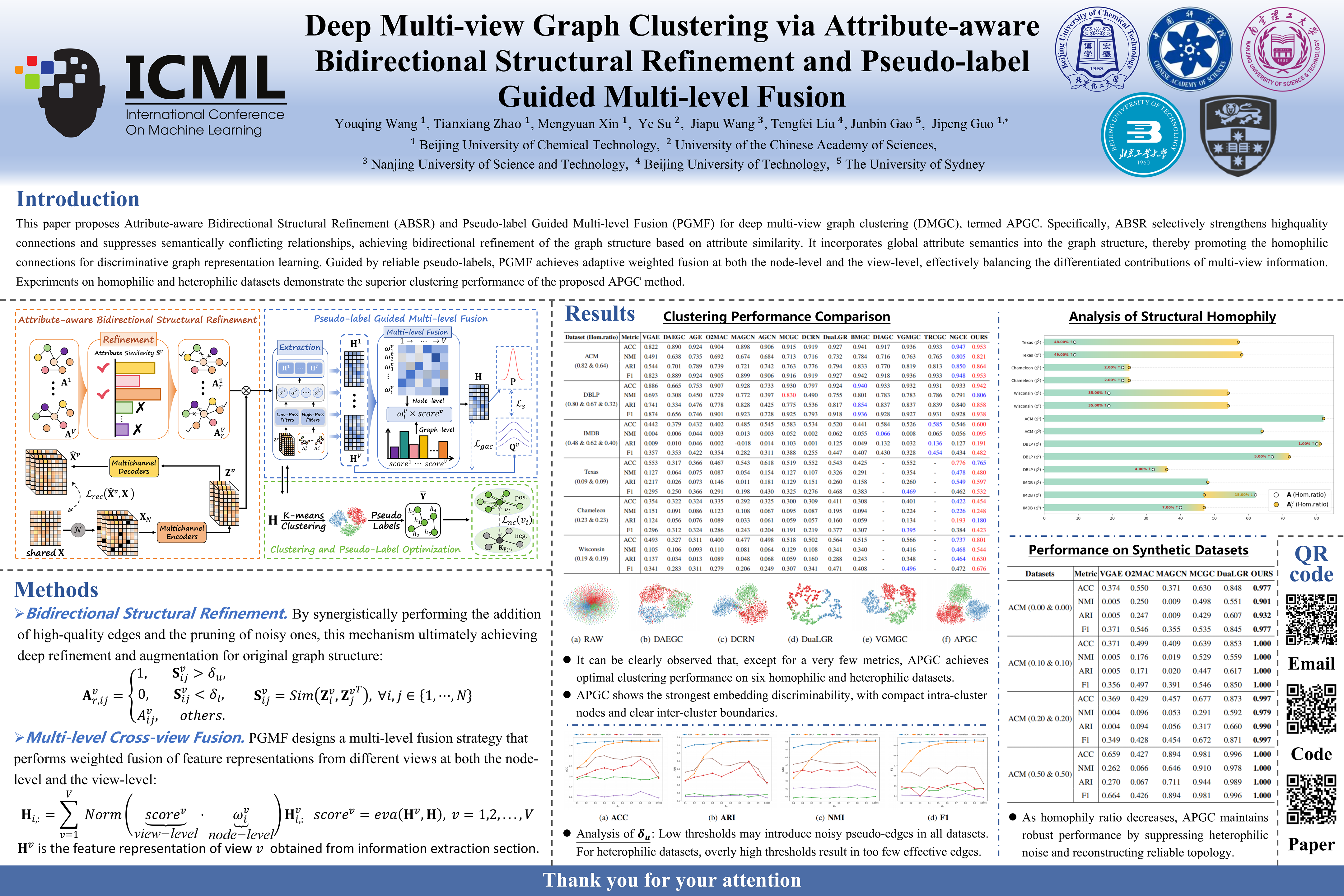
Deep Multi-view Graph Clustering via Attribute-aware Bidirectional Structural Refinement and Pseudo-label Guided Multi-level Fusion
Abstract
Deep multi-view graph clustering (DMGC) typically leverages graph neural networks for representation learning, but most existing methods excessively depend on local and static graph structures and only utilize simplistic cross-view fusion strategies. To this end, this paper proposes Attribute-aware Bidirectional Structural Refinement (ABSR) and Pseudo-label Guided Multi-level Fusion (PGMF) for DMGC, termed APGC. Specifically, ABSR selectively strengthens high-quality connections and suppresses semantically conflicting relationships, achieving bidirectional refinement of the graph structure based on attribute similarity. It incorporates global attribute semantics into the graph structure, thereby promoting the homophilic connections for discriminative graph representation learning. Guided by reliable pseudo-labels, PGMF achieves adaptive weighted fusion at both the node-level and the view-level, effectively balancing the differentiated contributions of multi-view information. Experiments on six homophilic and heterophilic datasets demonstrate the superior clustering performance of the proposed APGC method. The code of APGC could be available at https://github.com/TianxiangZhao0474/APGC.git.
Lay Summary
We often use specialized neural networks to group similar data into clusters by analyzing multiple views of the same information, much like looking at an object from different angles. However, current methods usually rely on rigid, imperfect connections and struggle to balance information from these different perspectives. To solve this, we developed a new method called APGC. It acts as an intelligent editor that improves the connections between data points. It automatically strengthens high-quality links based on how similar the items' traits are, while weed-out conflicting relationships. Furthermore, APGC uses pseudo-labels to automatically decide how much weight to give each view, ensuring the most reliable information stands out. Testing our method across six diverse datasets showed that it outperforms existing techniques.