
See First, Reason Later: Mutual Information-Guided Reinforcement Learning for Vision-Language Models
Abstract
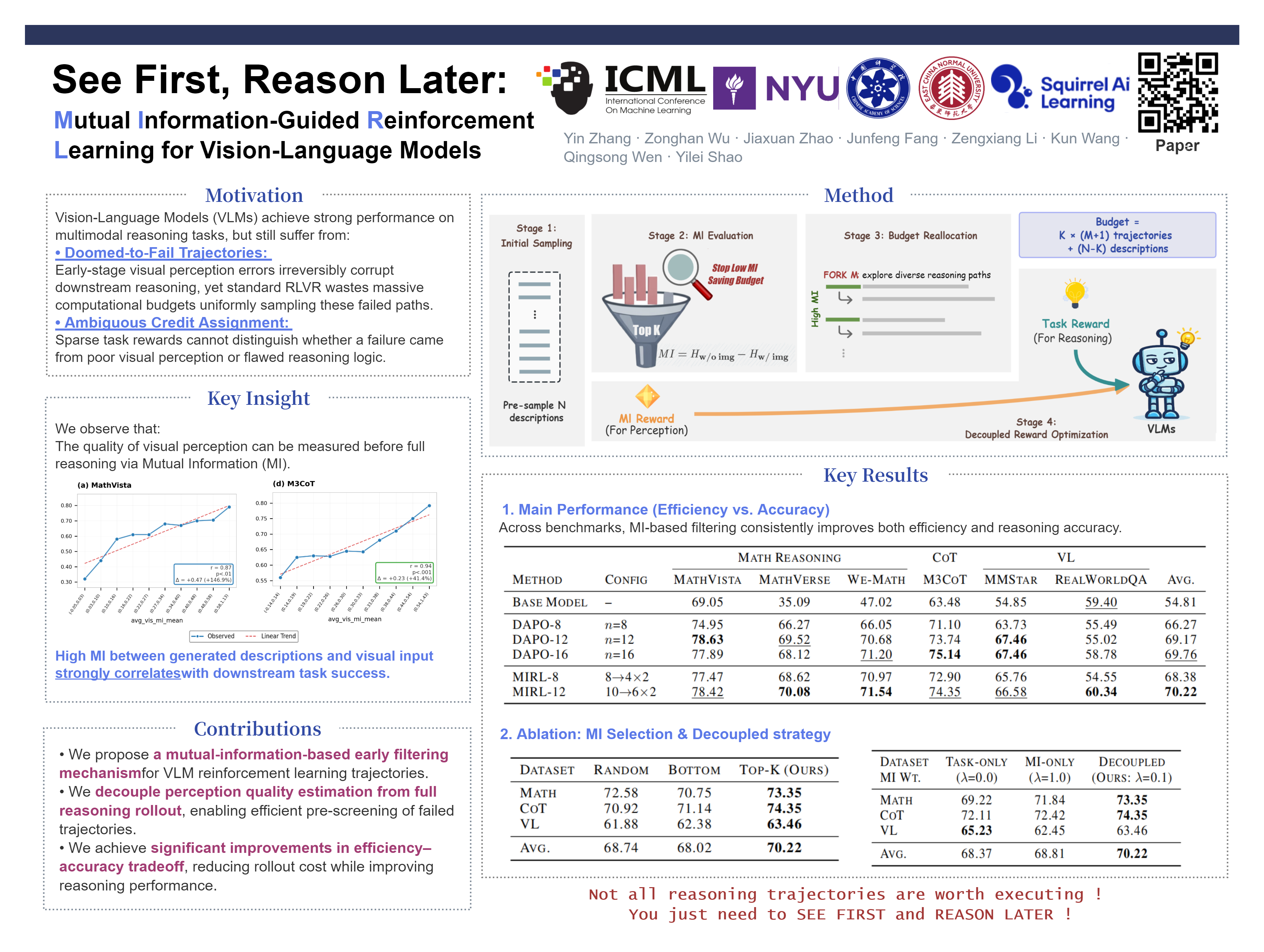
Vision-Language Models (VLMs) frequently suffer from visual perception errors and hallucinations that compromise answer accuracy in complex reasoning tasks. Reinforcement Learning with Verifiable Rewards (RLVR) offers a promising solution by optimizing policies using answer correctness signals. Despite their effectiveness, prevailing RLVR methods face two critical limitations. First, much of the sampling budget is wasted on trajectories doomed to fail due to early visual description errors. Second, sparse rewards cannot distinguish whether failures stem from visual perception or reasoning stages. We introduce MIRL, a decoupled framework that addresses both limitations by leveraging mutual information (MI) between generated descriptions and visual inputs as a cheap pre-screening signal. This enables intelligent budget allocation toward high-potential trajectories via forking, while decoupled training provides independent MI-based rewards for visual perception optimization, resolving reward blindness. Experiments on six vision-language reasoning benchmarks demonstrate that MIRL achieves 70.22\% average accuracy and successfully surpasses the performance of sampling 16 complete trajectories using only 10 pre-samples with top-6 selection (25\% fewer complete trajectories). Our code is available at: https://github.com/youwyouw/mirl-main.
Lay Summary
AI models that understand both images and text often make mistakes by misreading or ignoring visual content, leading to wrong answers. Current training methods waste significant computation by treating all attempts equally, even when the model has already failed to properly look at the image. They also struggle to identify whether a mistake came from poor image reading or flawed reasoning. We propose MIRL, a smarter training approach that first quickly checks how well the model is actually using visual information before investing full computational resources. By measuring the statistical dependence between the model’s description and the image, we identify promising attempts early and focus training effort on those. We also provide separate feedback signals for the image-reading and reasoning stages, so the model can improve each skill independently. Our method trains more efficiently than standard approaches and achieves better accuracy across six benchmarks covering math, science, and general visual understanding.