
Mind Your Margin and Boundary: Are Your Distilled Datasets Truly Robust?
Muquan Li ⋅ Yingyi Ma ⋅ Yihong Huang ⋅ Hang Gou ⋅ KE QIN ⋅ Ming Li ⋅ Yuan-Fang Li ⋅ Tao He
Abstract
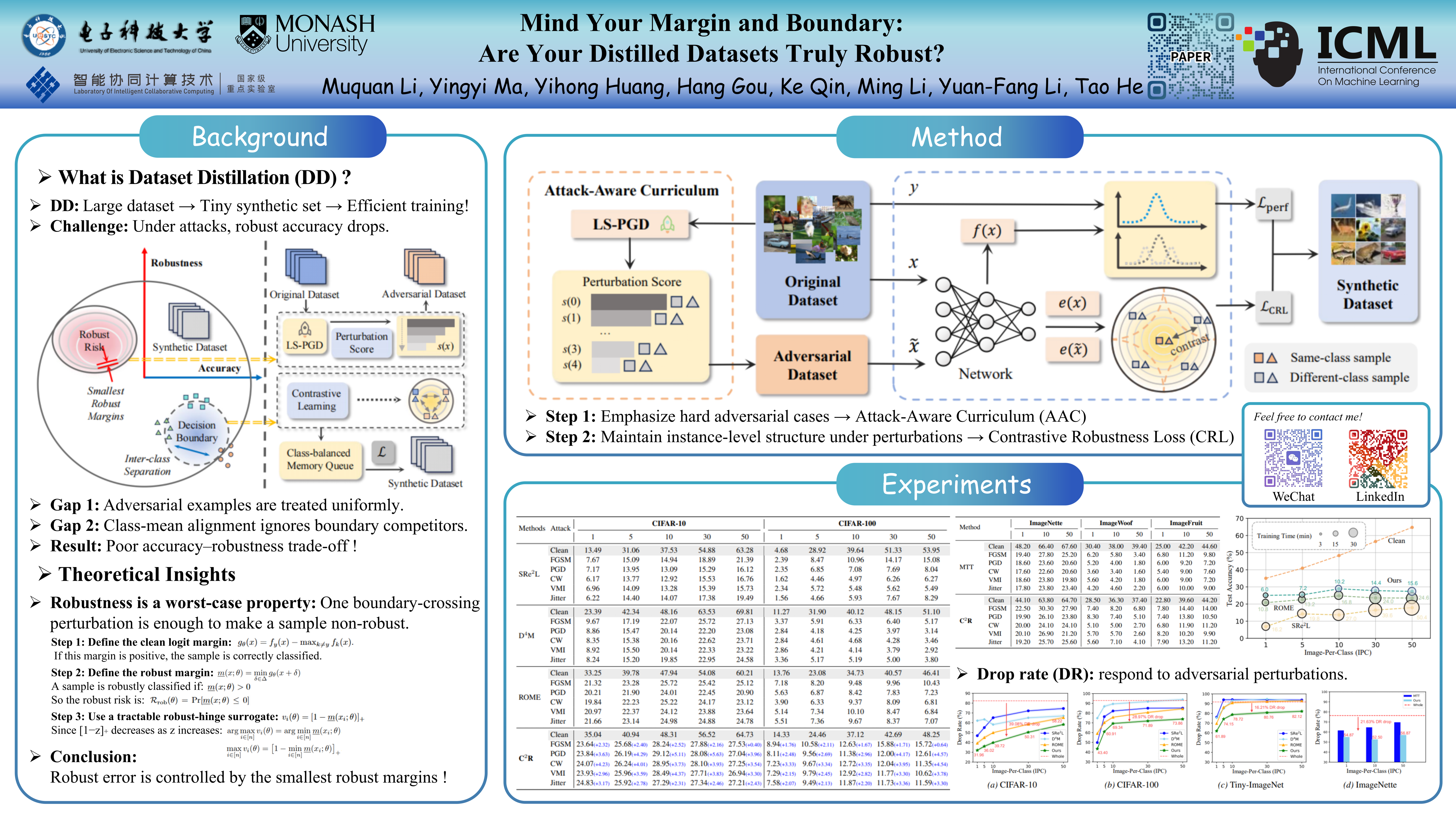
Dataset distillation (DD) compresses a large training set into a small synthetic set for efficient training, but most DD methods optimize only clean accuracy and leave robustness uncontrolled. Recent robust DD methods improve robustness, yet they often suffer from a poor accuracy–robustness trade-off because they (i) treat all adversarially perturbed examples uniformly, despite robust risk being dominated by near-zero robust margins, and (ii) do not explicitly increase inter-class separation in the decision boundary where attacks concentrate. We present Contrastive Curriculum for Robust Dataset Distillation (C$^2$R), a margin-centric framework that couples an attack-aware curriculum with a contrastive robustness objective. From a robust-margin perspective, we derive a perturbation score that approximates each sample’s robust hinge, enabling a curriculum that prioritizes the smallest-margin adversaries that most directly drive robust error. In parallel, a class-balanced contrastive robustness loss enforces adversarial invariance while explicitly widening boundary separation across classes. Experiments on CIFAR-10/100, Tiny-ImageNet, and multiple ImageNet-1K subsets under six attacks show that C$^2$R achieves the best robust accuracy, outperforming prior robust DD methods by $2.8$\% on average. Under PGD, C$^2$R also reduces the average drop rate (DR) below $66.8$\% across datasets, indicating a stronger accuracy–robustness balance.
Video
Chat is not available.
Successful Page Load