
Dynamic Compression Flows for Neuroscience Data
Abstract
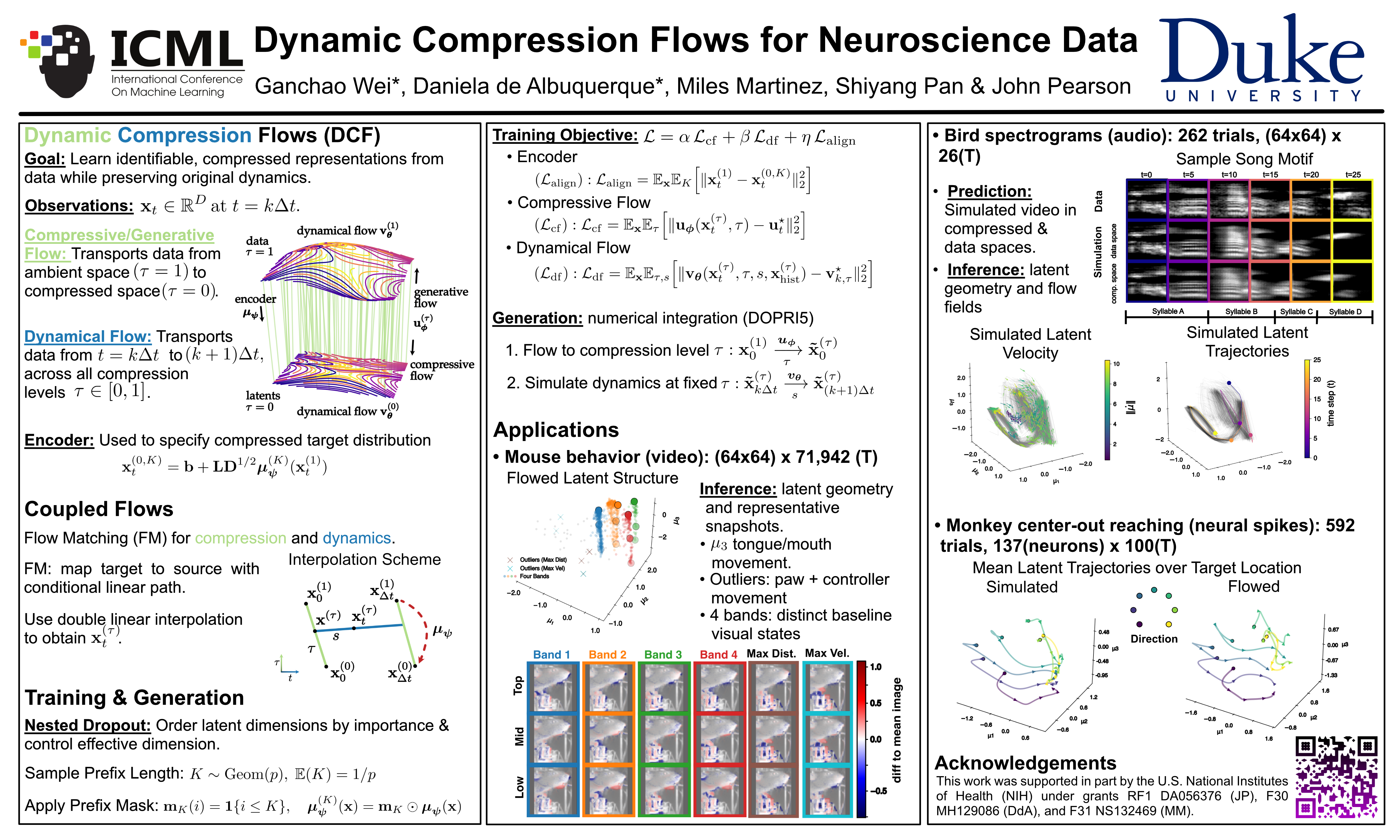
While neuroscience experiments have repeatedly demonstrated the involvement of large populations of neurons in even simple behaviors, these studies have just as often reported that the collective dynamics of neural activity are approximately low-dimensional. As a result, methods for identifying low-dimensional latent representations of time series data have become increasingly prominent in neuroscience. However, most existing methods either ignore temporal structure or model time evolution using latent dynamical systems approaches. In the first case, dynamics may be distorted or even scrambled in the latent space, while in the second, many possible latent dynamics may give rise to the same data. Here, we address these challenges using a novel flow-matching approach in which data are generated by a pair of flow fields, one governing time evolution, the other a mapping between data and a low-dimensional latent space. Importantly, the dimension-reducing flow is trained to minimize distortions of the temporal dynamics, learning an identifiable low-dimensional representation that preserves temporal relations in the original data. Additionally, we constrain our latent spaces to have low-dimensional support in a soft, parameterized manner, taking inspiration from ideas on nested dropout. Across both neural and behavioral data, we show that this dual flow approach produces both more interpretable dynamics and higher-quality reconstructions than competing models, including in noise-dominated data sets where conventional approaches fail.
Lay Summary
Modern neuroscience data are often thought to be complex and can have up to hundreds of thousands of dimensions. However, recent work has shown that these data are actually governed by much lower-dimensional dynamics. As such, developing techniques capable of capturing these low-dimensional representations of the data has become all but essential to neuroscientists. Existing methods often focus on either 1) finding low-dimensional representations of the data (while disregarding temporal structure), 2) capturing the temporal dynamics of the data (without compression), or 3) both, but often with unrealistic, strong modeling assumptions. Here, we used an existing deep generative modeling technique called “Flow Matching” to learn flow-fields capable of seamlessly transporting the data into a lower-dimensional representation while also preserving its intrinsic temporal structure. We applied this new method to multiple real open-source neuroscience datasets, and compared it against several competing approaches showing its ability to discover lower-dimensional dynamics directly from data, even in challenging scenarios where conventional models tend to fail. Of note, we also show that the low-dimension representations learned are unique (up to sign flips) and can be recovered consistently across different experimental runs. We hope that this work can provide a tool for neuroscientists to analyze and better understand their data, ultimately yielding new insights into brain dynamics and function.