
CoGe-GCD: Reframing Generalized Category Discovery with Compositional Generalization
Abstract
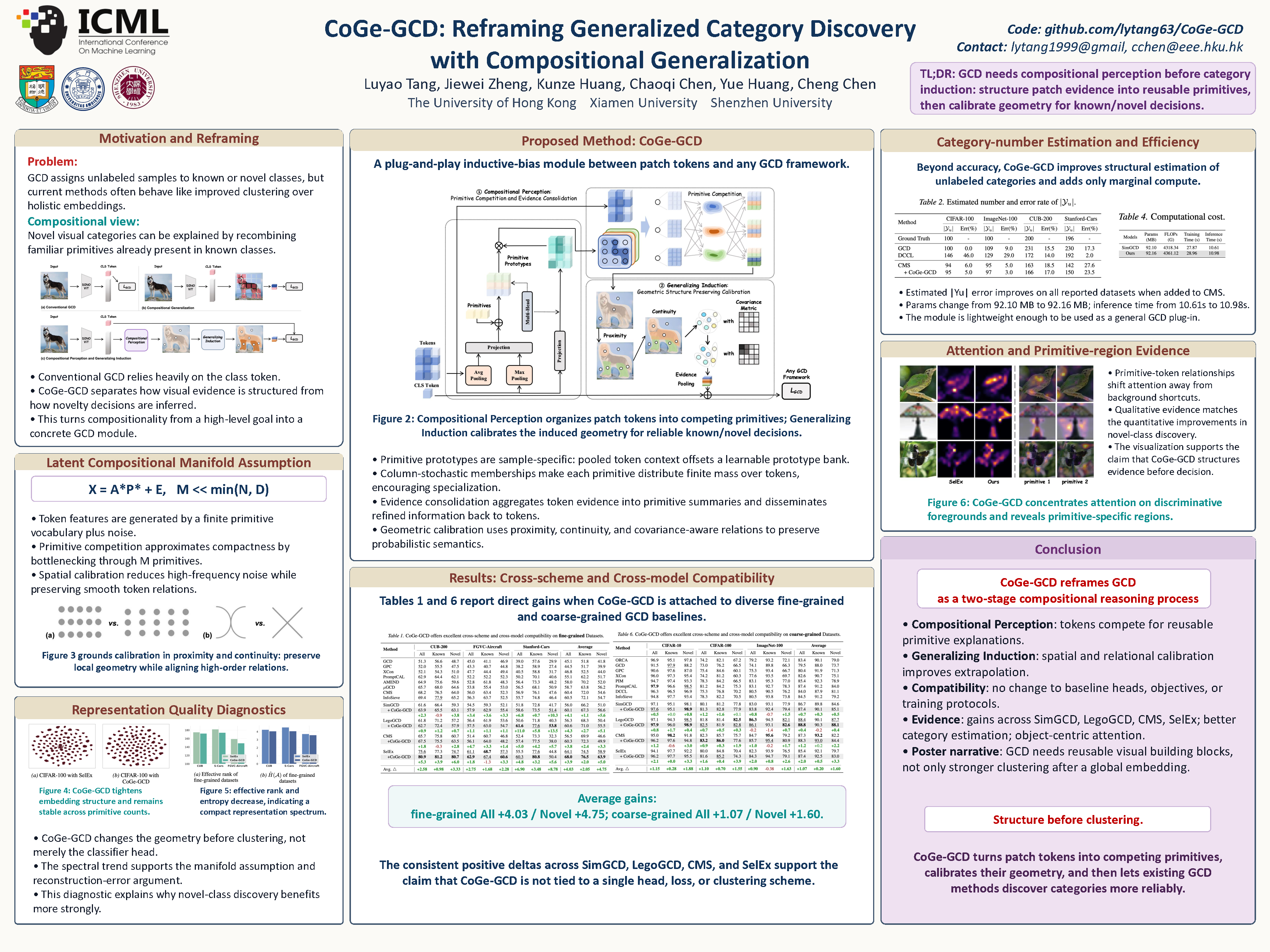
Generalized Category Discovery (GCD) assigns unlabeled instances, mixed with labeled data, to known or novel categories, requiring human-like compositional reasoning: reusing primitives learned from known classes and deciding when new combinations imply new categories. Existing GCD methods operate on unstructured token features and struggle to extrapolate to novel compositions. We propose CoGe-GCD, which rethinks GCD through compositional generalization with two coupled stages. (i) Compositional Perception structures patch tokens by mapping them to a small vocabulary of primitives and refining token embeddings via competitive token-primitive assignment and information passing, yielding coherent groups for discovery. (ii) Generalizing Induction exploits the induced geometric structure and applies a structure-preserving calibration over spatial relations, maintaining probabilistic semantics while improving extrapolation to unseen primitive combinations. CoGe-GCD is implemented as an inductive-bias module between backbone and projection head, without modifying heads or losses, and can be plugged into diverse GCD frameworks. On standard benchmarks, it consistently improves all-class accuracy, unknown-class number estimation, and geometric quality, with marginal computational overhead.
Lay Summary
Traditional visual category discovery methods struggle to identify new unseen object categories well, as they only rely on overall image features and lack the ability to reuse common visual parts learned from known categories. Inspired by how humans recognize new things by combining familiar basic visual elements, we design a simple and universal plug-in module to improve this task. Our method first automatically splits images into shared basic visual building blocks, then reasonably organizes and calibrates these blocks according to natural spatial relationships in real scenes. This allows the model to better understand both existing and new categories by recombining learned visual elements. Our approach can be easily inserted into any existing category discovery framework without changing model structures or training settings, achieves consistent accuracy improvements on multiple common benchmarks, and only brings negligible computational cost increase. We also open our code for follow-up research and practical applications.