
MM-Spectrum: Multimodal Multi-spectral Molecular Structural Elucidation with a Stable MoE Framework
Abstract
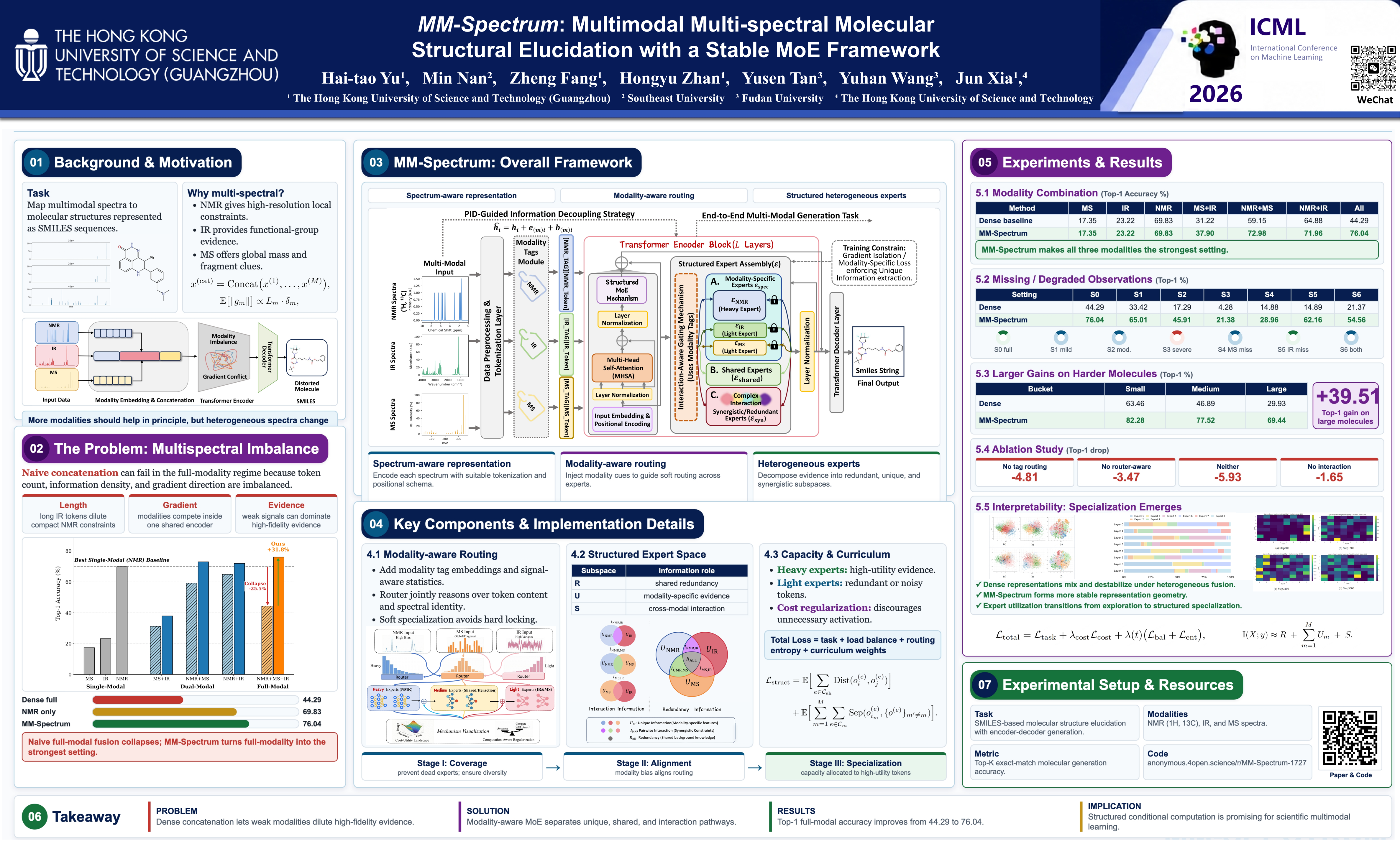
Inferring molecular structures from multimodal spectroscopic measurements requires integrating complementary yet highly heterogeneous signals. However, the common paradigm of directly concatenating multispectral sequences can exhibit anomalous performance degradation, primarily due to pronounced heterogeneity and the resulting multimodal imbalance across modalities. As a remedy, we propose MM-Spectrum, a sparse Mixture-of-Experts framework tailored for multimodal multispectral spectra-to-structure elucidation. To better match the information characteristics under multispectral imbalance, MM-Spectrum introduces an explicit modality-aware routing mechanism that exposes spectral identity to the router in addition to token content representations. Moreover, it incorporates shared and interaction experts, together with heterogeneous expert capacities, to extract multispectral modality-unique and cross-modal synergistic information while suppressing noise-induced interference. Across full-modality, bimodal, and missing-modality settings on molecular structural elucidation, MM-Spectrum achieves consistent and substantial improvements, supported by ablation studies and interpretability analyses. Code is available at https://github.com/HHHTTY/MM-Spectrum.
Lay Summary
Chemists often identify an unknown molecule by combining several kinds of measurements, such as nuclear magnetic resonance, infrared spectroscopy, and mass spectrometry. Machine learning models can assist this process, but simply giving them more types of spectra does not always help: signals with different lengths and noise patterns can interfere with each other and reduce accuracy. We developed MM-Spectrum, a model that learns to send different pieces of spectral evidence to different specialized processing modules while still allowing useful information to be combined. This design helps the model focus on informative structural clues and avoid being distracted by redundant or noisy signals. In experiments, MM-Spectrum improved molecular structure predictions when all spectra were available, when some spectra were missing, and on additional simulated and experimental spectral datasets. The approach may support more reliable computational tools for chemical analysis and molecular discovery, while predicted structures should still be verified experimentally before practical use.