
Adaptive Querying with AI Persona Priors
Abstract
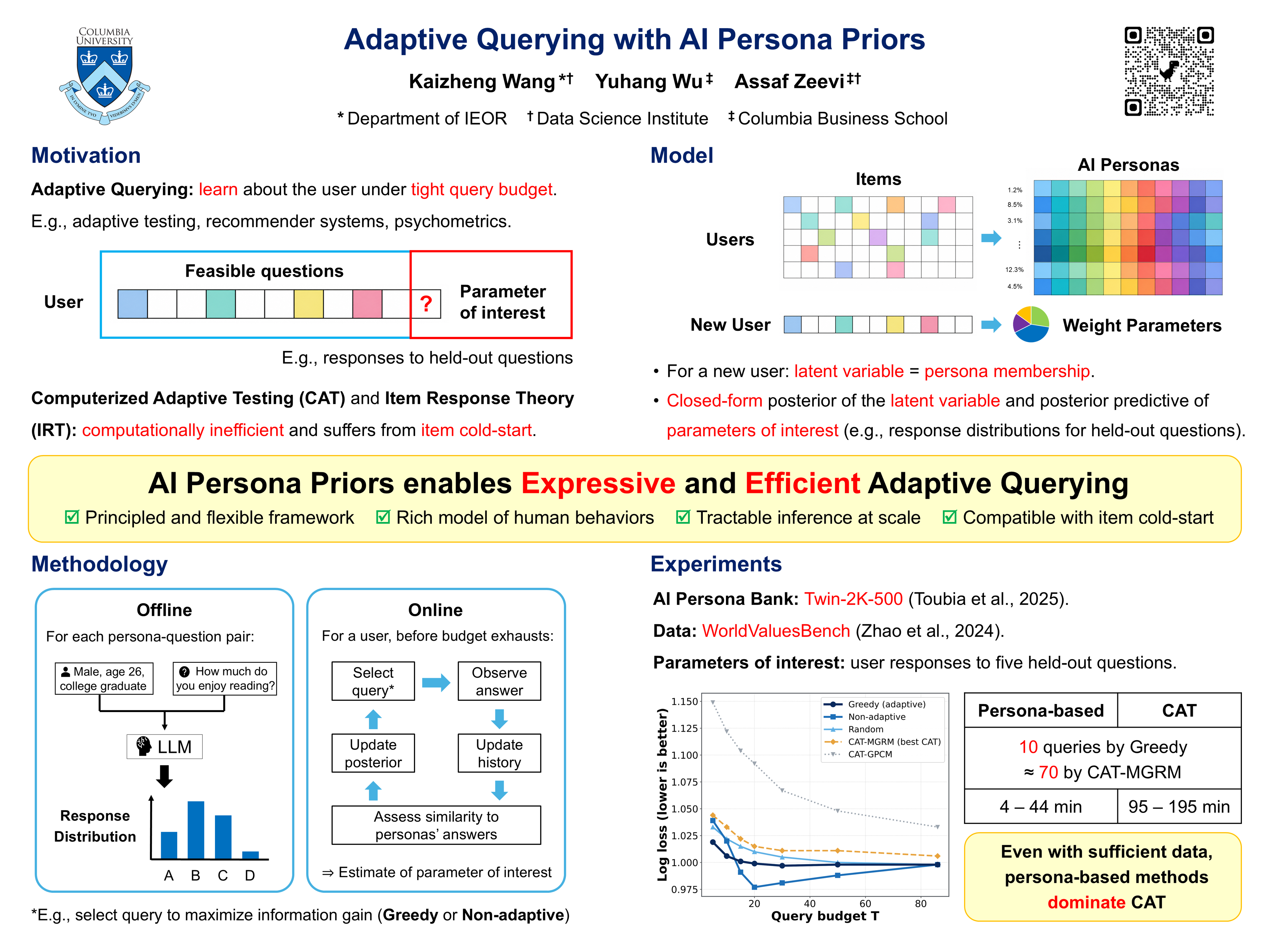
We study adaptive querying for learning user-dependent quantities of interest, such as responses to held-out items and psychometric indicators, within tight question budgets. Classical Bayesian design and computerized adaptive testing typically rely on restrictive parametric assumptions or expensive posterior approximations, limiting their use in heterogeneous, high-dimensional, and cold-start settings. We introduce a persona-induced latent variable model that represents a user's state through membership in a finite dictionary of AI personas, each offering response distributions produced by a large language model. This yields expressive priors with closed-form posterior updates and efficient finite-mixture predictions, enabling scalable Bayesian design for sequential item selection. Experiments on synthetic data and WorldValuesBench demonstrate that persona-based posteriors deliver accurate probabilistic predictions and an interpretable adaptive elicitation pipeline.
Lay Summary
When surveys, recommender systems, or educational tests try to learn about a person, they can ask only a limited number of questions, so it is crucial to pick each one carefully. Existing methods either oversimplify how people differ from one another or fail whenever the person or the question is new. We construct AI personas—simulations of realistic people generated by a large language model—and predict how each one would answer every question on a survey. When we then meet a real person, we treat this collection as a library of "types of person" and update our belief about which ones the person resembles after each answer. The resulting adaptive questioning method is easy to implement and fast for real-time use. On a large international values survey, our approach predicts a person's responses more accurately than standard computerized-testing methods used for decades, and it works even when there is no existing data about the person or the question. More broadly, it turns language models from black-box human simulators into transparent, principled tools for learning about people one question at a time.