
LithoDreamer: A Physics-Informed World Model for Multi-Stage Computational Lithography
Abstract
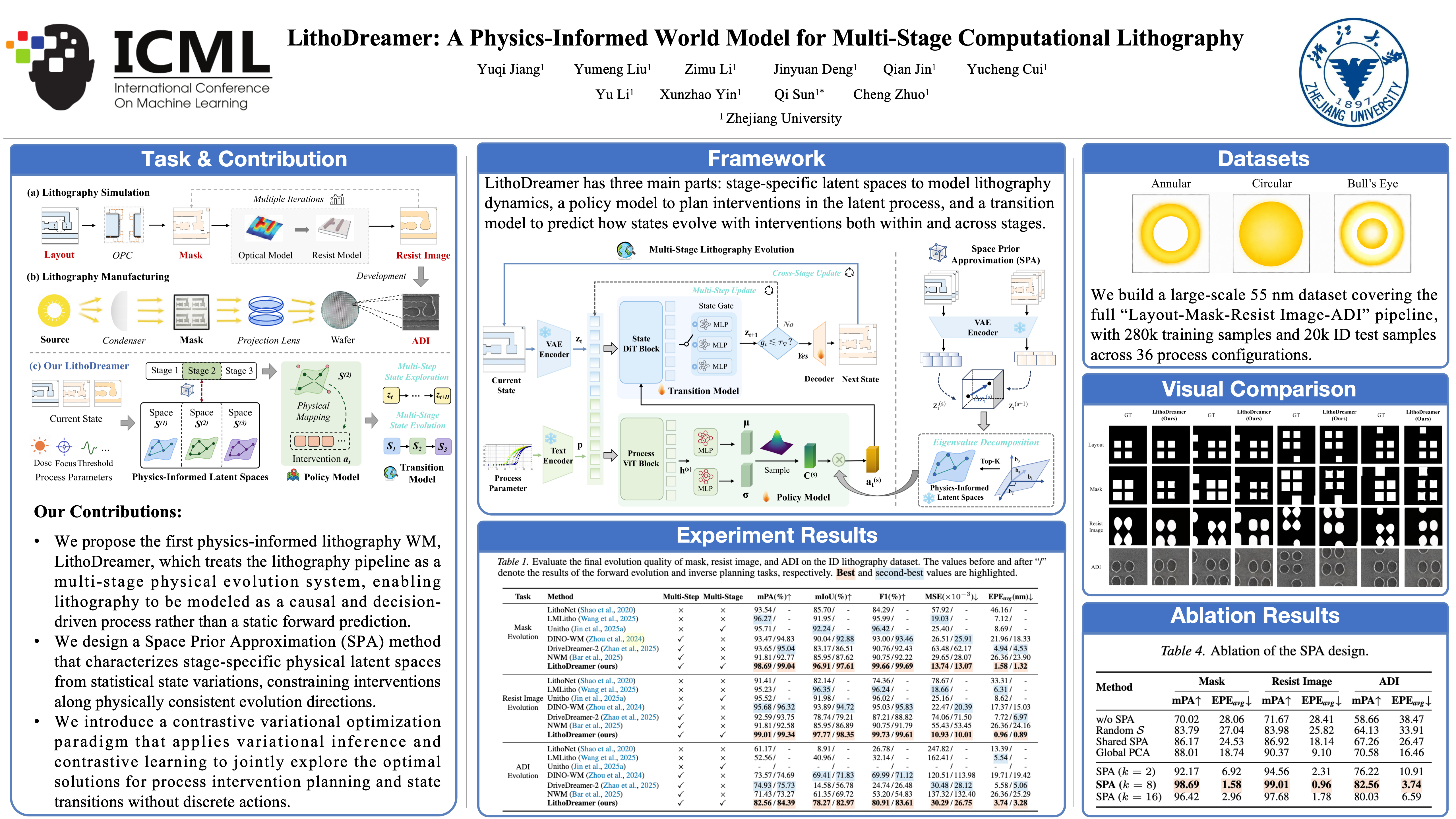
As semiconductor technology nodes scale, computational lithography is essential for ensuring yield and performance. However, lithography is a continuous physical process involving mask optimization, optical imaging, resist exposure, and development, which existing models fail to capture. To overcome this limitation, we present LithoDreamer, the first physics-informed World Model (WM) framework for computational lithography, which formulates the ''Layout-Mask-Resist Image-After Development Image (ADI)'' pipeline as a decision-driven multi-step evolution system. LithoDreamer captures feature changes between adjacent states to model stage-specific physics-informed latent spaces, in which it controls process intervention exploration and drives subsequent state transitions. To achieve interpretable intervention optimization without continuous supervision, we propose a contrastive variational optimization paradigm that contrasts the latent differences between intervention paths with variational evolution constraints, guiding the model to generate evolutions consistent with real lithography physics. Experiments show LithoDreamer achieves state-of-the-art performance in forward evolution and inverse planning.
Lay Summary
Modern computer chips are made by printing extremely tiny circuit patterns onto silicon wafers, but as these patterns become smaller, even a slight printing error can affect chip quality and manufacturing yield. Existing AI tools usually predict one step of this process at a time, which makes it hard to capture how small changes made early in manufacturing can gradually affect the final printed pattern. We built LithoDreamer, an AI system that learns the chip-printing process as a sequence of connected changes. It follows how an original circuit design becomes a printing mask, how light transfers that pattern, and how the final wafer pattern is formed. Rather than only guessing the final result, LithoDreamer can also explore how different manufacturing adjustments may guide the process toward a desired target. This matters because better prediction and planning can help engineers find printing problems earlier and reduce costly trial-and-error in chip manufacturing. In experiments on large industrial lithography data, LithoDreamer produced more accurate patterns than previous methods and worked well even under new manufacturing settings.