
CameraNoise: Enabling Faithful Camera Control in Video Diffusion through Geometry-Flow-Guided Noise Warping
Abstract
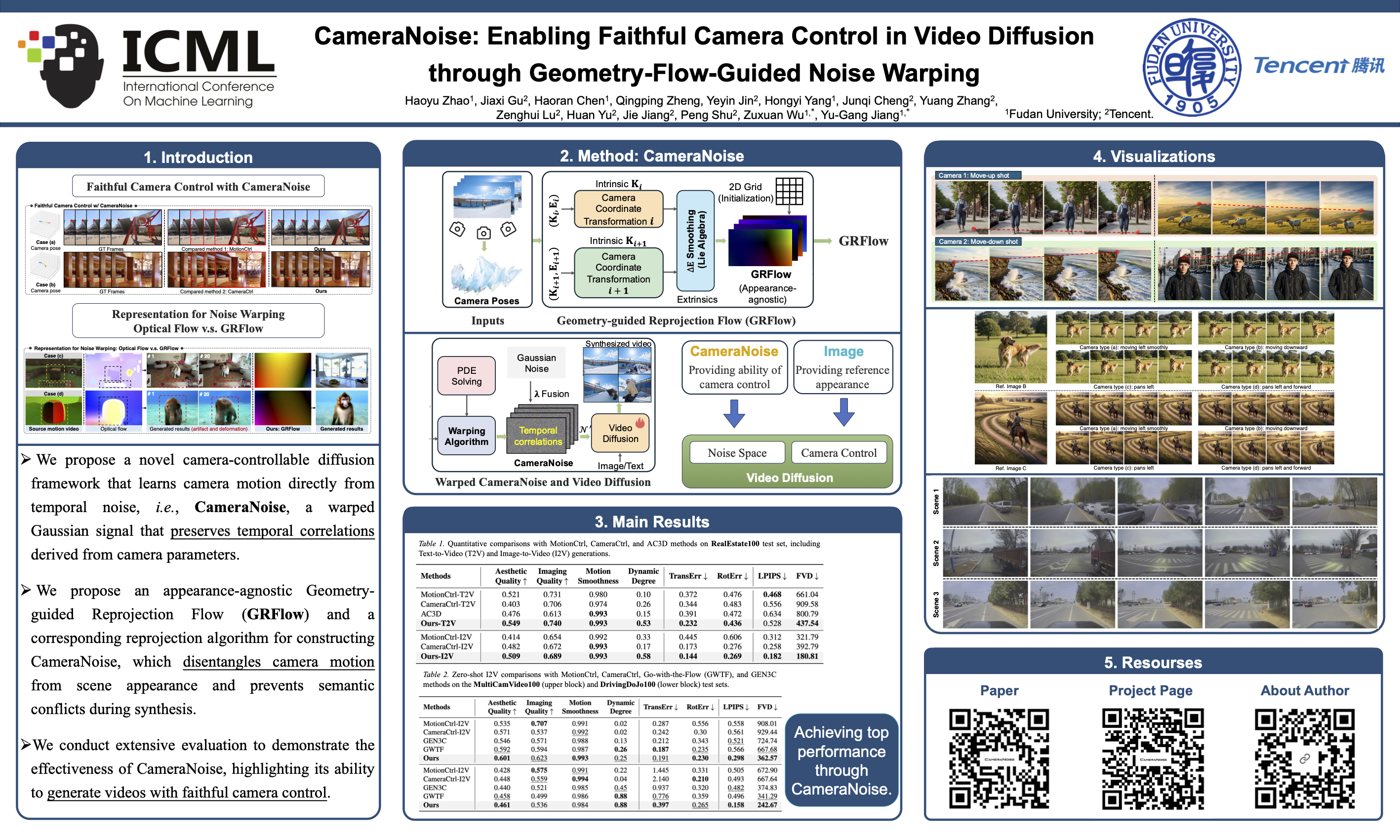
Precise camera pose control is critical for video diffusion, yet maintaining geometric consistency remains a challenge. Existing methods that directly inject numerical camera parameters into the diffusion backbone often fail to bridge the gap between abstract coordinates and visual content, leading to structural distortions. To address this issue, we propose CameraNoise, a flow-to-noise warping method that encodes camera motion into a temporally coherent stochastic representation. Unlike conventional conditioning, CameraNoise embeds camera poses directly into the noise space. This decouples motion from scene appearance while faithfully preserving trajectory dynamics. Specifically, we introduce a novel Geometry-guided Reprojection Flow and a noise warping algorithm, which jointly preserve the Gaussian prior of diffusion and ensure consistent noise propagation under camera transformations. By integrating CameraNoise into the diffusion process, our framework delivers stable, high-fidelity videos. Extensive experiments demonstrate that our approach significantly outperforms prior methods in both visual quality and trajectory faithfulness.
Lay Summary
Creating videos with AI is becoming increasingly powerful, but it is still difficult to precisely control how the camera moves. For example, when users want the camera to move forward, rotate, or follow a certain path, existing methods may produce videos where the scene structure becomes unstable, objects are distorted, or the camera motion does not match the intended direction. This paper introduces CameraNoise, a new way to guide AI video generation using camera movement. Instead of directly feeding camera numbers into the video model, our method turns the camera motion into a special form of starting randomness that the model can naturally use during generation. This allows the video model to follow the desired camera path while keeping the scene appearance separate from the camera movement. CameraNoise helps generate videos that are more stable, visually realistic, and faithful to the intended camera trajectory. It can support different camera motions and produce smoother results with fewer structural artifacts. Experiments show that our method performs better than previous approaches in both video quality and camera control accuracy.