
Graph-R1: Towards Agentic GraphRAG Framework via End-to-end Reinforcement Learning
Abstract
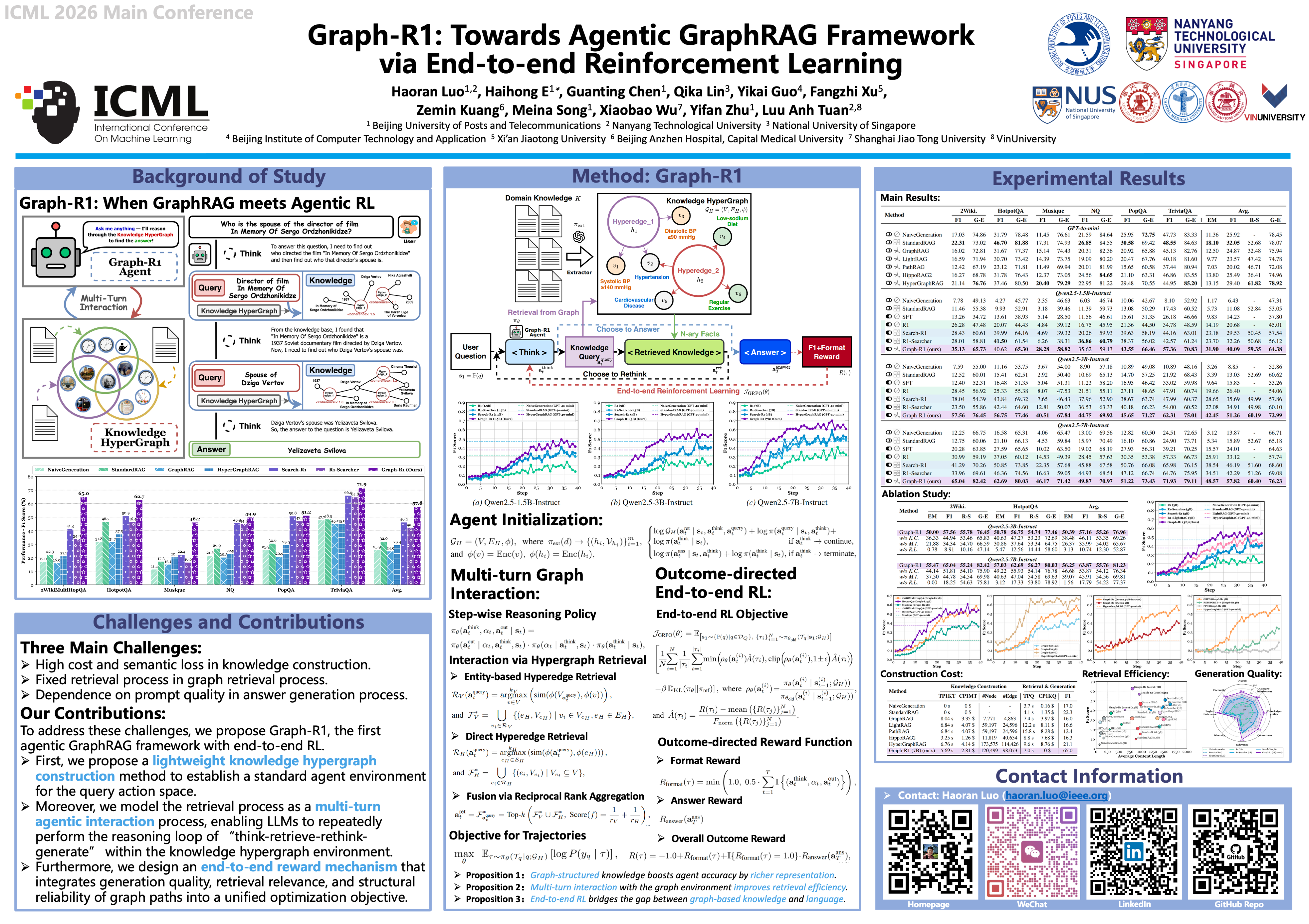
Retrieval-Augmented Generation (RAG) mitigates hallucination in LLMs by incorporating external knowledge, but relies on chunk-based retrieval that lacks structural semantics. GraphRAG methods improve RAG by modeling knowledge as entity-relation graphs, but still face challenges in high construction cost, fixed one-time retrieval, and reliance on long-context reasoning and prompt design. To address these challenges, we propose Graph-R1, the first agentic GraphRAG framework via end-to-end reinforcement learning (RL). It introduces lightweight knowledge hypergraph construction, models retrieval as a multi-turn agent-environment interaction, and optimizes the agent process via an end-to-end reward mechanism. Experiments on standard RAG datasets show that Graph-R1 outperforms traditional GraphRAG and RL-enhanced RAG methods in reasoning accuracy, retrieval efficiency, and generation quality. Our software and data are publicly available.
Lay Summary
AI chatbots powered by large language models sometimes generate inaccurate or made-up information. A common remedy is retrieval-augmented generation, which lets the model pull in external knowledge before answering, but existing methods rely on loose text chunks that lack structure and retrieve in a single fixed step. We propose Graph-R1, an agentic framework that organizes knowledge as a connected hypergraph and, through reinforcement learning, reasons over multiple turns, thinking, retrieving, rethinking, and answering. On standard benchmarks, Graph-R1 improves reasoning accuracy, retrieval efficiency, and generation quality over prior methods.