
Block-wise Codeword Embedding for Reliable Multi-bit Text Watermarking
Abstract
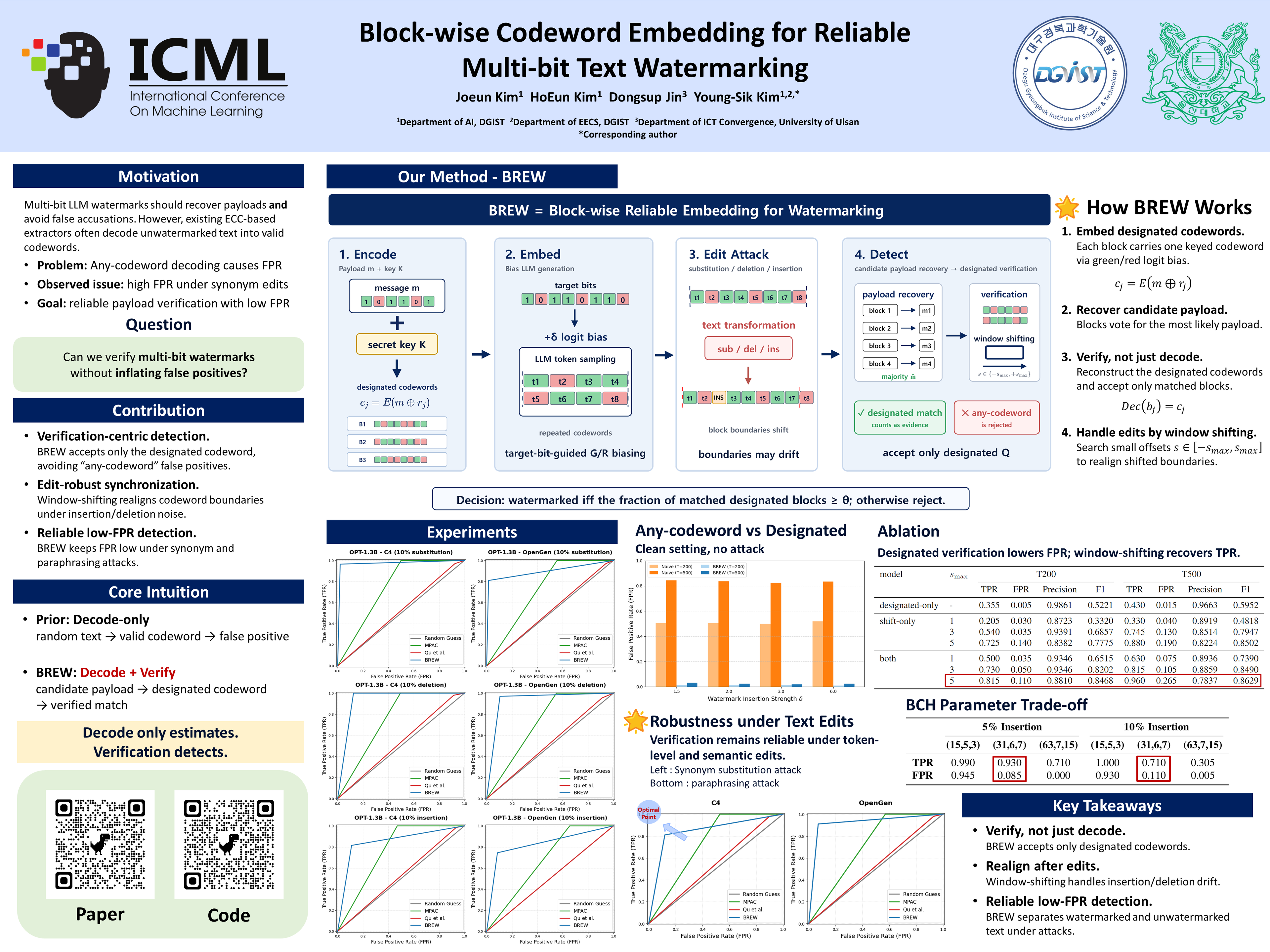
Recent multi-bit watermarking methods for large language models (LLMs) prioritize capacity over reliability, often conflating decoding with detection. Our analysis reveals that existing ECC-based extractors suffer from catastrophic false positive rates (FPR), and applying rejection thresholds merely collapses detection sensitivity (TPR) to random guessing. To resolve this structural limitation, we propose BREW (Block-wise Reliable Embedding for Watermarking), a framework shifting the paradigm to designated verification. BREW employs a two-stage mechanism: (i) blind message estimation via independent block voting, followed by (ii) window-shifting verification that rigorously validates the payload against local edits. Experiments demonstrate that BREW achieves a TPR of 0.965 with an FPR of 0.02 under 10\% synonym substitution, demonstrating that the high-FPR issue is not an inherent trade-off of multi-bit watermarking, but a solvable structural flaw of prior decoding-centric designs. Our framework is model-agnostic and theoretically grounded, providing a scalable solution for reliable forensic deployment.
Lay Summary
Large language models can generate realistic text, making it difficult to know whether a piece of text was written by a human or produced by AI. Watermarking methods try to address this issue by embedding hidden signals into AI-generated text. However, existing multi-bit watermarking methods can incorrectly label normal human-written text as watermarked, especially after the text is edited or paraphrased. This paper proposes BREW, a new watermarking framework that verifies only the specific hidden codewords that were intentionally embedded. This design substantially reduces false alarms while still enabling reliable detection after common text modifications such as synonym replacement, insertion, deletion, and paraphrasing. The method aims to support more reliable AI-text provenance detection in practical settings.