
$f$-Divergence Self-Play for Tabular Anomaly Detection via Large Language Models
Abstract
Lay Summary
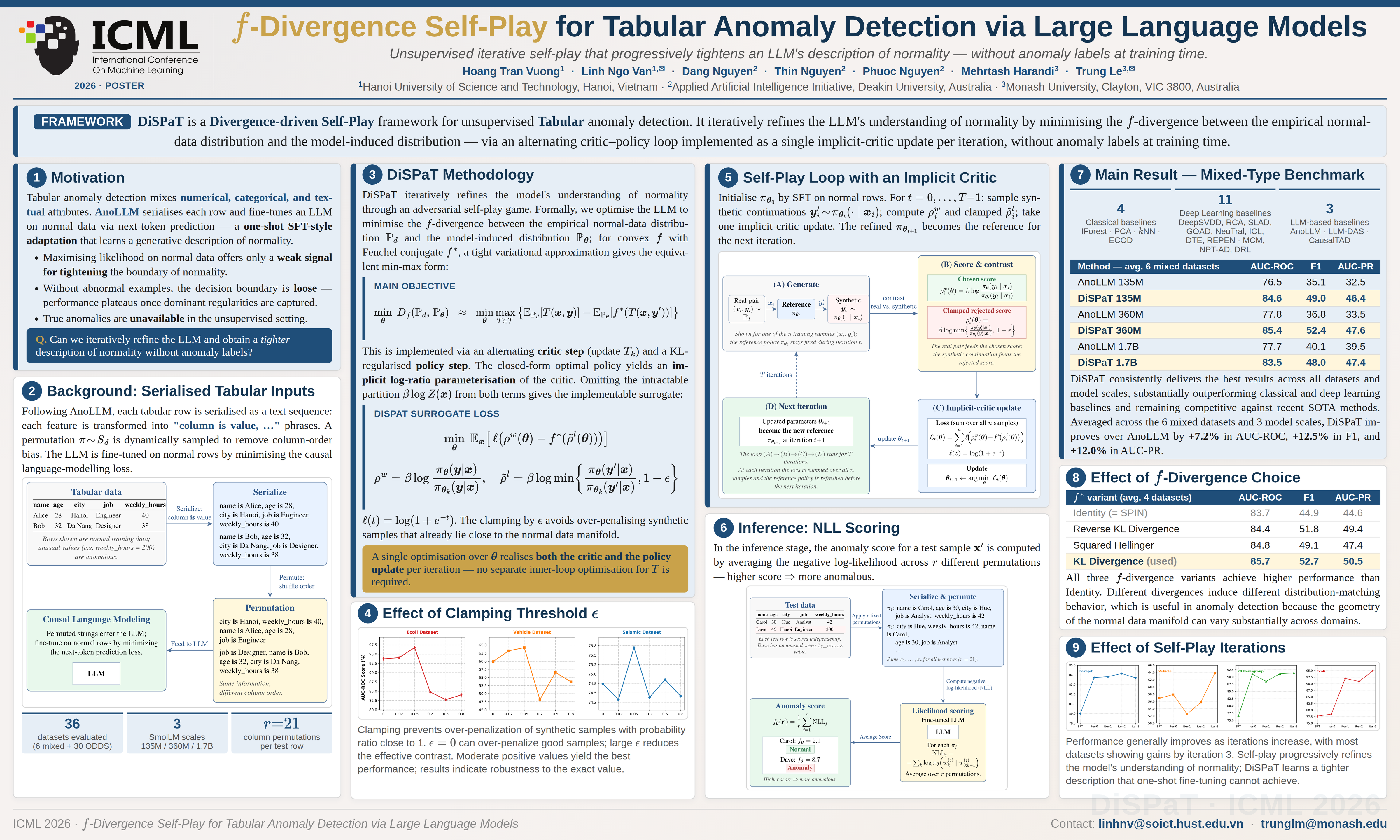
Many real-world anomaly detection problems involve tables that mix numbers, categories, and free text, making it difficult for standard methods to learn what normal data looks like. We propose DiSPaT, a method that fine-tunes a large language model by repeatedly comparing real normal examples with synthetic “not-normal” examples generated by the model itself. This self-play process provides a stronger learning signal than one-shot fine-tuning on normal data alone, allowing the model to learn a sharper description of normal behavior without requiring labeled anomalies. We also provide a theoretical analysis showing that the method reduces the gap between the model’s distribution and the true distribution of normal data. Across a wide range of tabular anomaly detection benchmarks, DiSPaT consistently outperforms prior LLM-based, deep learning, and classical baselines.