
Learning Attribute–Affordance Hierarchies in Hyperbolic Space for Open-Vocabulary 3D Object Affordance Grounding
Abstract
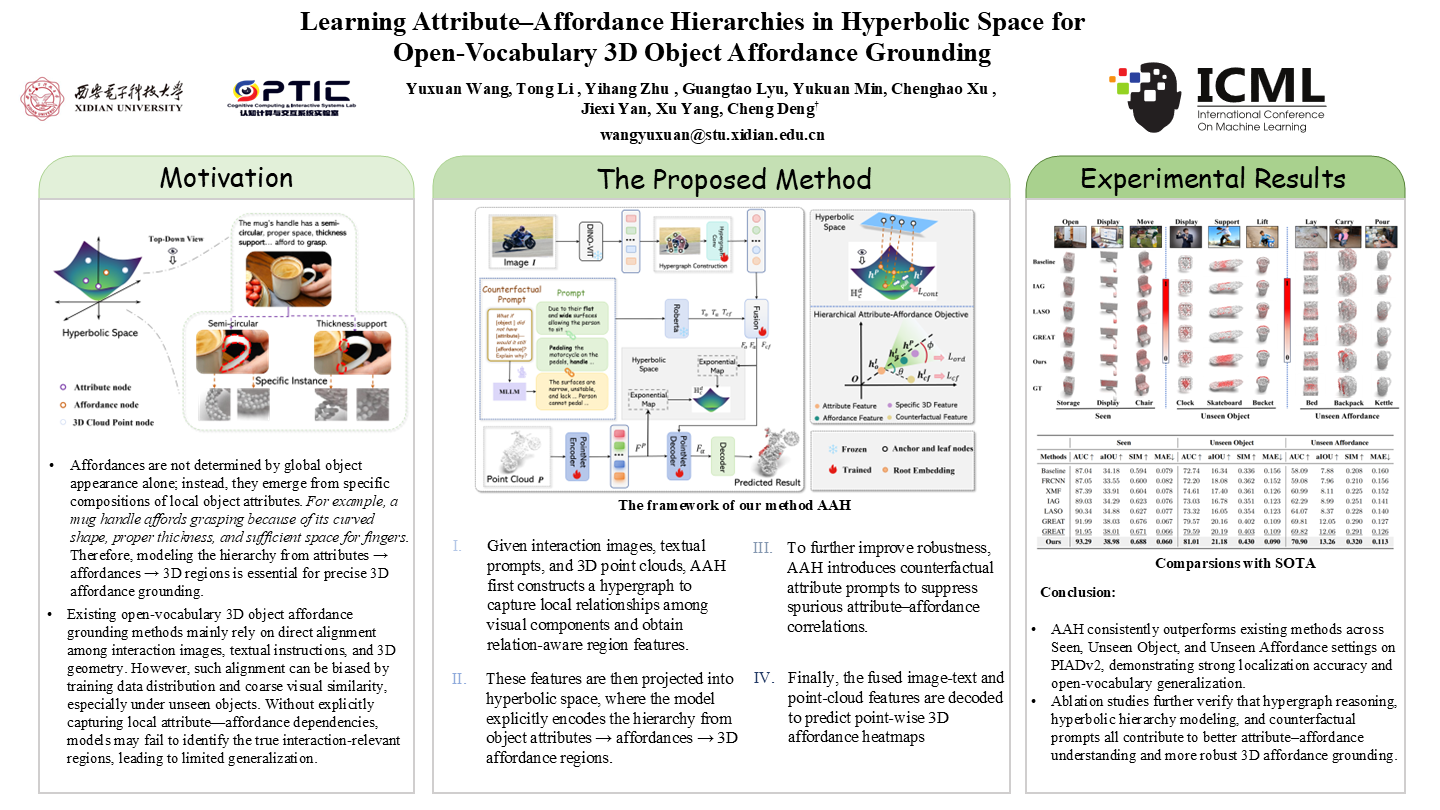
This paper pays attention to open-vocabulary 3D object affordance grounding (OVAG), which aims to localize affordance regions on 3D objects by leveraging interaction images or textual instructions. Most existing methods treat interaction images as sources of external affordance knowledge and align them with 3D visual representations, while overlooking the intrinsic relationship between local object attributes and affordances, which limits localization accuracy and generalization. For instance, a cup handle affords grasping due to its curved shape and appropriate thickness, indicating that affordances emerge from specific attribute compositions rather than global object appearance. Motivated by this, we propose Attribute-Affordance Hierarchies (AAH) learning framework that explicitly models the hierarchical relationships between object-region attributes and affordances. Our approach first captures local region relationships using hypergraph, and then projects these region-level concepts into a hyperbolic space to encode their hierarchical organization. Furthermore, we introduce counterfactual attribute samples to encourage robust learning of attribute–affordance dependencies under varying conditions. By jointly modeling visual structure and hierarchical concept information, our method achieves more accurate affordance localization. Extensive experiments and qualitative analyses demonstrate the effectiveness of our approach.
Lay Summary
Robots need to understand not only what an object is, but also how people can use it. For example, a cup handle can be grasped because it has the right shape and size. Teaching machines to recognize these usable parts of objects is challenging, especially when the instructions are open-ended and may describe interactions the system has never seen before. Most existing methods try to match images or language descriptions with 3D objects directly. However, they often overlook an important fact: affordances usually come from combinations of local object properties, such as shape, thickness, or structure, rather than from the whole object appearance. We propose a new learning framework called Attribute-Affordance Hierarchies (AAH), which helps machines organize object properties and interactions in a more structured way. Our method learns how local regions of an object relate to possible actions and builds a hierarchy of these relationships to improve reasoning about unseen interactions. Experiments show that our approach can more accurately identify interaction regions on 3D objects and generalize better to new affordance descriptions and object categories.