
Radial Scaling Voxelization for Accurate Small Object 3D Detection
Abstract
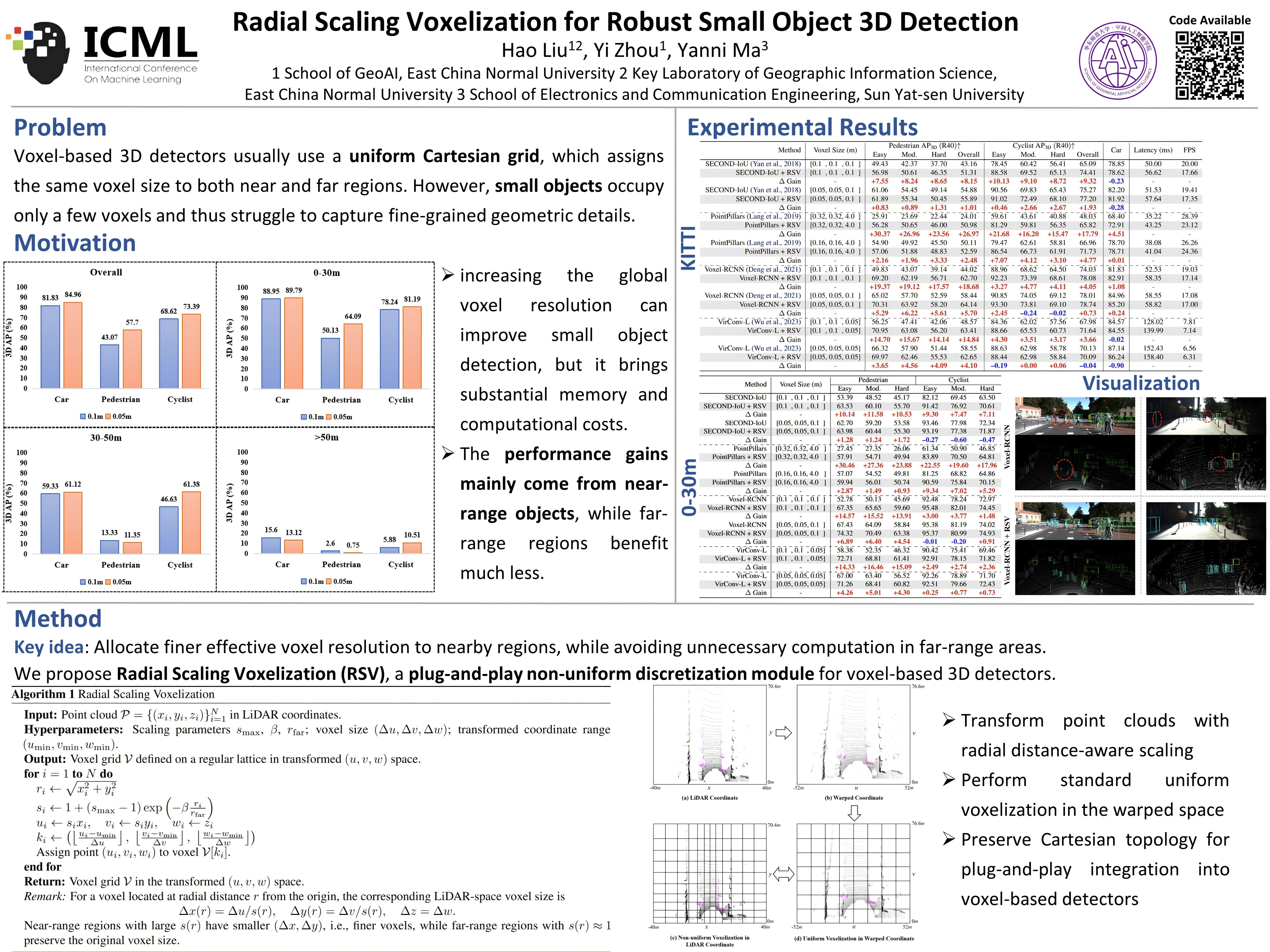
Voxel-based 3D object detectors typically discretize the spatial domain using a uniform Cartesian grid, which allocates the same voxel size to both near-range and far-range regions. However, this uniform discretization is suboptimal for small objects such as pedestrians and cyclists, as they occupy only a few voxels and thus struggle to capture fine-grained geometric details. Although increasing the global voxel resolution can alleviate this problem, it inevitably increases substantial memory consumption and computational cost. In this paper, we propose Radial Scaling Voxelization (RSV), a simple yet effective non-uniform discretization strategy that adaptively modulates the effective voxel size based on the radial distance from the LiDAR sensor. Unlike previous cylindrical or polar discretization schemes, RSV preserves the Cartesian grid topology by applying a continuous radial scaling function to the input coordinates before standard voxelization. This operation yields a near-high, far-unchanged resolution pattern, i.e., the effective voxel size becomes finer in near regions, where the geometric structures of small objects are difficult to capture, while remaining nearly unchanged in far regions to avoid unnecessary computational cost. Importantly, RSV is architecture-agnostic and can directly replace the discretization module in any voxel-based detector without modifying the backbone, network design, or training pipeline. Extensive experiments on the KITTI and nuScenes datasets demonstrate that integrating our RSV into several voxel-based baselines consistently enhances small-object detection performance, especially for the Pedestrian and Cyclist categories, while incurring only marginal additional computational overhead. Code is available at https://github.com/Zeoy2020/RadialScalingVoxelization.
Lay Summary
Autonomous vehicles rely on LiDAR sensors to detect surrounding objects in 3D, but small objects such as pedestrians and cyclists are often difficult to recognize accurately. A common approach is to divide the 3D space into small grid cells, called voxels, before applying a neural network. However, most existing methods use the uniform discretization, which assigns the same voxel size to both near-range and far-range regions. This introduces a contradiction: large voxels are efficient but may lose details of small objects, while making all voxels smaller greatly increases memory and computation. We address this problem with Radial Scaling Voxelization (RSV), a simple method that changes how the point cloud is discretized before it enters the detector. RSV gives nearby regions a finer effective resolution, where small objects usually need more detailed representation, while keeping far-away regions almost unchanged to avoid unnecessary cost. Importantly, RSV can be added to existing voxel-based detectors without modifying the network. Our experiments show that RSV consistently improves small object detection on standard autonomous driving benchmarks, especially for pedestrians and cyclists. This makes 3D perception more accurate and efficient, which is important for safer autonomous driving and robotic systems.