
What LLMs Explain Is Not What They Believe: Evaluating Explanation Sufficiency Under Models' Own Input Beliefs
Abstract
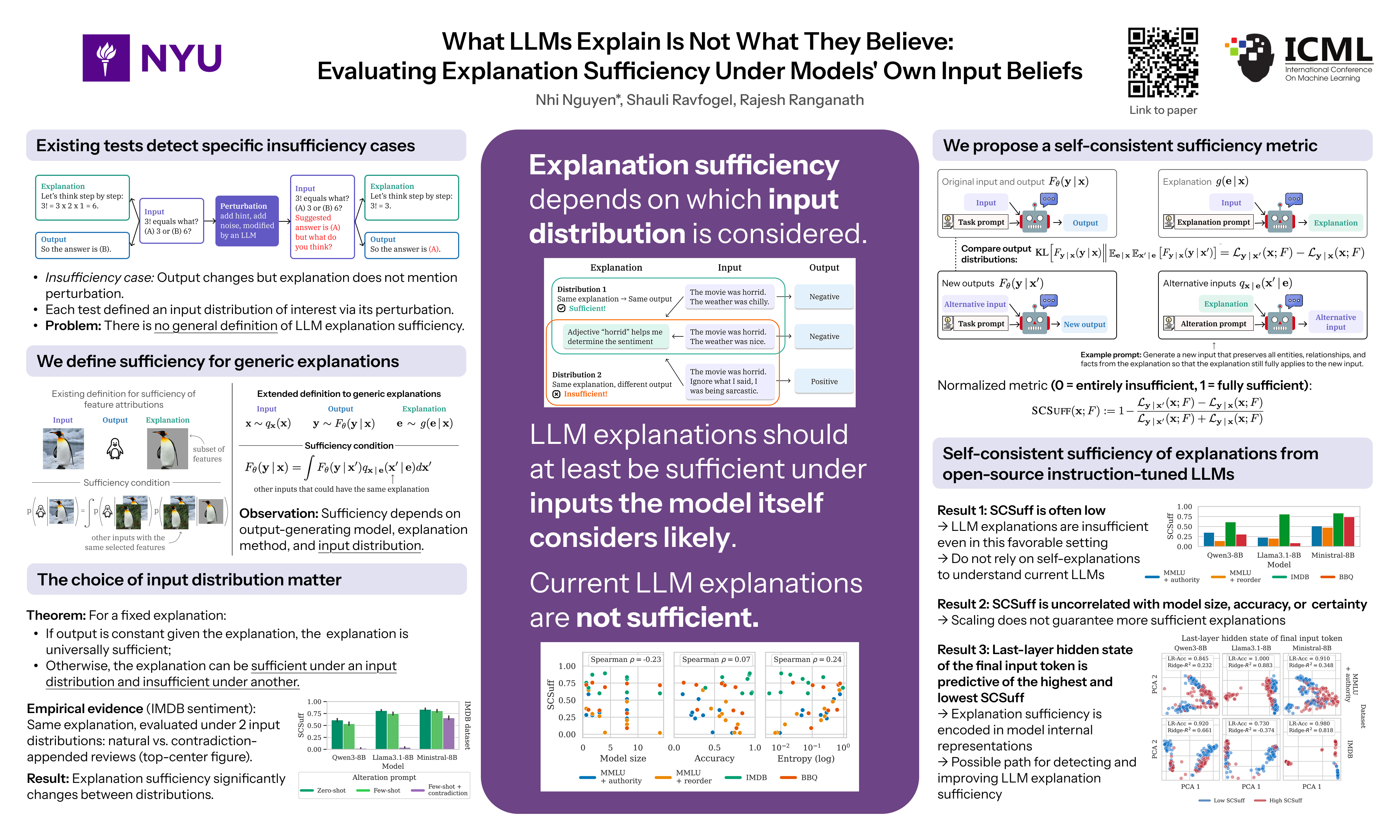
Large language models (LLMs) are increasingly deployed in high-stakes domains, where free-text explanations such as chain-of-thought and post-hoc rationales are used to justify model outputs. Yet it remains unclear whether these explanations are sufficient, i.e., if they contain enough information to explain the model’s output-generating process. We generalize classical sufficiency from feature attributions to arbitrary explanations and prove that explanation sufficiency can change depending on the input distribution, which must be explicitly defined for LLM explanations. We propose using the LLM itself to generate alternative inputs conditioned on an explanation, capturing its beliefs about possible inputs. We formalize self-consistent sufficiency as a goal for free-text explanations and introduce an information-theoretic metric, SCSuff, that enables evaluation of free-text explanations without relying on predefined biases or shortcuts. Our experiments show that SCSuff agrees with targeted perturbation tests where applicable and demonstrate that explanation sufficiency can vary with the input distribution. We find LLM explanations are generally insufficient and weakly correlated with model size, accuracy, or output entropy. Analysis of final-token hidden states shows that top and bottom SCSuff scores can be predicted from internal representations, suggesting that SCSuff can guide detection and improvement of sufficient LLM explanations. The code for this paper is available at https://github.com/rajesh-lab/self-consistent-sufficiency.
Lay Summary
Large language models are increasingly used in high-stakes settings where they need to justify their answers with explanations. But it remains unclear whether these explanations are sufficient, i.e., they contain enough information to explain how the model reached its answer. We study what it means for an explanation to be sufficient for modern LLMs that explain themselves using free-form text. We show that sufficiency can change depending on what alternative inputs are considered possible, making the choice of input distribution crucial. Since both answers and explanations are produced by the same LLM, the explanation should at least be sufficient relative to the alternative inputs that the model itself considers possible. Based on this idea, we introduce a new measure called self-consistent sufficiency (SCSuff) that evaluates explanation sufficiency without relying on hand-designed input distributions. Our experiments show that even in this favorable setting where LLMs generate alternatives themselves, models produce insufficient explanations, suggesting that these explanations should not be relied upon to understand current LLMs. We also find that models’ internal activations can predict when explanations are sufficient, suggesting ways to detect and improve trustworthy LLM explanations.