
Foundation Inference Models for Ordinary Differential Equations
Abstract
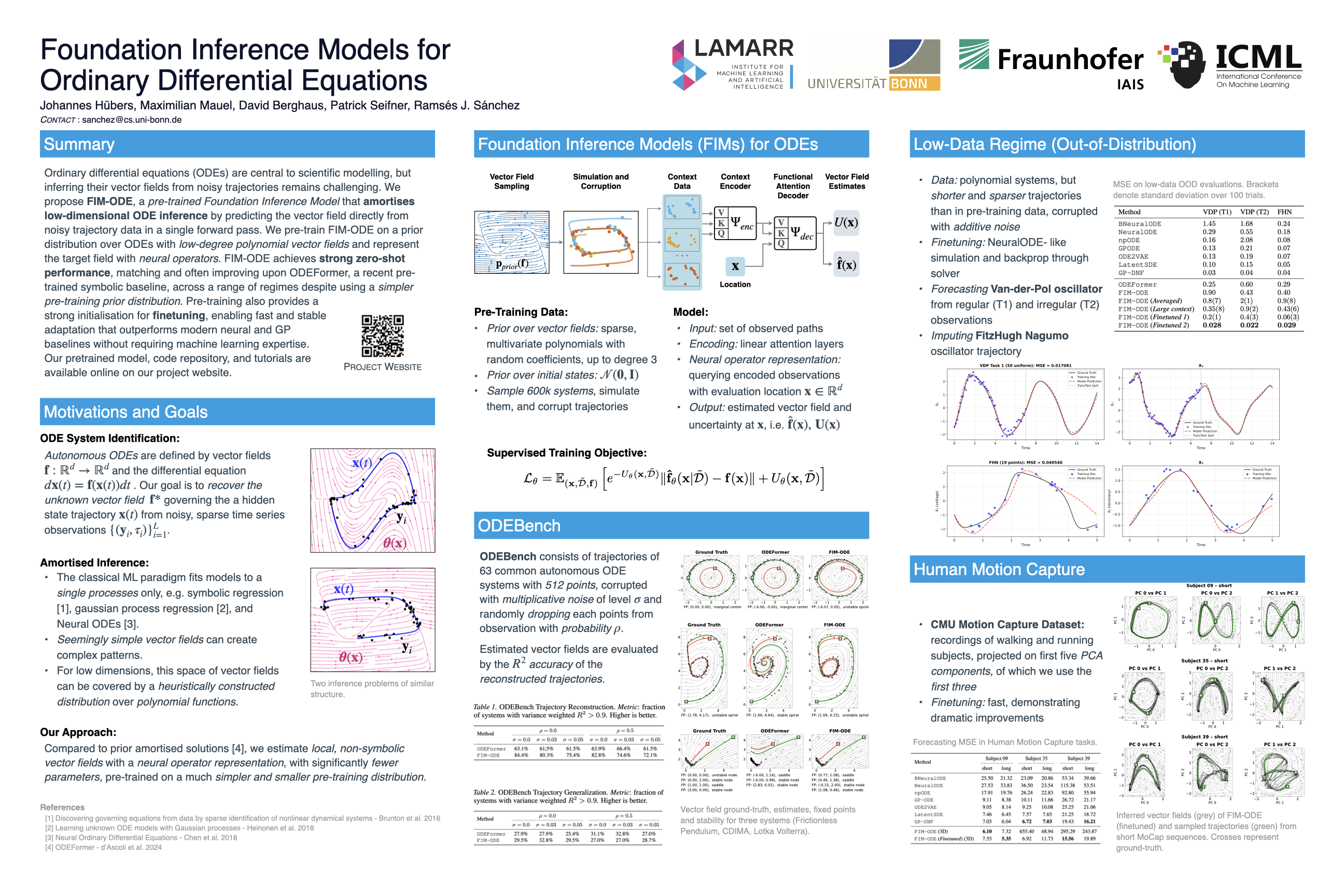
Ordinary differential equations (ODEs) are central to scientific modelling, but inferring their vector fields from noisy trajectories remains challenging. Current approaches such as symbolic regression, Gaussian process (GP) regression, and Neural ODEs often require complex training pipelines and substantial machine learning expertise, or they depend strongly on system-specific prior knowledge. We propose FIM-ODE, a pretrained Foundation Inference Model that amortises ODE inference by predicting the vector field directly from noisy trajectory data in a single forward pass. We pretrain FIM-ODE on a prior distribution over ODEs with low-degree polynomial vector fields and represent the target field with neural operators. FIM-ODE achieves strong zero-shot performance, matching and often improving upon ODEFormer, a recent pretrained symbolic baseline, across a range of regimes despite using a simpler training prior. Pretraining also provides a strong initialisation for finetuning, enabling fast and stable adaptation that outperforms modern neural and GP baselines without requiring machine learning expertise. Our pretrained model, code repository, and tutorials are available online.
Lay Summary
Many scientific questions involve understanding how a system changes over time, such as how a population grows, how a disease spreads, or how a physical object moves. Scientists often describe these changes using ordinary differential equations, but discovering the right equations from noisy measurements is difficult. Existing methods can require careful manual choices, long training procedures, or substantial machine learning expertise. We introduce FIM-ODE, a pretrained machine learning model that can infer ordinary differential equations directly from observed trajectories. Instead of training a new model from scratch for every dataset, FIM-ODE learns from many simulated examples beforehand and then applies this knowledge to new systems in a single prediction step. It can also be further adapted to a particular dataset when more accuracy is needed. Our results show that FIM-ODE performs well across different settings. This makes equation discovery more accessible to scientists who have data but may not have large computational resources or specialized machine learning expertise.