
Winformer: Transcending Pairwise Similarity for Time-series Generation
Abstract
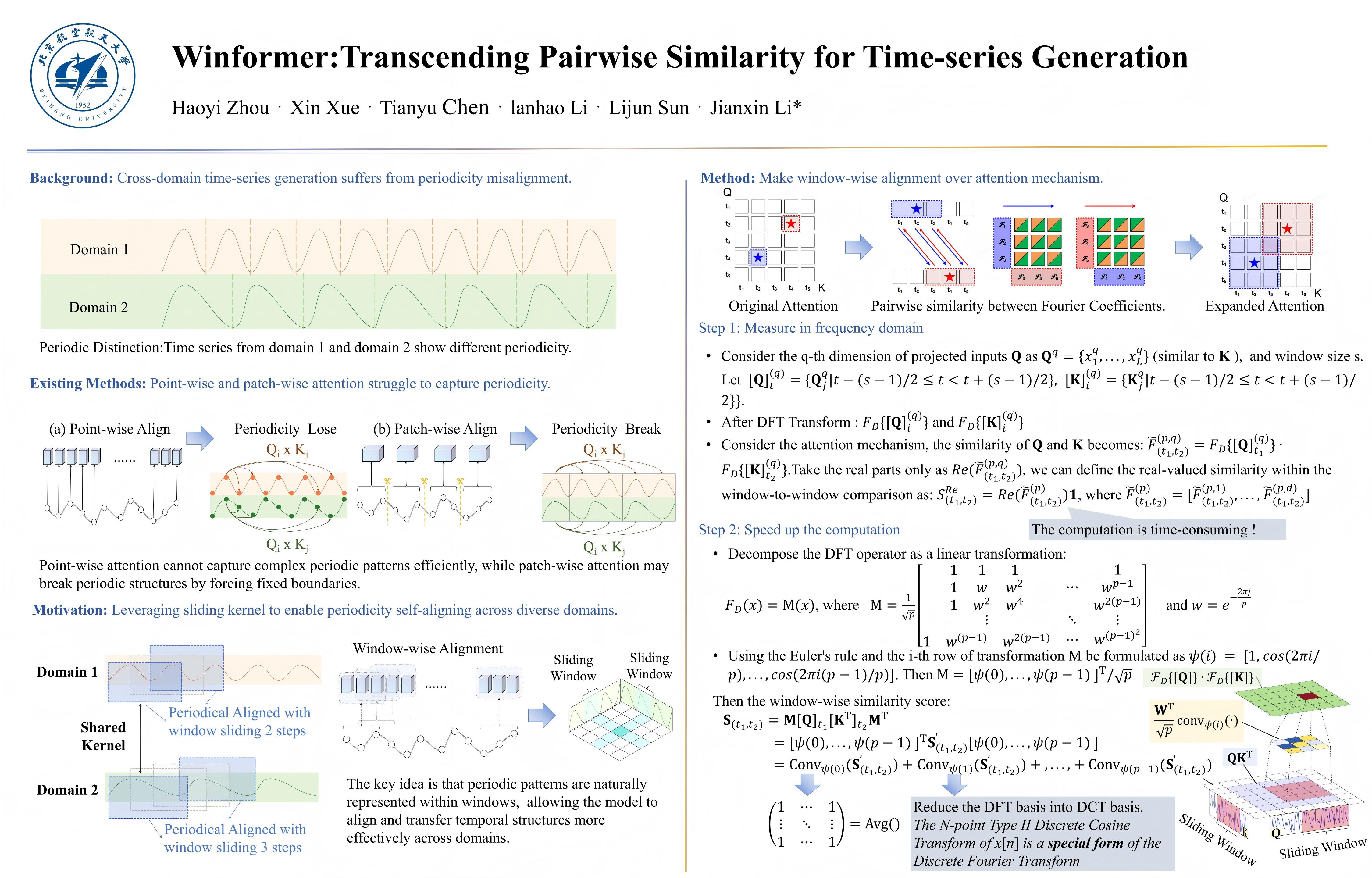
The periodicity misalignment remains a challenge problem in generating time-series data across multiple domains. The fundamental processing unit of attention in time-series modeling has long been restricted to either individual points or fragmented segments, limiting their ability to capture and adapt to complex periodic patterns inherent in diverse domains. To address this, we introduce Winformer, first to extend this processing unit from individual points to sliding windows, establishing a unified window-wise attention paradigm. Leveraging the adaptive window-alignment kernels derived from the frequency decomposition, Winformer brings semantically richer window representations, and effectively captures and transfers complex periodic patterns across domains. Extensive experiments on 12 real-world datasets demonstrate Winformer's effectiveness, achieving an average performance gain of 10.67\% over SOTA baselines.
Lay Summary
Many real-world data, such as weather, traffic, and medical signals, contain repeating patterns over time. Existing AI methods often focus only on individual points or short fragments, making it difficult to capture complex periodic behaviors across different domains. To address this, we propose Winformer, a new framework for time-series generation that models continuous time windows instead of isolated points. This allows the model to better understand periodicity patterns and adapt to different types of data. Experiments on 12 real-world datasets show that Winformer consistently improves generation quality, outperforming existing methods by an average of 10.67\%.