
BabyVision: Visual Reasoning Beyond Language
Abstract
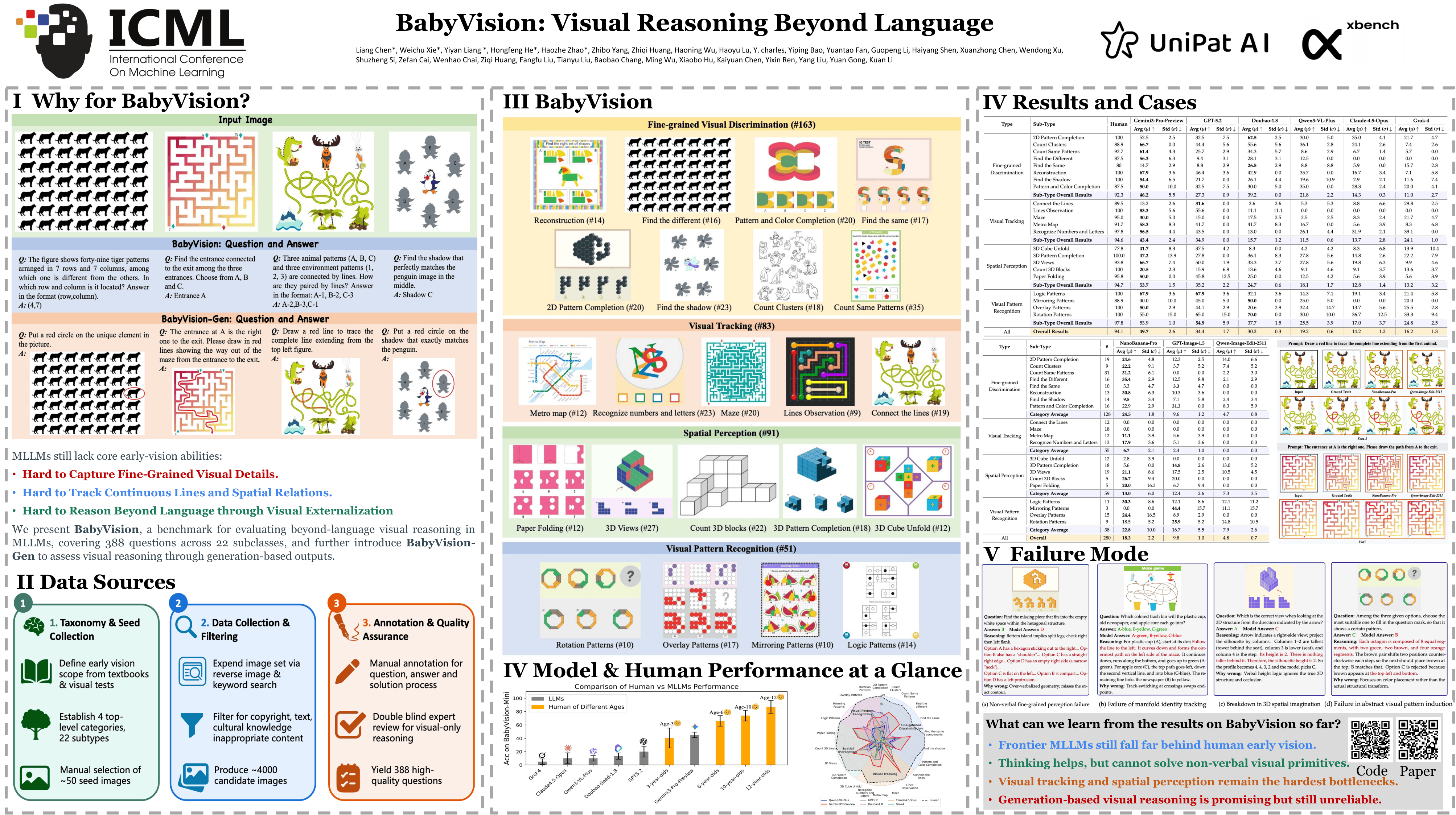
While humans develop core visual skills long before acquiring language, contemporary Multimodal LLMs (MLLMs) still rely heavily on linguistic priors to compensate for their fragile visual understanding. We uncovered a crucial fact: state-of-the-art MLLMs consistently fail on basic visual tasks that humans, even 3-year-olds, can solve effortlessly. To systematically investigate this gap, we introduce BabyVision, a benchmark designed to assess core visual abilities independent of linguistic knowledge for MLLMs. BabyVision spans a wide range of tasks, with 388 items divided into 22 subclasses across four key categories. Empirical results and human evaluation reveal that leading MLLMs perform significantly below human baselines. Gemini3-Pro-Preview scores 49.7, falling well behind the average adult score of 94.1. These results show despite excelling in knowledge-heavy evaluations, current MLLMs still lack fundamental visual primitives. Progress in BabyVision represents a step toward human-level visual perception and reasoning capabilities. We also explore solving visual reasoning with generation models by proposing BabyVision-Gen and automatic evaluation toolkit. Code and data are released at https://github.com/UniPat-AI/BabyVision.
Lay Summary
Before learning to speak, infants can already tell shapes apart, track moving objects, and recognize patterns. Today's most powerful AI vision systems, however, struggle with these same basic tasks — despite acing expert-level exams. We created BabyVision, a set of 388 visual puzzles testing the kind of "seeing" abilities children develop before language. The best AI model scored only 49.7%, while human adults averaged 94.1%, with most models falling below typical 3-year-olds. The core issue is that these models must convert what they see into words before reasoning, losing visual details that words cannot capture. We also explore letting image-generation models "think in pictures" by drawing on images, showing early promise. Our work reveals that acing language-heavy tests does not mean an AI truly sees.