
Bend the Basics: Degradation-Aware Deformable Tokenization for All-in-One Image Restoration
Abstract
Lay Summary
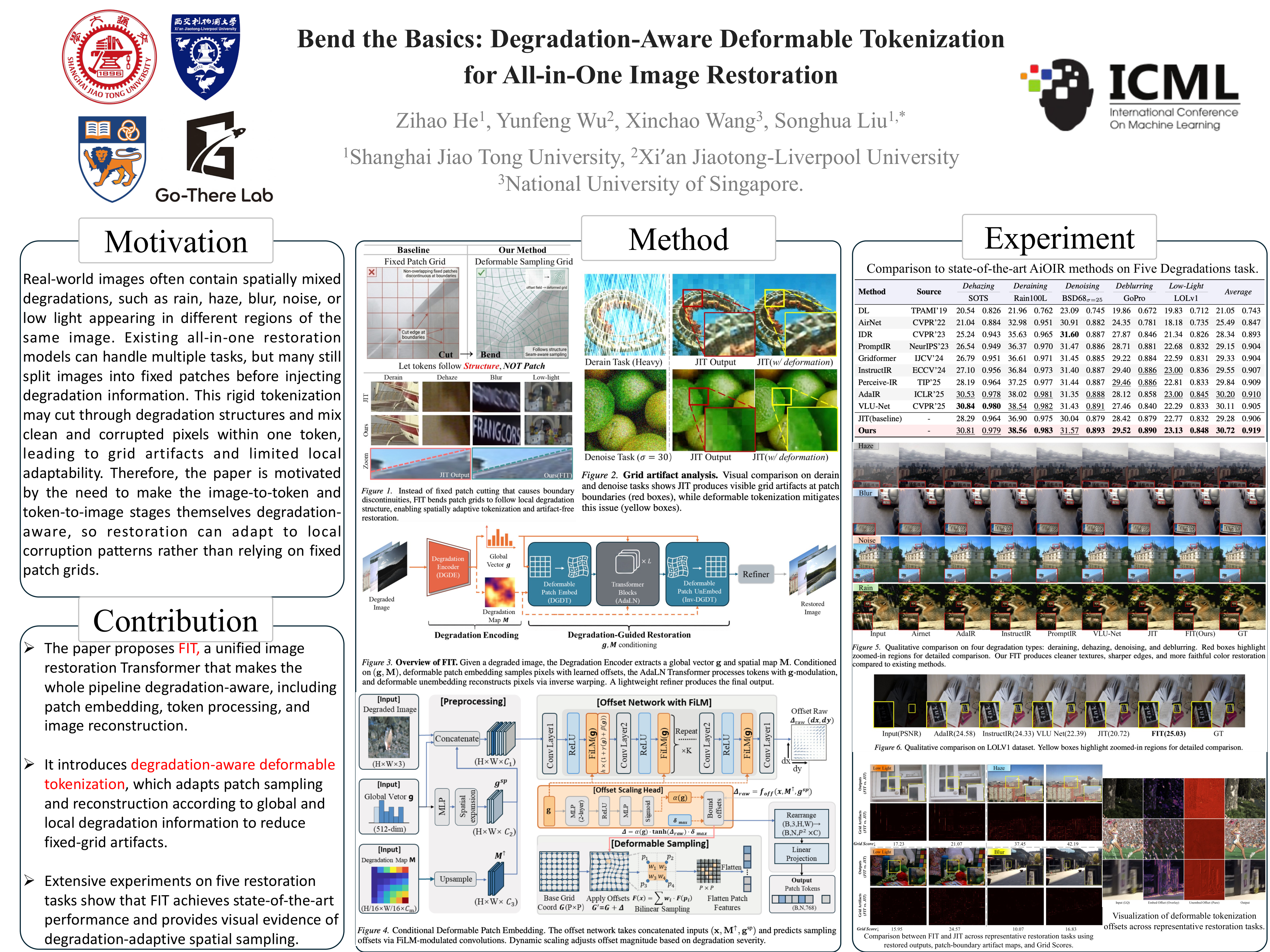
Photos taken in bad conditions, heavy rain, fog, motion blur, low light, or sensor noise, often suffer several of these problems at once. We want a single AI model that can clean any combination of them automatically. Most existing methods chop the image into a fixed grid of small squares and clean each square separately. But this rigid grid often cuts right through a rain streak or a blurry edge, leaving visible seams where the squares meet. Our method, called FIT, lets the grid bend. It first looks at the image to find where the damage is and what kind, then reshapes its squares so their edges fall between problem areas rather than across them. Each square then holds a more coherent piece of the scene, and the result stitches back together without seams. On five standard test sets—noise, rain, fog, motion blur, and low light—FIT produces sharper, more natural-looking results than previous methods. The broader takeaway: how an AI carves an image into pieces is as important as what it does with each piece.