
Generative Visual Code Mobile World Models
Abstract
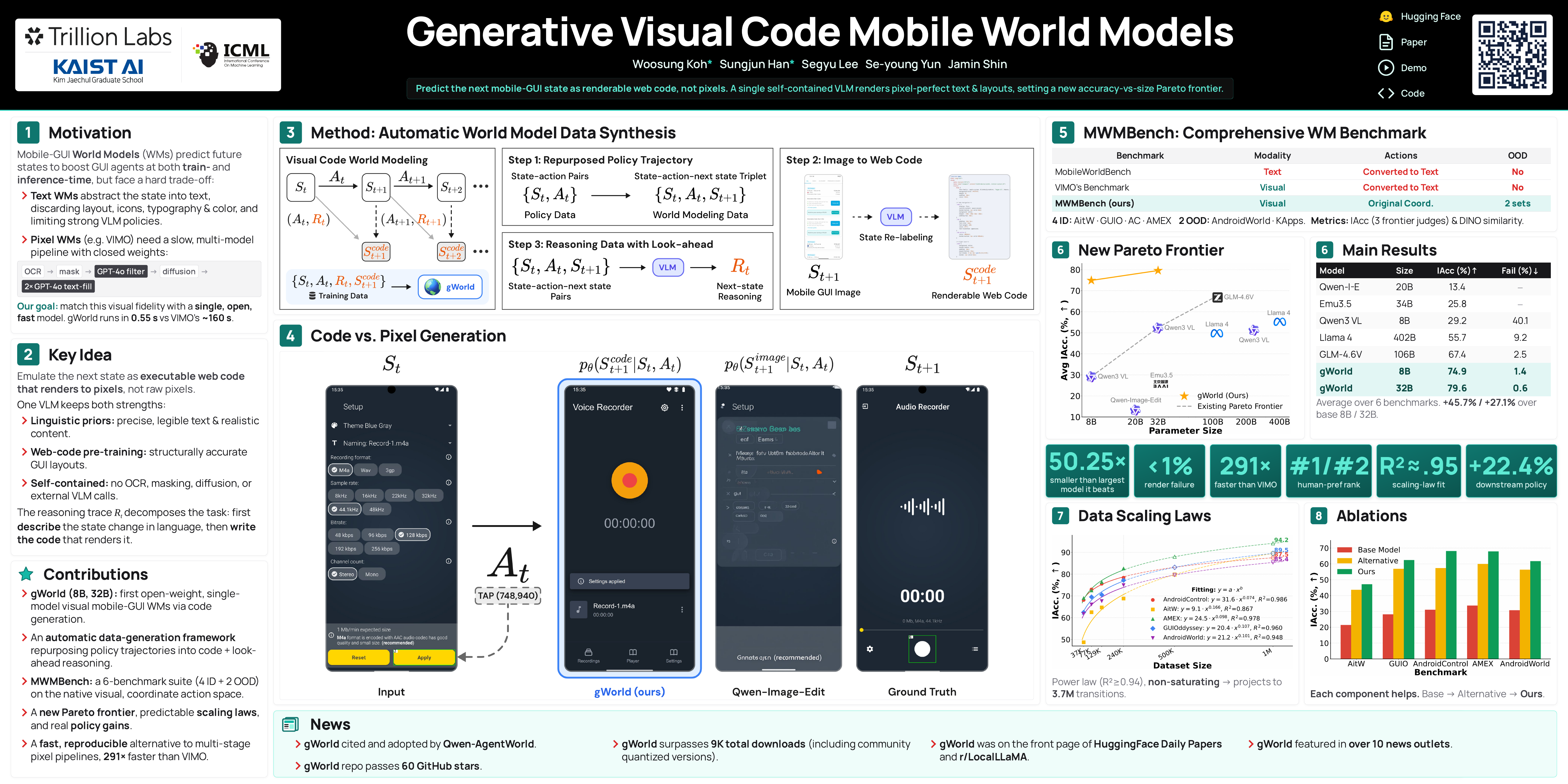
Mobile Graphical User Interface (GUI) World Models (WMs) offer a promising path for improving mobile GUI agent performance at train- and inference-time. However, current approaches face a critical trade-off: text-based WMs sacrifice visual fidelity, while the inability of visual WMs in precise text rendering led to their reliance on slow, complex pipelines dependent on numerous external models. We propose a novel paradigm: visual world modeling via renderable code generation, where a single Vision-Language Model (VLM) predicts the next GUI state as executable web code that renders to pixels, rather than generating pixels directly. This combines the strengths of both approaches: VLMs retain their linguistic priors for precise text rendering while their pre-training on structured web code enables high-fidelity visual generation. We introduce gWorld (8B, 32B), the first open-weight visual mobile GUI WMs built on this paradigm, along with a data generation framework (gWorld) that automatically synthesizes code-based training data. In extensive evaluation across 4 in- and 2 out-of-distribution benchmarks, gWorld sets a new pareto frontier in accuracy versus model size, outperforming 8 frontier open-weight models over 50.25x larger. Further analyses show that (1) scaling training data via gWorld yields meaningful gains, (2) each component of our pipeline improves data quality, and (3) stronger world modeling improves downstream mobile GUI policy performance.
Lay Summary
Mobile GUI agents need to predict how app screens change after actions, but existing world models trade off visual fidelity and text precision. We introduce gWorld, a code-based visual world model that predicts the next GUI state as executable web code, which is then rendered into pixels. This lets a single VLM preserve both screen layout and readable text without slow multi-model pipelines. Across six benchmarks, gWorld achieves a strong accuracy–model size Pareto frontier, outperforming much larger open-weight models. Our results show that scaling code-based training data improves world modeling, and stronger world models can directly improve downstream mobile GUI policy performance.