
Learning-to-Optimize via Deep Unfolded Flows
Augustinos Saravanos ⋅ Oswin So ⋅ H M Sabbir Ahmad ⋅ Chuchu Fan
Abstract
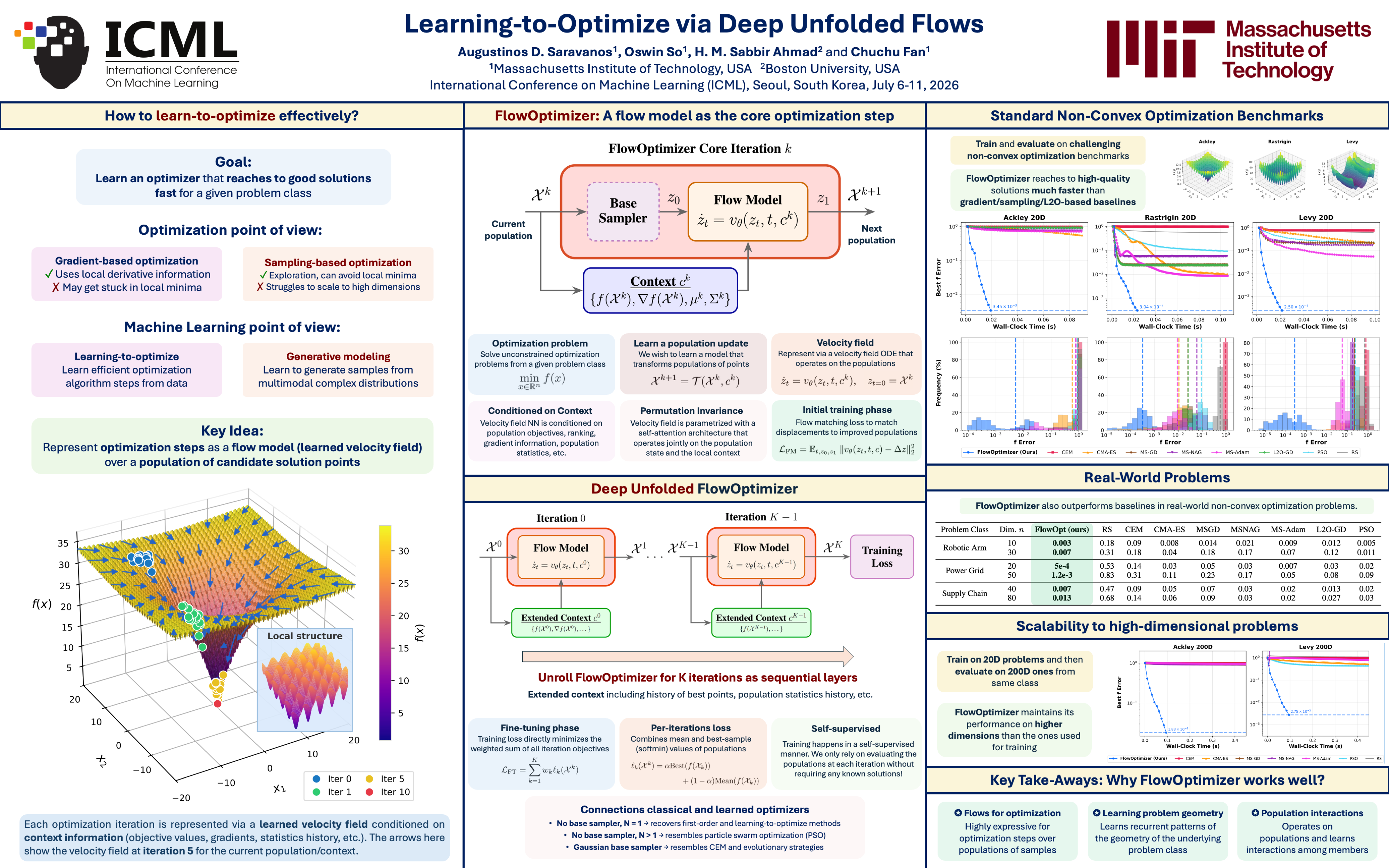
We introduce *FlowOptimizer*, a deep unfolded, flow-based framework for learned iterative optimization. Motivated by the expressiveness of flow models, we represent each optimization iteration via a velocity field that operates on a population of candidate solutions, i.e., a set of parallel iterates, conditioned on contextual information including their objective values and gradients, as well as population-level statistics. The velocity field is initially trained in a simulation-free manner by matching displacements from source populations to improved target ones obtained through sampling the objective. Subsequently, we unfold this velocity field as the internal iteration of an optimization sequence, and fine-tune it in an end-to-end manner by directly optimizing objective values over a targeted class of problems. Notably, FlowOptimizer is a self-supervised framework whose training relies solely on objective evaluations without requiring knowledge of solutions. We evaluate our approach on a series of tasks from standard non-convex optimization benchmarks to real-world problems from supply chain, robotics and power grid applications. FlowOptimizer consistently outperforms well-established sampling-based/gradient-based traditional optimization and learning-to-optimize methods, often by orders of magnitude in terms of solution quality. We further highlight its ability to be trained on low-dimensional problems and successfully generalize to substantially higher-dimensional $(\times 10)$ ones.
Video
Chat is not available.
Successful Page Load