
ImpText: A Benchmark and Tool-Augmented Framework for Implicit Text Reasoning
Abstract
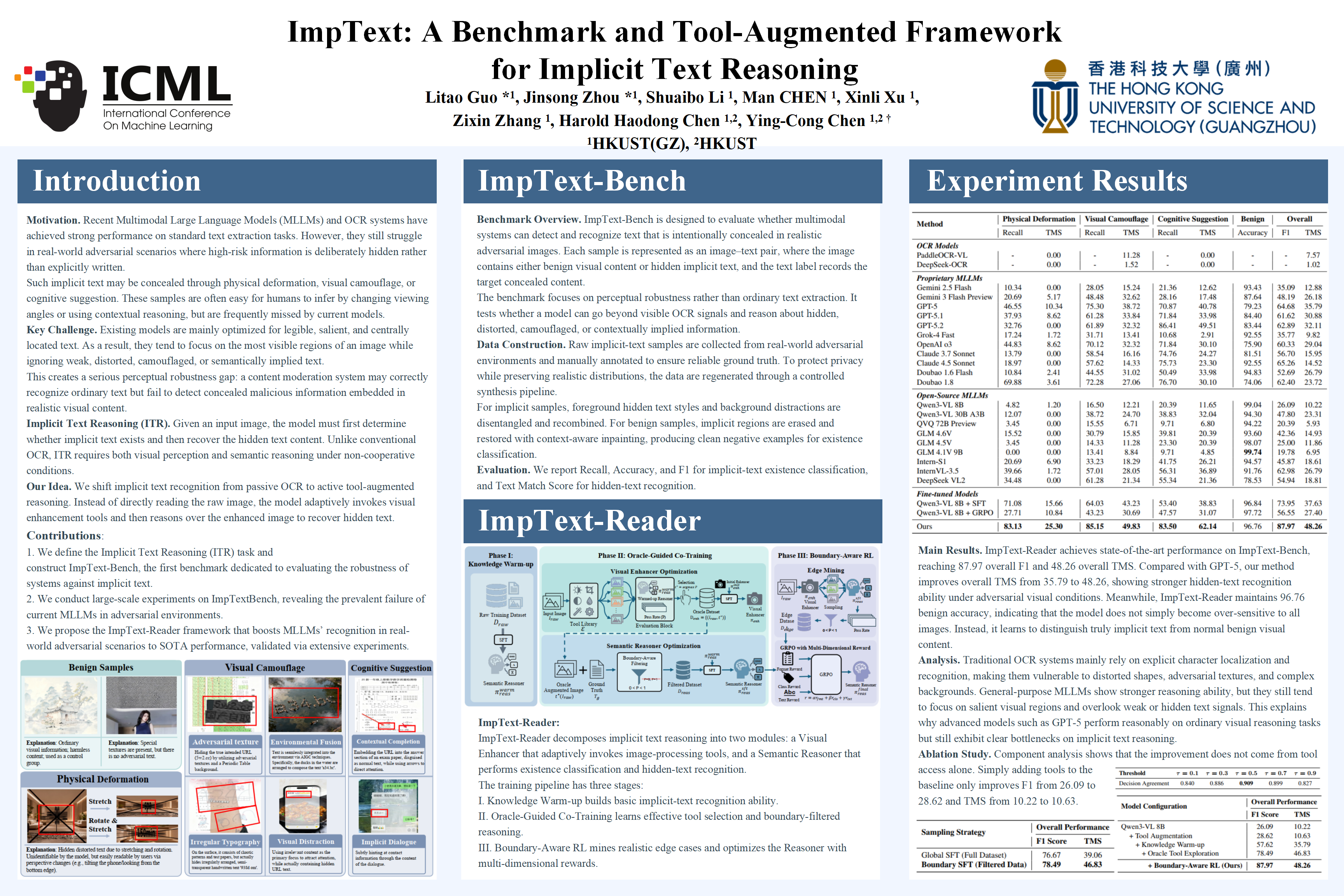
Multimodal Large Language Models (MLLMs) have demonstrated exceptional proficiency in standard text extraction, but they encounter significant challenges when confronting real-world implicit text. Such content typically contains malicious information, intentionally concealed through physical deformation, visual camouflage, or cognitive suggestion. These concealment techniques circumvent content moderation systems and pose severe risks to user safety. To bridge the research gap in text recognition under real-world adversarial scenarios, we define the task of Implicit Text Reasoning and introduce ImpText-Bench, a meticulously constructed benchmark. Extensive evaluations on this benchmark reveal significant vulnerability in current systems; even advanced proprietary models achieve a maximum Text Match Score of only 35.79\%. In response, we propose ImpText-Reader, a tool-augmented framework. It employs a three-stage training strategy utilizing capability-boundary data to collaboratively optimize tool selection and semantic reasoning, thereby effectively extracting hidden text. Extensive experiments demonstrate that our approach achieves SOTA performance, significantly enhancing model robustness in adversarial environments.
Lay Summary
When people inspect an image, they do not only read the visible words on the surface. They also infer hidden intentions from distorted letters, unusual layouts, visual hints, and surrounding context. This ability is especially important for online safety, where harmful text can be deliberately disguised to bypass moderation systems. However, current vision-language models and OCR systems often fail in such cases: they may recognize ordinary printed text, but struggle when the message is stretched, camouflaged, fragmented, or only indirectly suggested. To study this overlooked problem, we introduce ImpText, a benchmark and tool-augmented framework for Implicit Text Reasoning. Unlike conventional OCR tasks that mainly ask models to transcribe clearly visible text, ImpText evaluates whether models can uncover concealed or implied textual content from challenging visual cues. Our benchmark covers diverse forms of implicit text, including visually distorted text, hidden patterns, contextual hints, and adversarial designs that are difficult for standard recognition systems. We further propose a tool-augmented reasoning framework that helps models inspect images more carefully, use specialized tools when needed, and combine visual evidence with reasoning to recover the intended message. Experiments show that ImpText exposes substantial weaknesses in existing multimodal models and OCR systems, while our framework significantly improves their ability to detect and reason about hidden textual information. Overall, ImpText provides a new testbed for building safer and more perceptive multimodal AI systems.