
Proximal-Based Generative Modeling for Bayesian Inverse Problems
Abstract
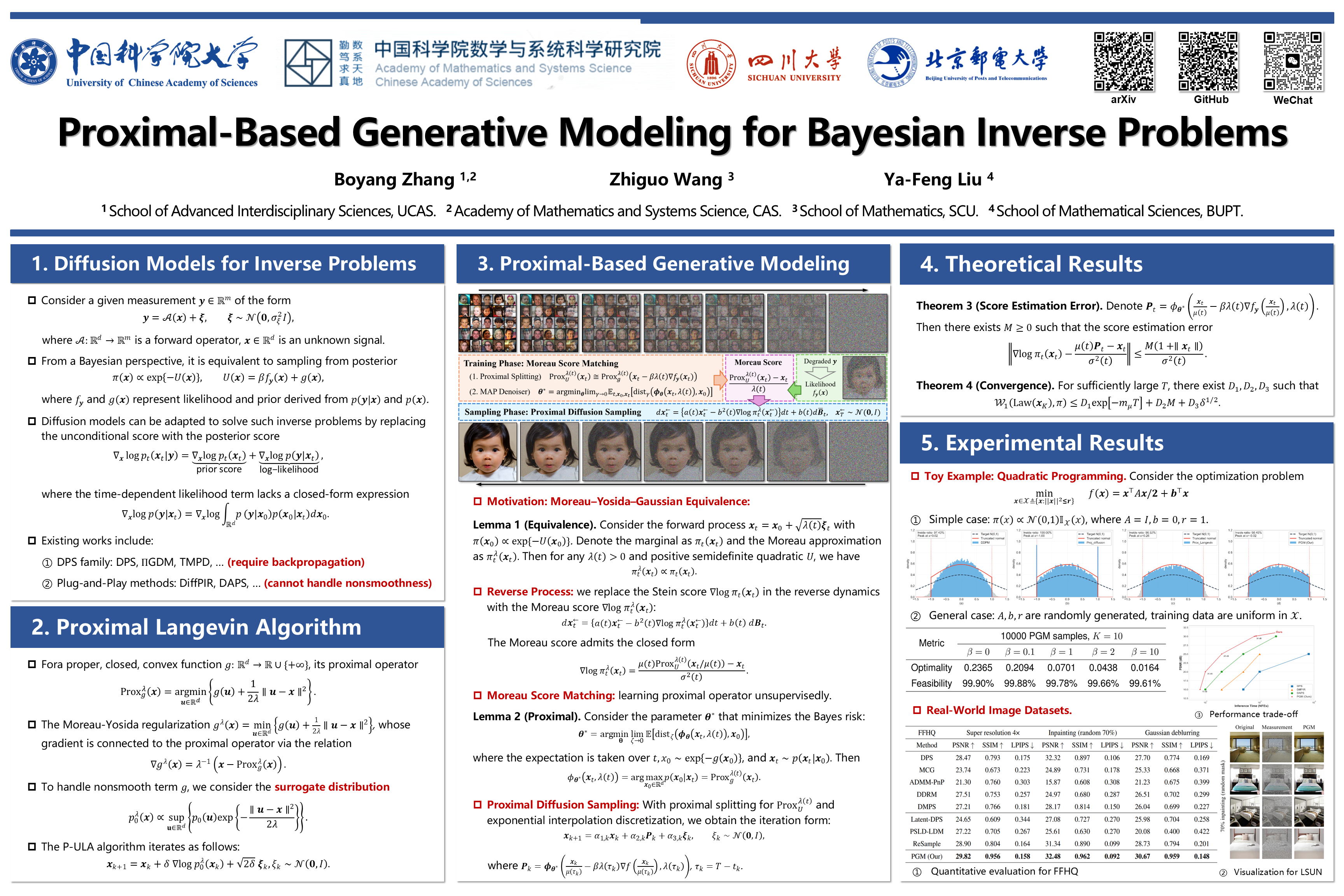
Score-based diffusion models demonstrate superior performance in generative tasks but encounter fundamental bottlenecks in inverse problems due to the analytical intractability of the time-dependent likelihood score. To bridge this gap, we propose a novel proximal-based generative modeling (PGM) framework that rigorously circumvents explicit likelihood evaluation. Our framework is built upon a theoretical equivalence between Gaussian convolution in diffusion processes and Moreau-Yosida regularization in nonsmooth optimization. This enables a new sampling mechanism driven by the proposed Moreau score, which admits a closed-form expression via proximal operators. Moreover, we introduce Moreau score matching to learn the proximal operators that rely solely on samples drawn from the prior distribution. Theoretically, PGM eliminates the early-stopping bias inherent in the score-based diffusion model and achieves non-asymptotic convergence. Experiments demonstrate that PGM significantly surpasses state-of-the-art methods in reconstruction quality and sampling time.
Lay Summary
Recovering a clean image from a blurry, low-resolution, or incomplete version is a common but challenging task. Diffusion models have recently revolutionized image generation, but applying them to these restoration problems is difficult because it requires computing an intractable correction term that introduces errors. We propose proximal-based generative modeling (PGM), a new framework that replaces this troublesome term with a simpler, mathematically equivalent alternative inspired by optimization. PGM learns a proximal network and uses it to efficiently guide the reconstruction process, eliminating a known early-stopping error and providing theoretical convergence guarantees. Experiments on super-resolution, inpainting, and deblurring show that PGM produces higher-quality restorations in significantly less time than current state-of-the-art methods.