
Beyond Majority Voting: LLM Aggregation by Leveraging Higher-Order Information
Abstract
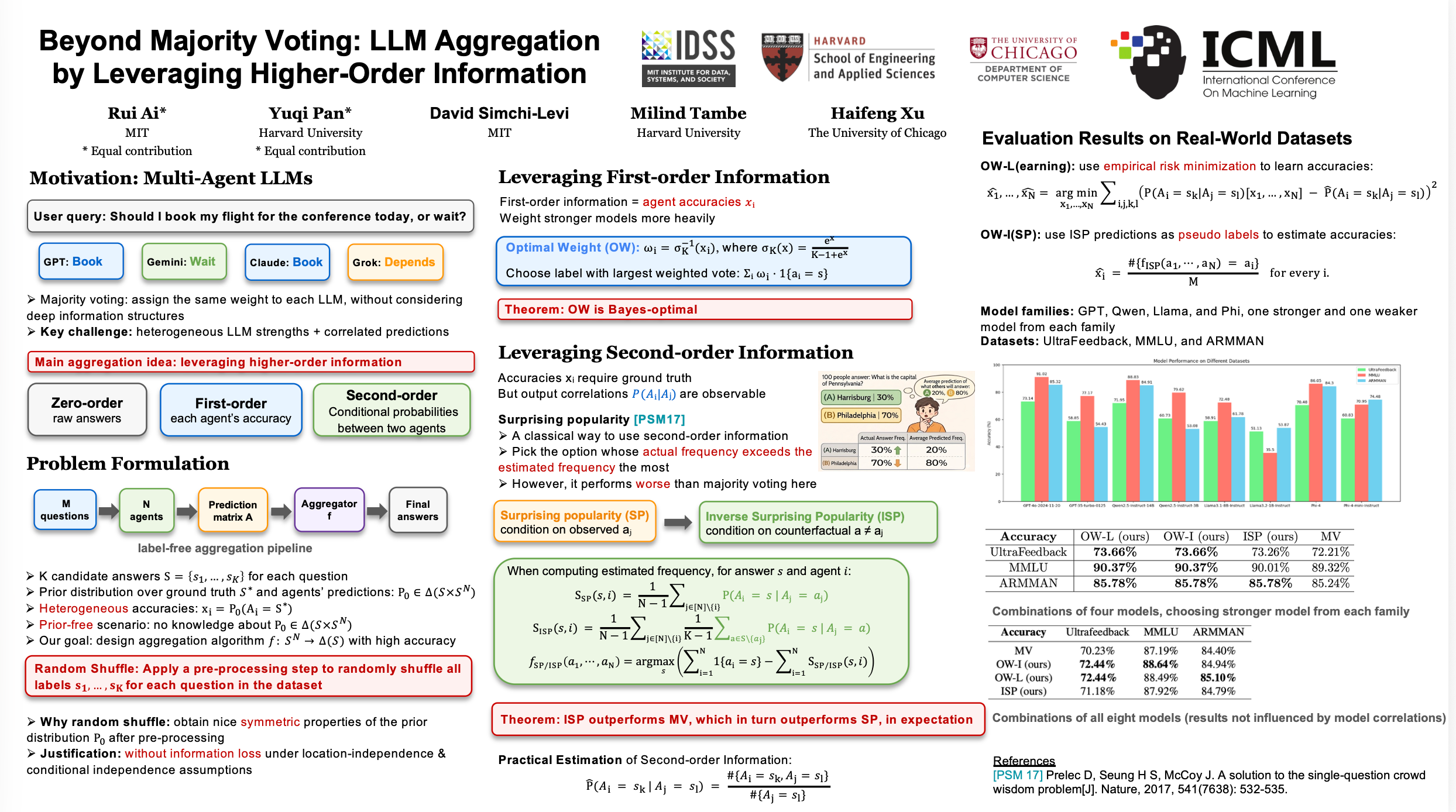
With the rapid progress of multi-agent large language model (LLM) reasoning, how to effectively aggregate answers from multiple LLMs has emerged as a fundamental challenge. Standard majority voting treats all answers equally, failing to consider latent heterogeneity and correlation across models. In this work, we design two new aggregation algorithms called Optimal Weight (OW) and Inverse Surprising Popularity (ISP), leveraging both first-order and second-order information. Our theoretical analysis shows these methods provably mitigate the inherent limitations of majority voting under mild assumptions, leading to more reliable collective decisions. We empirically validate our algorithms on synthetic datasets, popular LLM fine-tuning benchmarks such as UltraFeedback and MMLU, and a real-world healthcare setting ARMMAN. Our algorithms consistently outperform standard baselines, establishing a robust, training-free framework for effective multi-agent LLM aggregation.
Lay Summary
When several AI models answer the same question, how should we combine their answers into one? The common approach, majority voting, simply picks whichever answer got the most votes, treating every model as equally trustworthy. We propose two better methods. The first assigns each model a weight based on how often it tends to be right, using a formula we prove is mathematically optimal. The second works without any answer key: it studies how different models' responses relate to each other across many questions and uses these patterns to infer the most likely correct answer, which we also prove beats majority voting. We tested both on standard language-model benchmarks and on a real healthcare task with the nonprofit ARMMAN, predicting which expectant mothers might disengage from a maternal health program in India. Our methods consistently beat majority voting and often outperform even the strongest individual model. They run in seconds on a laptop and need no extra training, so they can replace majority voting in existing AI pipelines and make more accurate and reliable AI accessible even to teams without large compute budgets.