
Learning Graph Foundation Models on Riemannian Graph-of-Graphs
Abstract
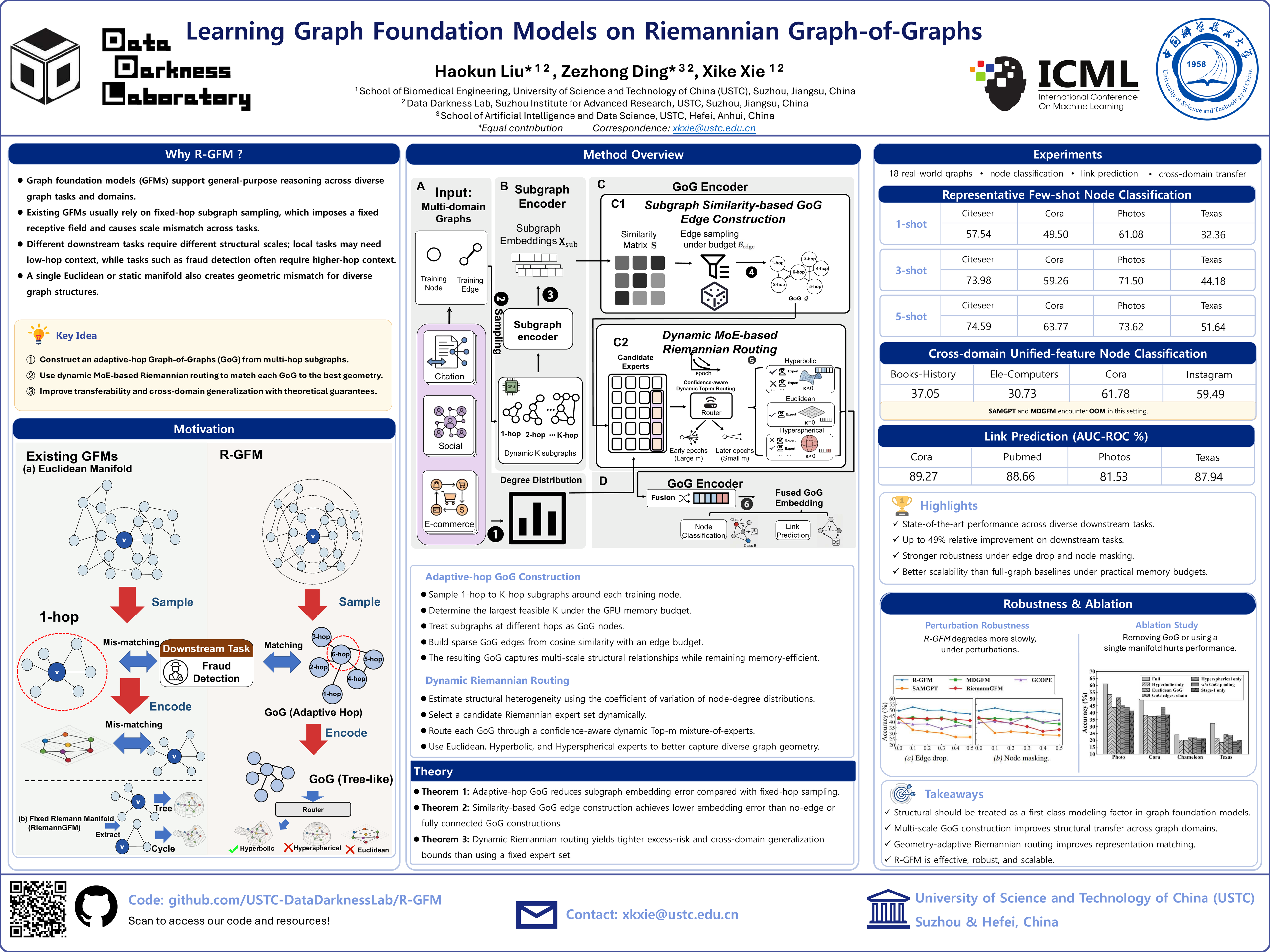
Graph foundation models (GFMs), pretrained on massive graph data, have transformed graph machine learning by supporting general-purpose reasoning across diverse graph tasks and domains. Existing GFMs pretrained with fixed-hop subgraph sampling impose a fixed receptive field, causing scale mismatch on diverse tasks, which often require heterogeneous and unknown structural contexts beyond a fixed sampling scale. We propose R-GFM, a Riemannian Graph-of-Graphs (GoG) based foundation model, that treats structural scale as a first-class citizen in modeling. R-GFM constructs a multi-scale GoG over-sampled subgraphs at different hop distances and learns geometry-adaptive representations from Riemannian manifolds. Theoretical analysis shows that R-GFM reduces structural domain generalization error compared to fixed-scale GFMs. Experiments on various datasets demonstrate that R-GFM achieves state-of-the-art performance, with up to a 49\% relative improvement on downstream tasks.
Lay Summary
Many real-world problems can be represented as graphs, such as social networks, citation networks, shopping systems, and molecules. Existing graph learning models often look at a fixed-size neighborhood around each node, but different tasks may need information from nearby or farther-away parts of the graph. We propose R-GFM, a new graph foundation model that automatically combines information from multiple neighborhood sizes and adapts how it represents different graph structures. This makes the model more flexible when it is trained on some graph datasets and then used on new, unseen graph datasets. Experiments on a wide range of graph tasks show that R-GFM performs better than existing graph foundation models.