
Cold-Start Personalization via Bayesian Adaptive Questioning
Abstract
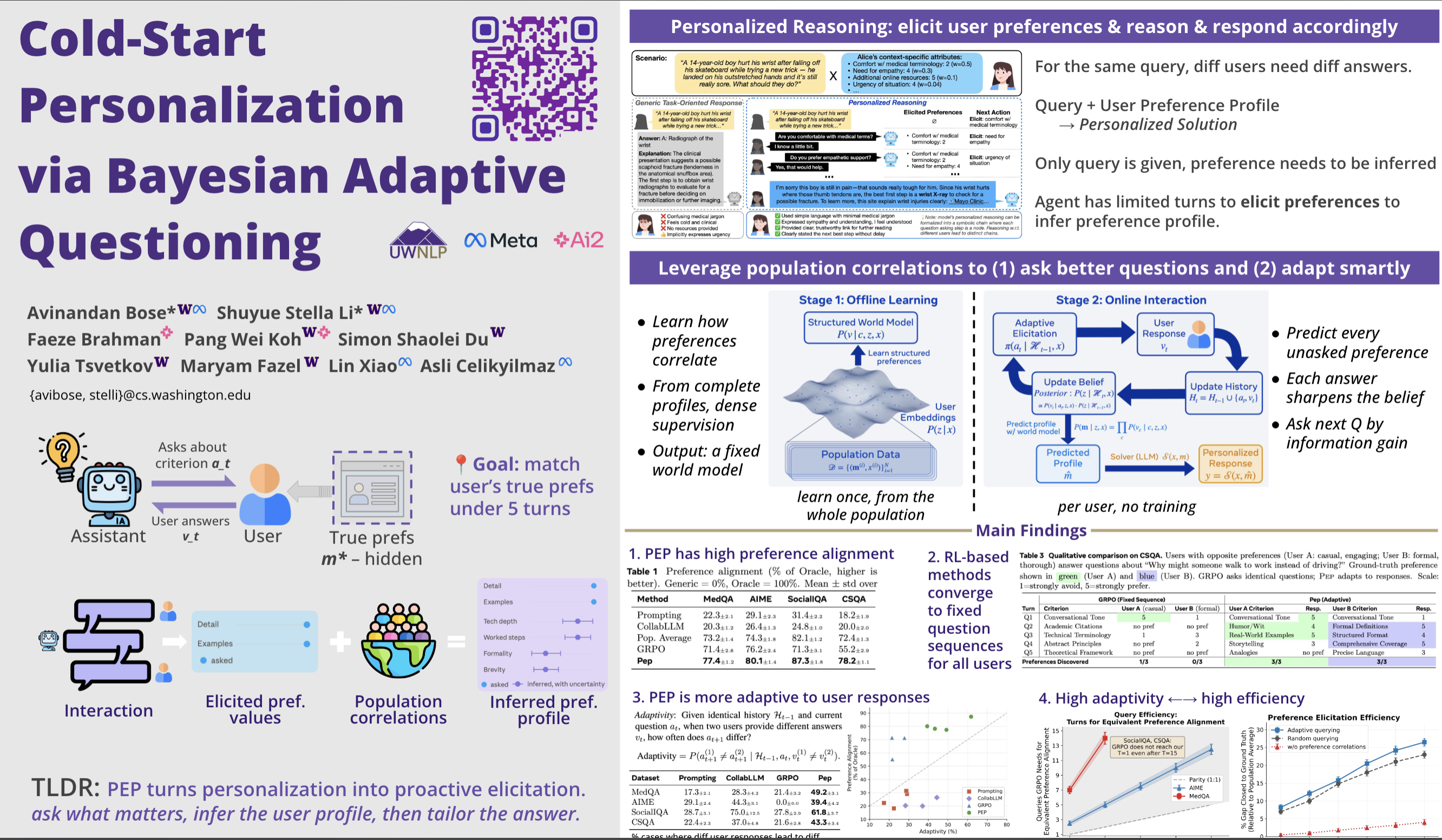
Cold-start personalization requires inferring preferences from minimal interaction when no user-specific historical data is available. The space of possible preferences is vast, yet users care about only a sparse subset and rarely articulate them upfront; combined with limited interaction budgets, this makes preference elicitation challenging. Our key insight is that preferences exhibit predictable structure across populations; e.g., users who want detailed explanations often also value worked examples. We propose CAPE (Cold start Adaptive Preference Elicitation with Priors), a principled system decomposition framework for cold-start personalization: learning a structured world model of preference correlations offline using latent variables, then performing Bayesian inference online without retraining. Even simple belief model instantiations (e.g., linear regression) substantially outperform end-to-end RL. Across medical, mathematical, social, and commonsense reasoning, CAPE achieves 80.8% alignment with ground-truth user preferences versus 68.5% for RL, requires 3-5× fewer interactions, and adapts twice as often. Our contribution is a principled decomposition of cold-start personalization that makes Bayesian preference elicitation practical at scale for LLM systems.
Lay Summary
When a new user interacts with an AI, the system faces a "cold-start" problem because it knows nothing about their unique preferences. To solve this, you created CAPE, a framework that maps out common patterns in human behavior beforehand (like how people who want detailed explanations usually value worked examples, too). By leveraging these population-level insights, your system accurately predicts a new user's preferences after just a few quick interactions without any online retraining. Ultimately, PEP achieves 80.8% alignment with ground-truth preferences while requiring 3 to 5 times fewer interactions than traditional end-to-end reinforcement learning.