
SI-IGCL: Subject Invariance-aware Inverse Graph Contrastive Learning for Psychiatric Disorder Identification
Abstract
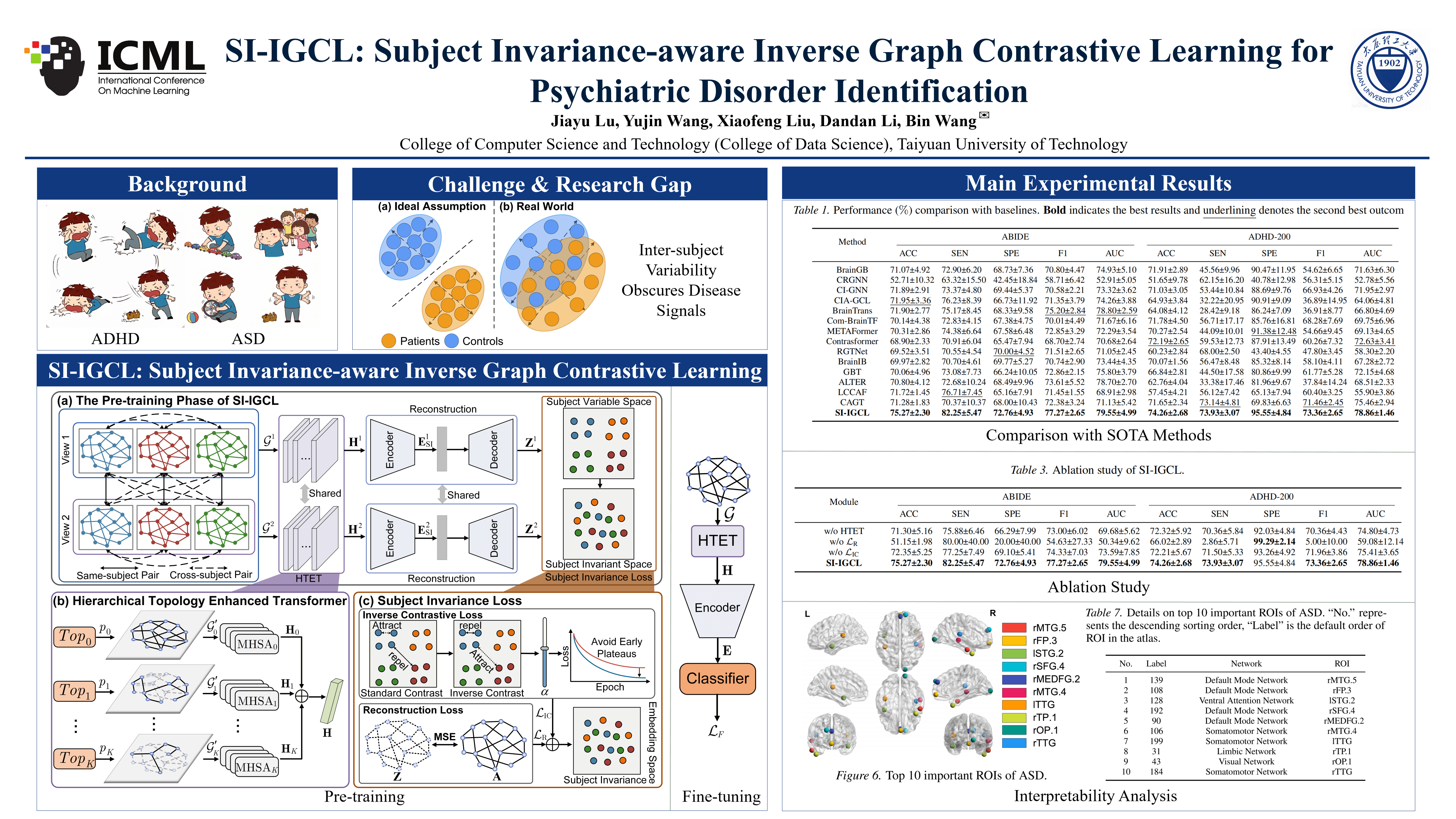
Functional brain network analysis plays an important role in understanding and diagnosing psychiatric disorders. However, current methods struggle with subject variations, impairing the model’s generalization ability to the test set. To address this issue, we propose the Subject Invariance-aware Inverse Graph Contrastive Learning (SI-IGCL) model, which adopts a two-stage paradigm with self-supervised subject-invariant pre-training followed by supervised fine-tuning for identification. During the pre-training phase, we construct an inverse contrastive objective that reshapes the embedding space by repelling intra-subject and attracting inter-subject embeddings to learn subject-invariant representations, with an auxiliary correction term to avoid early optimization plateaus. Meanwhile, we incorporate a structure-preserving reconstruction constraint to preserve discriminative information. Moreover, a Hierarchical Topology Enhanced Transformer (HTET) module is designed to enable multi-level modeling of subject-invariant functional patterns. During the fine-tuning phase, a supervised classifier is integrated to perform psychiatric disorder classification. Extensive experiments demonstrate that our method outperforms all state-of-the-art methods. The code is available at https://anonymous.4open.science/r/SI-IGCL.
Lay Summary
Brain scans can provide important clues for understanding and diagnosing psychiatric disorders, but artificial intelligence systems often struggle because every person’s brain is naturally different. These individual differences can make it difficult for models to identify the brain patterns that are truly related to disease, limiting their reliability in real-world clinical settings. We developed a new machine learning framework called SI-IGCL that helps AI focus on disease-related brain signals while reducing the influence of person-specific variations. Our approach first trains the model to recognize patterns that are shared across individuals, while preserving important diagnostic information in the brain network structure. It then fine-tunes the model to classify psychiatric disorders more accurately. To better capture complex brain organization, our method also analyzes brain connectivity patterns at multiple levels. Experiments on public brain imaging datasets show that our approach consistently outperforms existing state-of-the-art methods. By improving the reliability and generalizability of AI-based brain analysis, this work may support earlier and more accurate psychiatric diagnosis and contribute to the development of mental health care.