
RAST-MoE-RL: A Regime-Aware Spatio-Temporal MoE Framework for Deep Reinforcement Learning in Ride-Hailing
Abstract
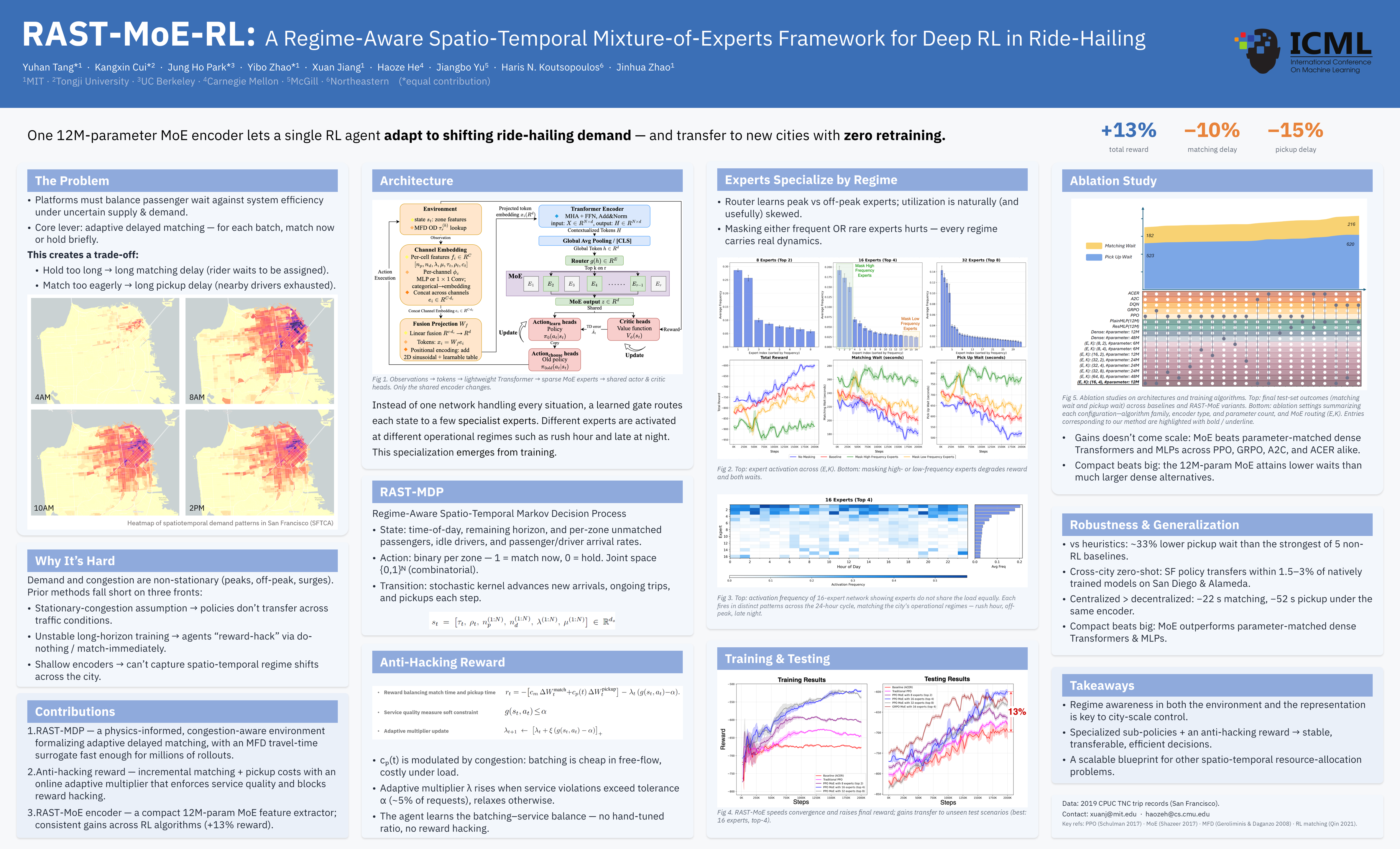
Ride-hailing platforms must balance passenger waiting times with overall system efficiency under highly uncertain supply--demand conditions. Adaptive delayed matching, which controls the holding intervals for batched sets of requests and vehicles, exposes an inherent trade-off between matching and pickup delays. The non-stationary nature of request arrivals and dynamic congestion exposes a key limitation of existing methods, which rely on shallow encoders that cannot capture these spatio-temporal regime shifts. We introduce the Regime-Aware Spatio-Temporal Mixture-of-Experts (RAST-MoE) framework, which formalizes adaptive delayed matching as a regime-aware Markov Decision Process and equips RL agents with a self-attention Mixture-of-Experts encoder, letting different experts specialize automatically across operational regimes while keeping per-sample computation modest. On real-world TNC trajectory data from San Francisco, our 12M-parameter model reduces average matching delay by 10% and pickup delay by 15%, trains stably without reward hacking, generalizes zero-shot to two additional cities, and exhibits clear expert specialization across demand regimes. These results demonstrate the value of MoE-enhanced RL for large-scale decision-making tasks with complex spatio-temporal dynamics.
Lay Summary
Ride-hailing platforms constantly decide when to match passengers with drivers. Matching immediately can reduce the time before a passenger is assigned, but it may also lead to longer pickup trips if the closest available drivers are not well-positioned. Waiting briefly can sometimes create better matches, but it also risks making passengers wait too long. This trade-off becomes especially difficult because cities change throughout the day: rush hours, quiet periods, local demand surges, and congestion all create different operating conditions. We study this problem using deep reinforcement learning, a form of AI where a system learns better decisions by repeatedly interacting with a simulated environment and receiving feedback. Our method, RAST-MoE-RL, uses a Mixture-of-Experts model, which means that different parts of the AI system can specialize in different traffic and demand situations, such as peak-hour congestion or off-peak sparse demand. The system then learns which experts to rely on when deciding whether to match passengers now or wait briefly. Using real ride-hailing data from San Francisco, our method reduces both the time passengers wait to be matched and the time they wait for pickup. It also transfers well to other California cities without retraining. These results suggest that deep reinforcement learning with specialized expert components can help ride-hailing platforms make more adaptive and efficient matching decisions under changing urban conditions.