
Reuse your FLOPs: Scaling RL on Hard Problems by Conditioning on Very Off-Policy Prefixes
Abstract
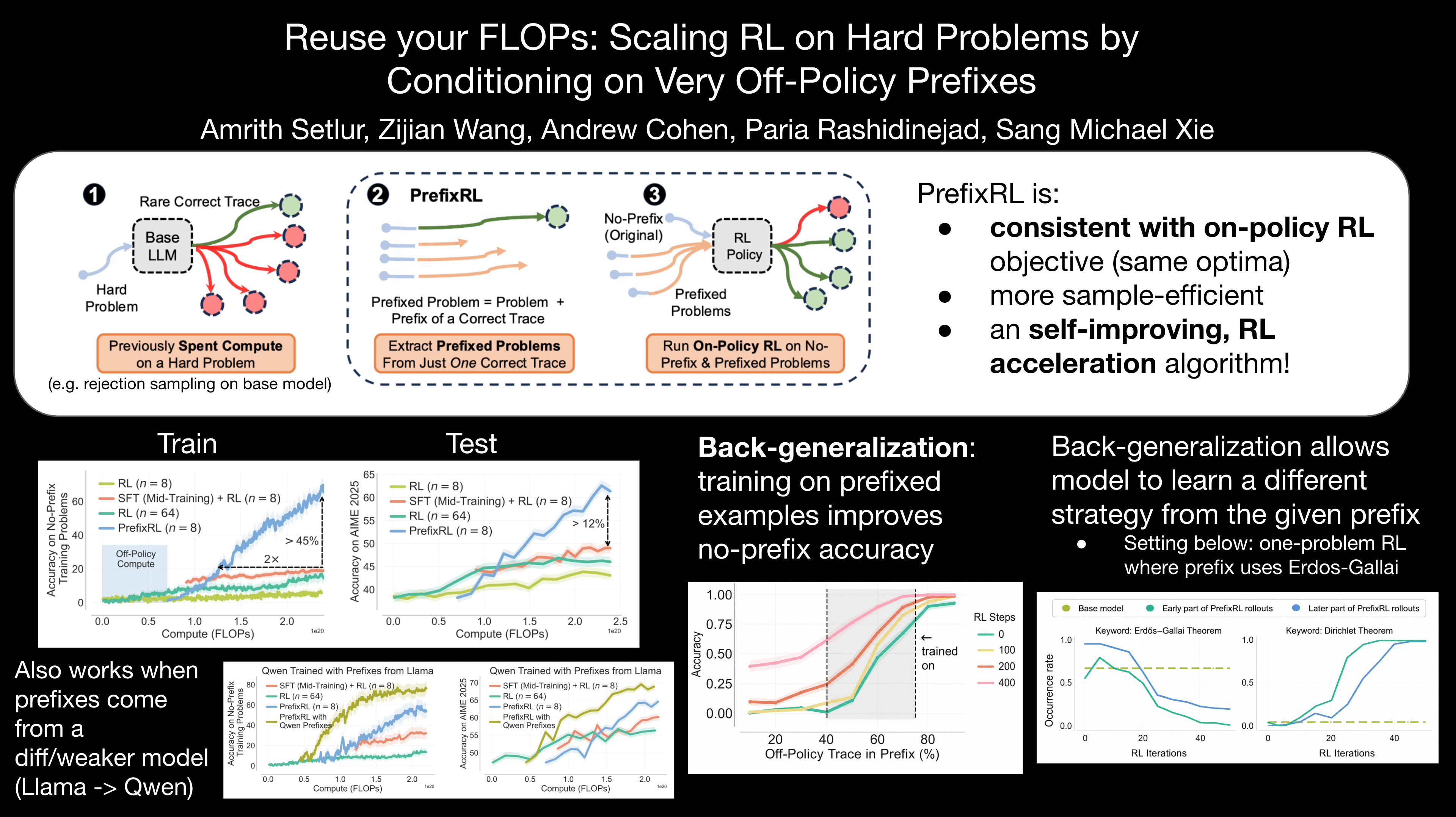
Typical reinforcement learning (RL) methods for LLM reasoning waste compute on hard problems, where correct on-policy traces are rare and policy gradients vanish. To bootstrap more efficient RL, we consider reusing old sampling FLOPs (from prior inference or RL training) in the form of off-policy traces. We introduce PrefixRL, where we condition on the prefix of successful off-policy traces and run on-policy RL to complete them, side-stepping instabilities from using off-policy data as supervision targets. PrefixRL boosts the learning signal on hard problems by modulating the difficulty of the problem through the off-policy prefix length. We prove that the PrefixRL objective is not only consistent with the standard RL objective but also more sample efficient. Empirically, we discover back-generalization: training only on prefixed problems generalizes to out-of-distribution unprefixed performance, with learned strategies often differing from those in the prefix. In our experiments, we source the off-policy traces by rejection sampling with the base model, creating a self-improvement loop. On hard reasoning problems, PrefixRL reaches the same training reward 2x faster than the strongest baseline (SFT on off-policy data then RL), even after accounting for the compute spent on the initial rejection sampling, and increases the final reward by 3x.
Lay Summary
AI models often waste huge amounts of computation trying to solve very hard problems, because they rarely stumble on a correct answer. Our method shows how to reuse that past effort: when a model once found a correct solution, even rarely, we use the beginning of that solution to help it practice more effectively. The implication is simple: AI systems can get better at hard reasoning by recycling their own previous attempts instead of starting from scratch every time. This could make training more efficient and help models improve on difficult math, science, or coding problems where correct solutions are rare.