
Neural Quantum States in Mixed Precision
Abstract
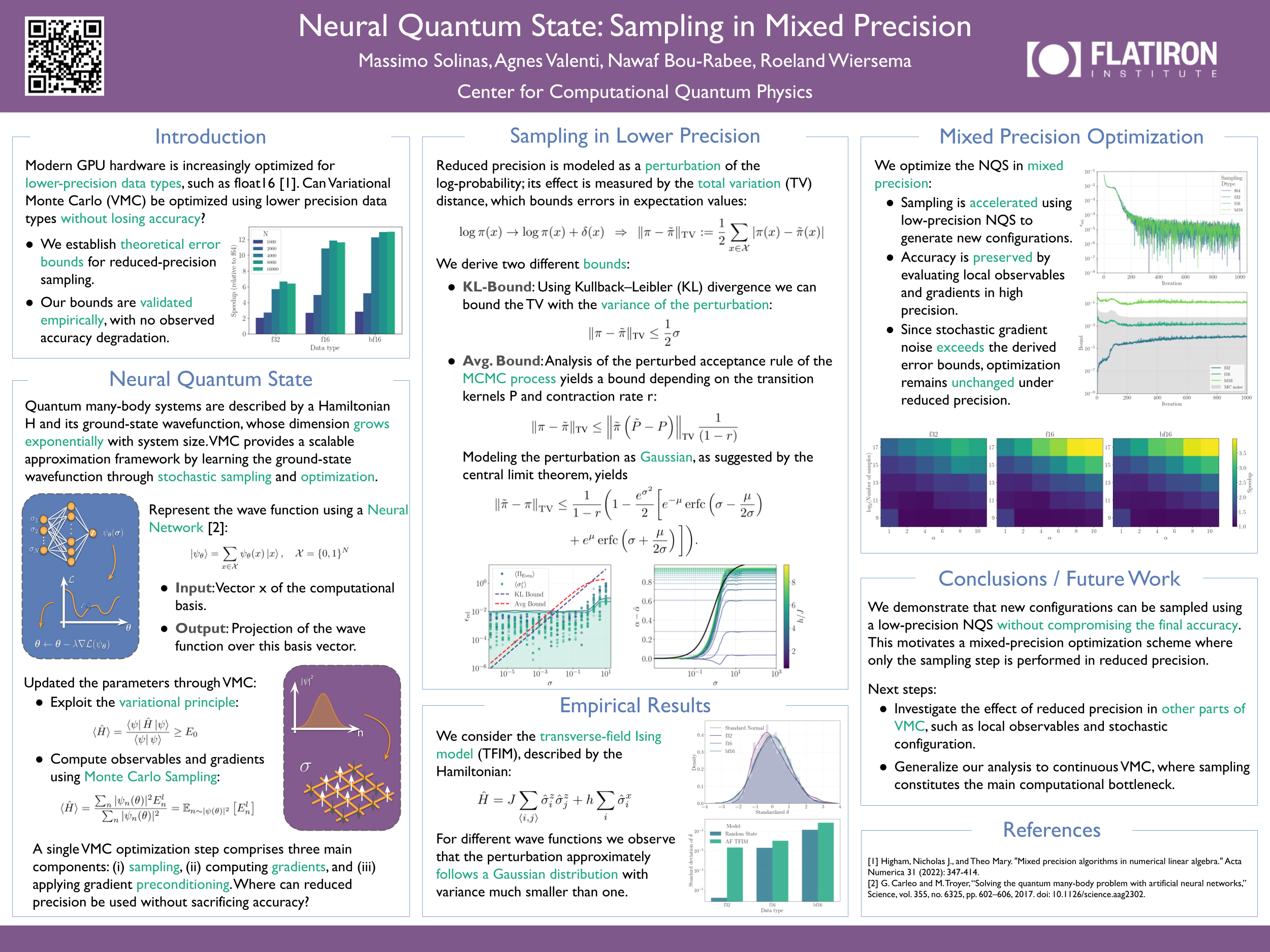
Scientific computing has long relied on double precision (64-bit floating point) arithmetic to guarantee accuracy in simulations of real-world phenomena. However, the growing availability of hardware accelerators such as Graphics Processing Units (GPUs) has made low-precision formats attractive due to their superior performance, reduced memory footprint, and improved energy efficiency. In this work, we investigate the role of mixed-precision arithmetic in neural-network based Variational Monte Carlo (VMC), a widely used method for solving computationally otherwise intractable quantum many-body systems. We first derive general analytical bounds on the error introduced by reduced precision on Metropolis-Hastings MCMC, and then empirically validate these bounds on the use-case of VMC. We demonstrate that significant portions of the algorithm, in particular, sampling the quantum state, can be executed in half precision without loss of accuracy. More broadly, this work provides a theoretical framework to assess the applicability of mixed-precision arithmetic in machine-learning approaches that rely on MCMC sampling. In the context of VMC, we additionally demonstrate the practical effectiveness of mixed-precision strategies, enabling more scalable and energy-efficient simulations of quantum many-body systems.
Lay Summary
Simulating interacting quantum systems consisting of many particles is one of the hardest computational problems in science. For example, understanding how electrons interact in materials and give rise to interesting physical properties requires enormous computational resources. Modern AI-based methods for such simulations have made significant progress in the last couple of years, but rely on high-precision arithmetic that is slow and memory-hungry on modern GPU hardware. We investigate whether lower-precision arithmetic is safe to use for specific parts of these types of simulations. We first derive mathematical guarantees on the errors floating point arithmetic introduces, which we then validate in practice. We find that significant portions of the simulation can run in half precision (16-bit) with no meaningful loss of accuracy, which makes quantum simulations faster, cheaper, and more energy-efficient without compromising scientific validity. Beyond quantum physics, our framework can guide mixed-precision adoption in any machine-learning pipeline relying on probabilistic sampling, benefiting a broad range of scientific computing applications.