
Affine-Scaled Attention: Towards Flexible and Stable Transformer Attention
Abstract
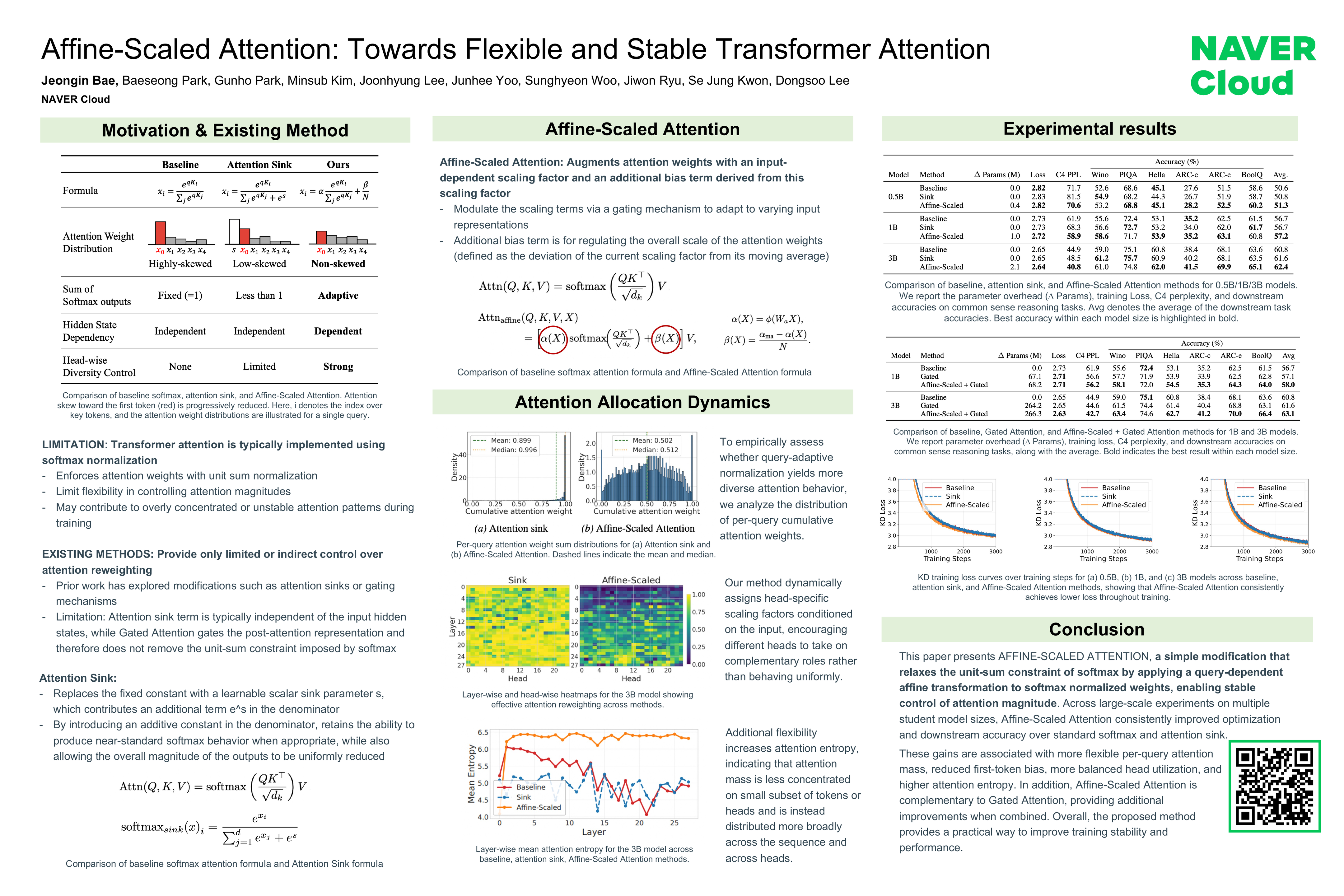
Transformer attention is typically implemented using softmax normalization, which enforces attention weights with unit sum normalization. While effective in many settings, this constraint can limit flexibility in controlling attention magnitudes and may contribute to overly concentrated or unstable attention patterns during training. Prior work has explored modifications such as attention sinks or gating mechanisms, but these approaches provide only limited or indirect control over attention reweighting. We propose Affine-Scaled Attention, a simple extension to standard attention that introduces input-dependent scaling and a corresponding bias term applied to softmax-normalized attention weights. This design relaxes the strict normalization constraint while maintaining aggregation of value representations, allowing the model to adjust both the relative distribution and the scale of attention in a controlled manner. We empirically evaluate Affine-Scaled Attention in large-scale language model pretraining across multiple model sizes. Experimental results show consistent improvements in training stability, optimization behavior, and downstream task performance compared to standard softmax attention and attention sink baselines. These findings suggest that modest reweighting of attention outputs provides a practical and effective way to improve attention behavior in Transformer models.
Lay Summary
Modern language models use attention mechanisms to decide which words or tokens should influence each other. However, the standard way of computing attention can force the model to distribute attention in a rigid way, even when weaker or more flexible interactions would be better. We study this issue and propose Affine-Scaled Attention, a simple modification that relaxes the normalization behavior of standard attention. Our method allows the model to control attention strength more flexibly during training, which can improve performance without changing the overall transformer architecture. This work helps make large language models more efficient and effective by improving one of their core components.