
Prototype-guided Bilateral Alignment Multimodal Federated Learning
Abstract
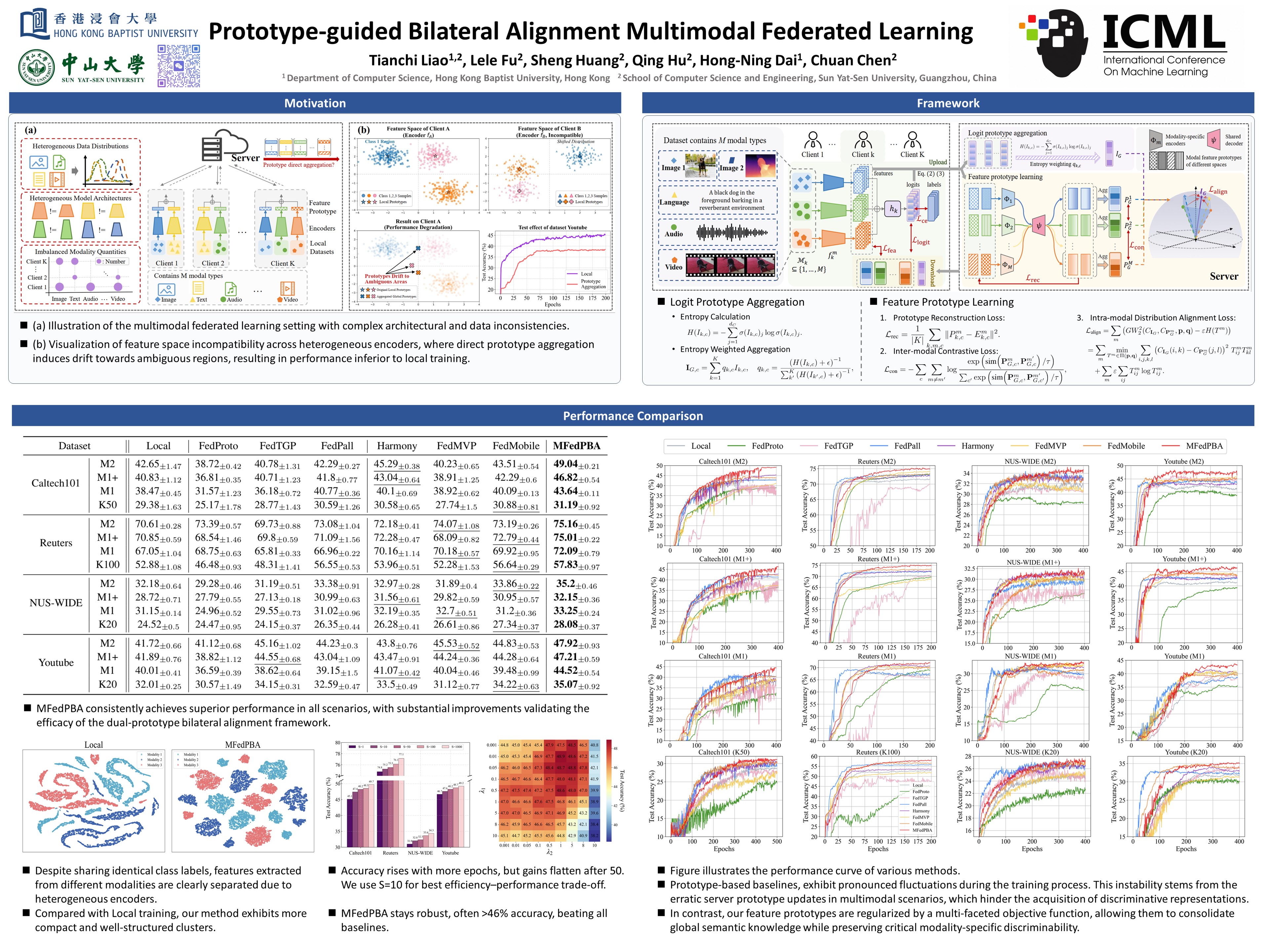
Multimodal federated learning (MFL) has emerged as a pivotal paradigm for leveraging distributed data to enhance model performance. However, existing methods predominantly rely on idealized assumptions of model homogeneity and balanced modality distributions, rendering them ill-suited for practical scenarios characterized by heterogeneous client architectures and severe modality imbalance. To address these challenges, we propose a \textbf{M}ultimodal \textbf{Fed}erated learning Prototype-guided Bilateral Alignment (MFedPBA) framework. MFedPBA facilitates robust knowledge synergy through a dual alignment mechanism: (i) at the feature level, it aligns heterogeneous feature spaces via a projection encoder optimized by contrastive learning and the Gromov-Wasserstein distance; (ii) at the decision level, it employs an entropy-weighted aggregation of naturally aligned logit prototypes. This novel design achieves robust MFL by jointly tackling heterogeneous feature spaces and collectively aggregating decisions. Extensive experiments demonstrate that our method significantly outperforms state-of-the-art baselines under conditions of model heterogeneity and modality imbalance.