
Evolutionary Multi-View Classification with Label Noise via Gradient and Feature Dual-Perception
Abstract
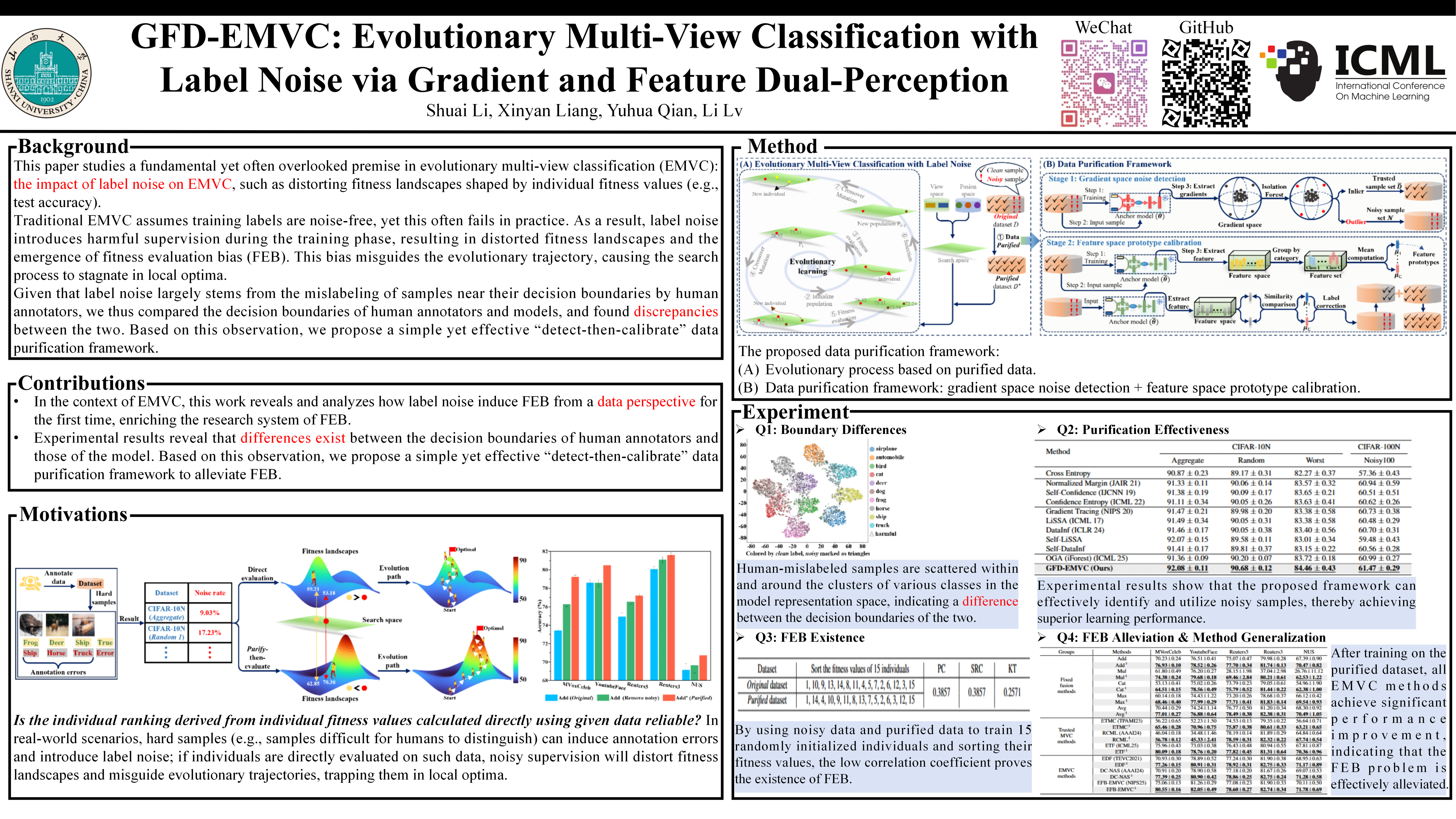
This paper studies a fundamental yet often overlooked premise in evolutionary multi-view classification (EMVC): the impact of label noise on EMVC, such as distorting fitness landscapes shaped by individual fitness values (e.g., test accuracy). Traditional EMVC assumes training labels are noise-free, yet this often fails in practice. As a result, label noise introduces harmful supervision during the training phase, resulting in distorted fitness landscapes and the emergence of fitness evaluation bias (FEB). This bias misguides the evolutionary trajectory, causing the search process to stagnate in local optima. Given that label noise largely stems from the mislabeling of samples near their decision boundaries by human annotators, we thus compared the decision boundaries of human annotators and models, and found discrepancies between the two. Based on this observation, we propose a simple yet effective ``detect-then-calibrate" data purification framework that leverages outlier analysis in the gradient space (i.e., treating outliers as noisy samples) and prototype calibration in the feature space (i.e., utilizing feature prototypes of noise-free samples to correct the labels of noisy samples). Experimental results demonstrate that this strategy can effectively purify the data and alleviate FEB; furthermore, it can improve the performance of various multi-view learning paradigms in label noise scenarios. (The code will be published.)