
EPSVec: Efficient and Private Synthetic Data Generation via Dataset Vectors
Abstract
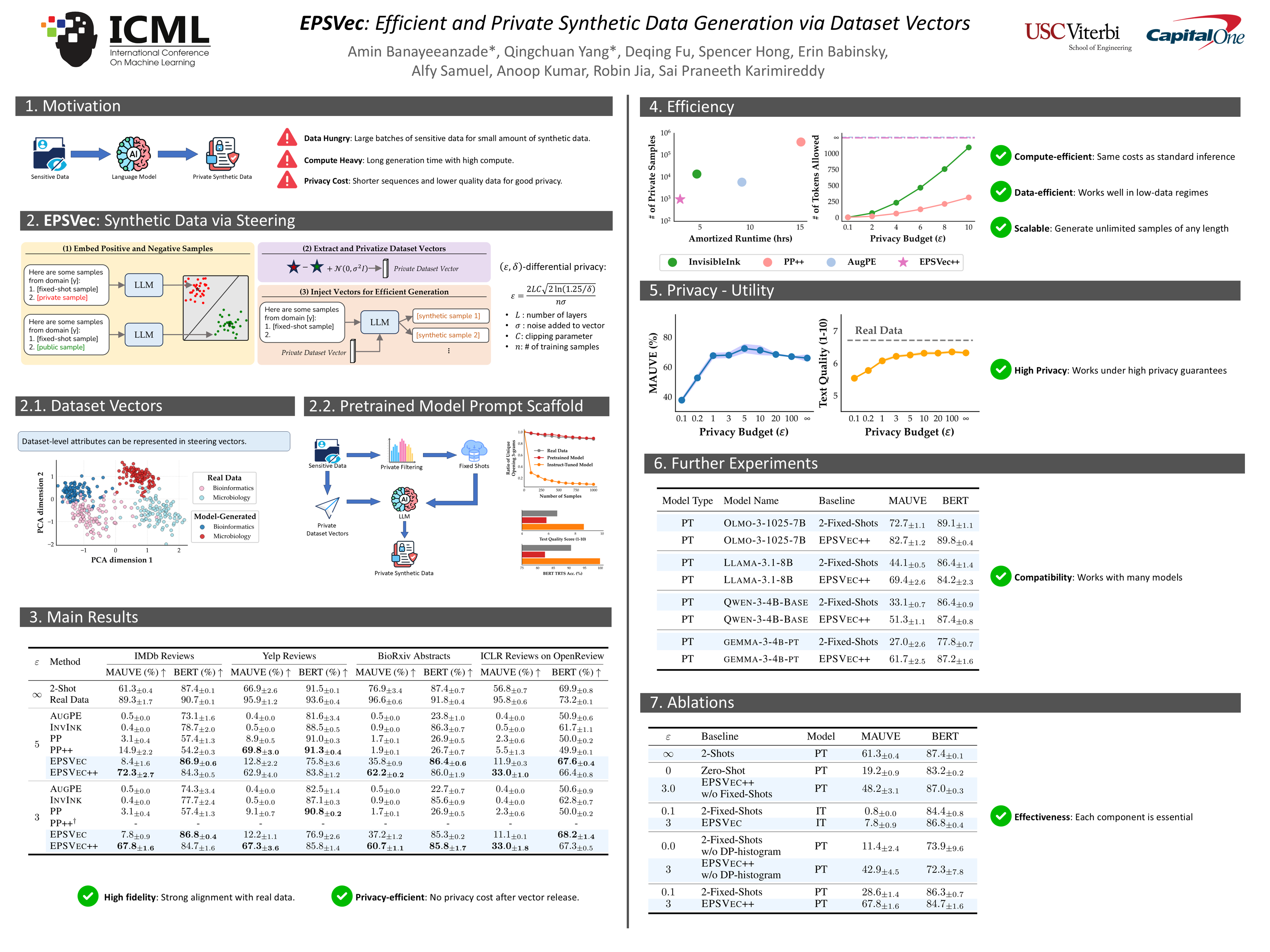
High-quality data is essential for modern machine learning, yet many valuable corpora are sensitive and cannot be freely shared. Synthetic data offers a practical substitute for downstream development, and large language models (LLMs) have emerged as powerful engines for generating it. However, existing private text generation methods are severely inefficient: they are data-intensive, computationally slow, and often require large private corpora or batch sizes to achieve usable quality. We introduce EPSVec, a differentially-private lightweight alternative that steers LLM generation using dataset vectors-directions in activation space that capture the distributional gap between private data and public priors. EPSVec extracts and sanitizes steering vectors just once and then performs standard decoding. This decouples the privacy budget from generation, enabling arbitrarily many synthetic samples without additional privacy cost and yielding strong fidelity even in low-data regimes. Furthermore, we enhance our method by utilizing pretrained (base) models and introducing fixed-shot prompting to boost generation diversity and fidelity. Our experiments demonstrate that EPSVec outperforms existing baselines in distributional alignment and downstream utility, particularly in low-data regimes, while significantly reducing computational overhead.
Lay Summary
Many important datasets, such as medical records, company documents, and user reviews, cannot be shared because they contain sensitive information. Instead, organizations often rely on synthetic data—artificially generated text that mimics real data without revealing private details—to support research and development. Current methods for creating private synthetic text are often slow, costly, and need large amounts of data. We introduce EPSVec, a new method that learns the overall patterns and writing style of a private dataset without exposing individual examples. It then uses these patterns to guide a language model to generate realistic synthetic text while protecting privacy. Unlike previous approaches, our method only needs to access the private data once and can later produce unlimited synthetic samples without extra privacy risks. Experiments on reviews, scientific papers, and peer-review datasets show that EPSVec creates more realistic and useful synthetic data while using much less computation and fewer private examples. This can help organizations safely share data for research and development when the original data cannot be released.