
Neuro-Symbolic AI for Analytical Solutions of Differential Equations
Abstract
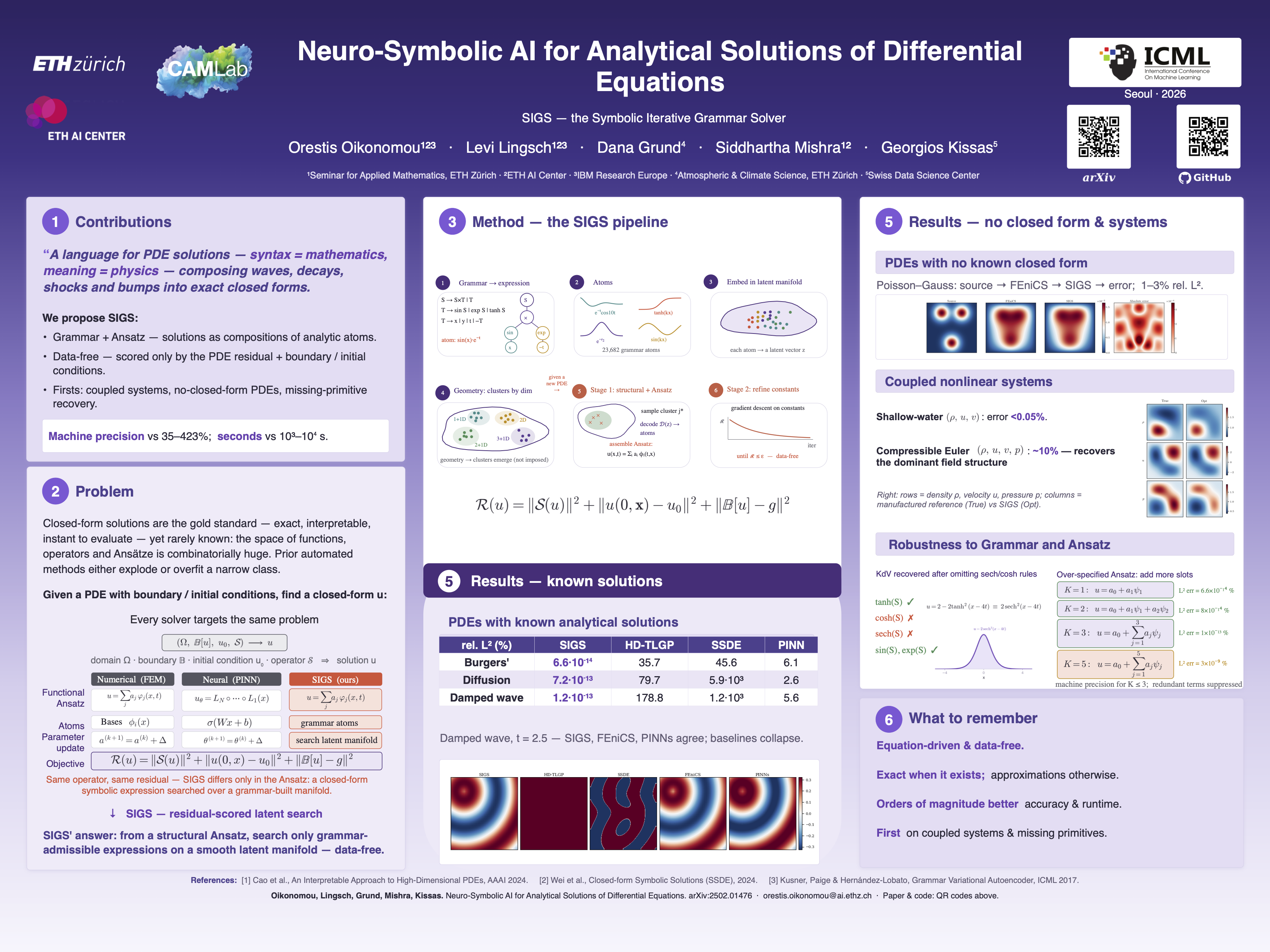
Analytical solutions to differential equations offer exact, interpretable insight but are rarely available because discovering them requires expert intuition or exhaustive search of combinatorial spaces. We introduce SIGS, a neuro-symbolic framework for equation-driven closed-form solution discovery. SIGS uses a context-free grammar to generate mathematically valid and physically meaningful building blocks, with a user-specified Ansatz prescribing how these blocks combine, embeds them into a topology-regularised continuous latent manifold, and searches this manifold in two stages: structure selection followed by coefficient refinement using gradient descent, scoring candidates only against the PDE residual and prescribed boundary and initial conditions. This design unifies symbolic reasoning with numerical optimization; the grammar constrains candidate solution blocks to be proper by construction, while the latent search makes exploration tractable and data-free. SIGS is the first neuro-symbolic method to (i) recover analytical solutions for coupled nonlinear PDE systems, (ii) discover equivalent symbolic forms when the grammar lacks the natural primitives, and (iii) produce accurate symbolic approximations for PDEs lacking known closed-form solutions. Overall, SIGS improves over existing symbolic methods by orders of magnitude in both accuracy and runtime across standard PDE benchmarks.
Lay Summary
Physics asks a fundamental question: when we know what drives a phenomenon, can we write an analytical formula describing how it evolves through space and time? These formulae reveal structure such as symmetries, periodicity and parameter dependencies, but finding them remains difficult. Even with known physical laws, the right formula depends on a precise choice of mathematical patterns and their interactions, choices that usually require human expertise. To automate these choices, we built SIGS, an AI system that finds analytical solutions for differential equations. The insight is simple: many physical systems can be described by a language whose syntax is mathematics and whose meaning is physics. This language composes elementary functions into physical patterns: waves, decays, shocks and localised bumps, while a composition Ansatz specifies how they combine into valid formulas. Once built, the language lets SIGS, for any new differential equation, efficiently find candidates that satisfy the PDE, boundary, and initial conditions, and refine the most promising ones. On benchmarks, SIGS rediscovers known exact formulas with high accuracy, finds equivalent formulas when the expected building block is missing, and produces useful approximations when no exact formula is known. Most importantly, it tackles coupled systems where quantities interact, such as shallow-water flow and compressible aerodynamics. The long-term impact is to make formula discovery less dependent on rare human intuition and more available as a practical tool for science and engineering.