
Watch Your Step: Information Injection in Diffusion Models via Shadow Timestep Embedding
Abstract
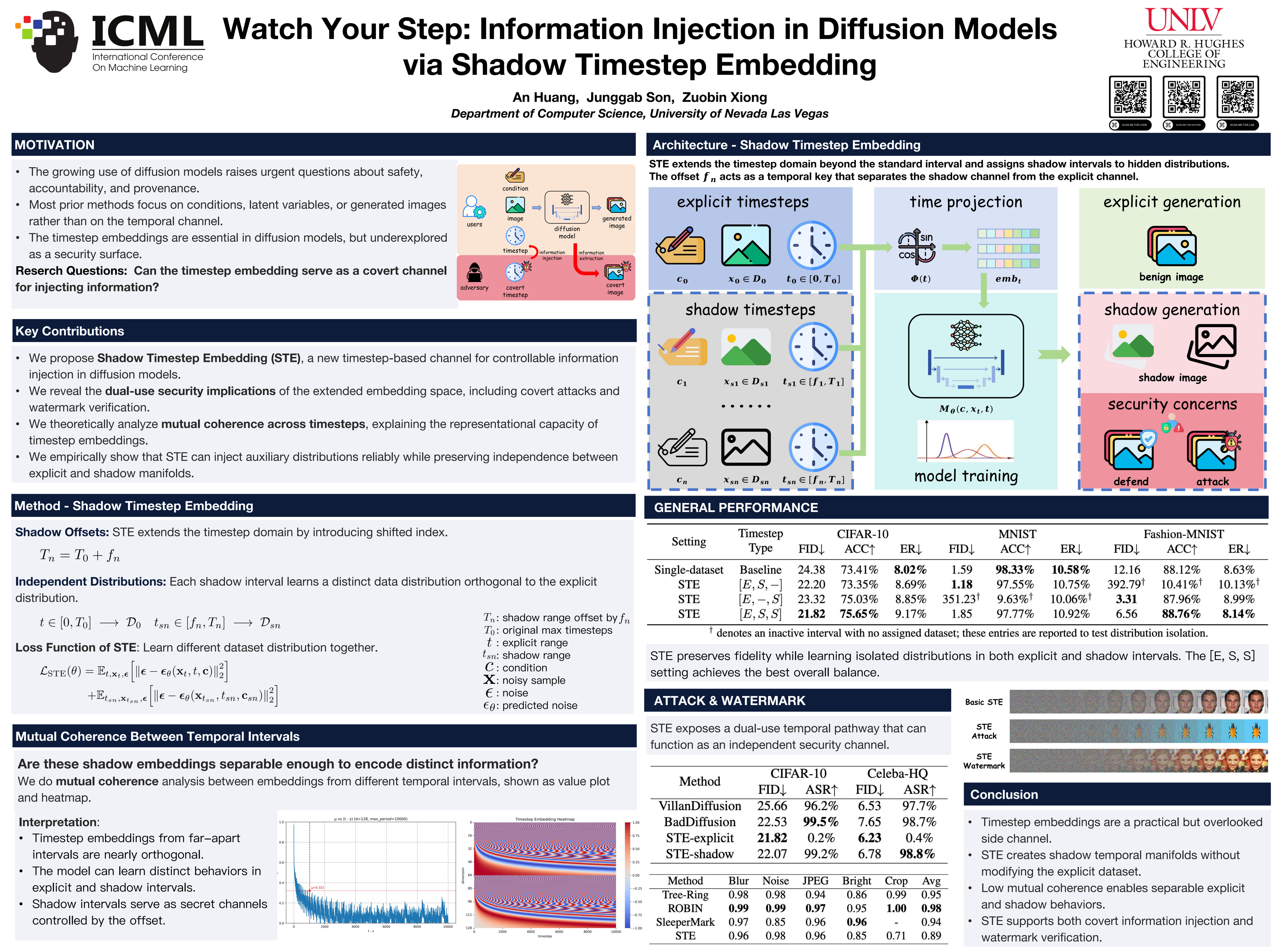
Diffusion models have become the foundation of modern generative systems, with most research focusing primarily on improving generation efficiency and output quality. The timestep embedding component is a crucial part of the diffusion pipeline, which provides a temporal conditioning signal to the denoising network, enabling it to adapt its predictions across different noise levels throughout the process. Despite their potential to contain substantial information, timestep embeddings remain underexplored in current research, especially for security risks and reliable provenance. To fill this gap, we introduce Shadow Timestep Embedding (STE), a novel mechanism that investigates the underutilized temporal space for malicious information injection into diffusion models. In particular, when zooming in on the timestep embedding space, we find that different timesteps exhibit distinct representational capabilities that can encode side-channel information. Moreover, such encoded information can be utilized for attack and defense purposes through the scheduler interface. We present a theoretical analysis of timestep embeddings as position-encoding mappings and derive a mutual coherence evaluation that explains the separability of disjoint timestep intervals. Our findings reveal the diffusion model's timestep as a powerful side channel for carrying dedicated information, motivating new directions for adversarial generative modeling by understanding the temporal dimension.
Lay Summary
We started this research because timestep embeddings, a core component of diffusion models, remain underexplored despite their potential security implications. We found that different timestep regions can encode hidden side-channel information, which may be used for malicious injection or reliable provenance tracking. To study this, we proposed Shadow Timestep Embedding (STE) and analyzed timestep embeddings as position-encoding mappings with separable temporal intervals. Our work shows that the temporal dimension of diffusion models is not only important for generation, but also critical for building safer and more trustworthy generative AI systems.