
Towards Cold-Start Drafting and Continual Refining: A Value-Driven Memory Approach with Application to NPU Kernel Synthesis
Abstract
Lay Summary
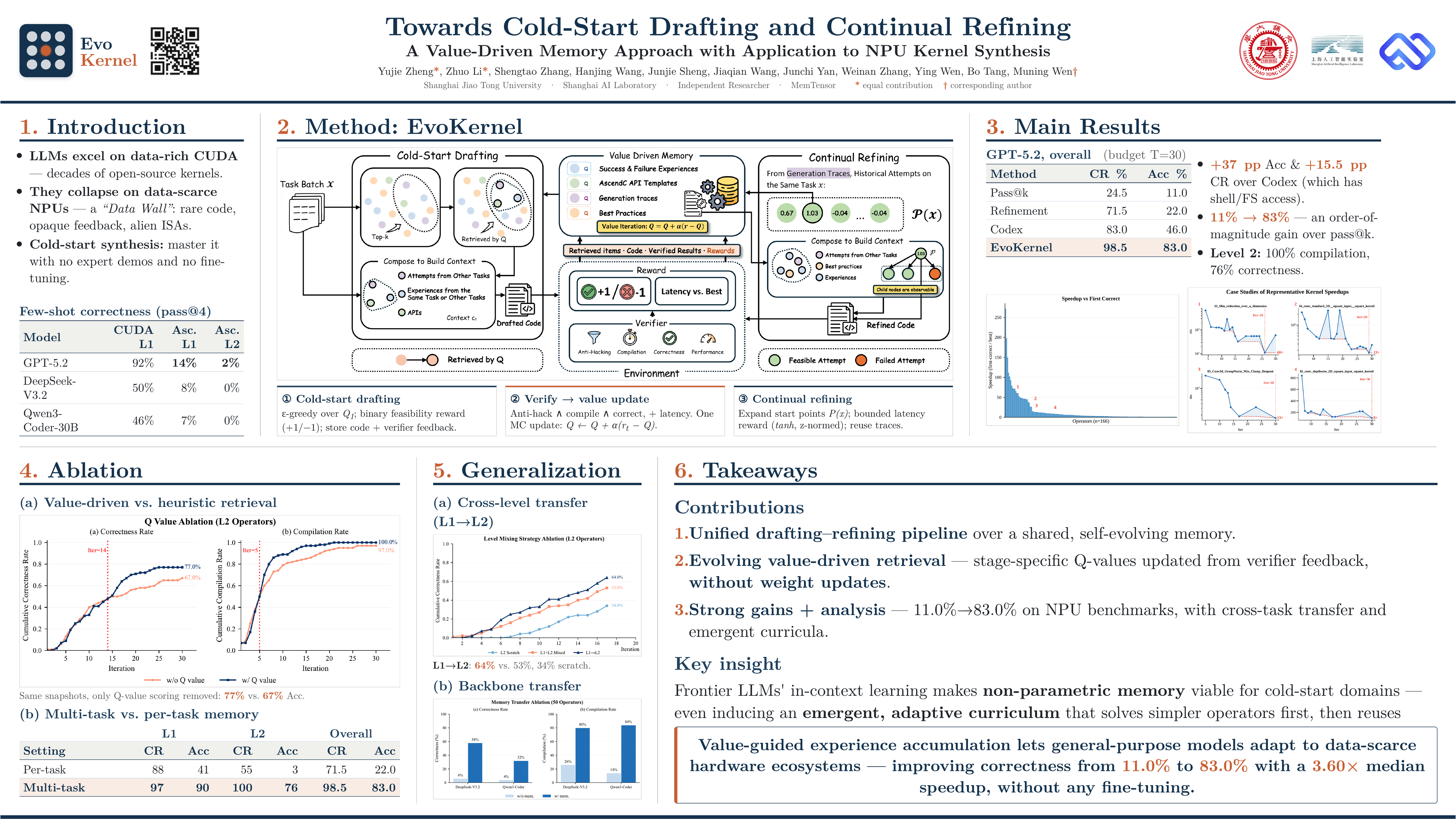
Today's AI models write impressive code for widely used platforms because billions of code examples exist online to learn from. Many emerging computing domains, however, are starved of such data — new specialized hardware architectures keep appearing, but documentation and example code remain scarce. Even the most capable models get such code right only about one time in ten on these less-supported platforms. We built EvoKernel, a system that turns a general-purpose AI model into an effective programmer for such a data-scarce domain, without retraining the model itself. The idea is to give the model a growing notebook of its own past attempts: each time it tries a problem, the system records what worked and learns which past notes help most on the next problem. Lessons from easier problems help the model tackle harder ones. Using the Ascend architecture as a representative example of an emerging, low-resource domain, EvoKernel raises the AI's success rate from 11% to 83% and makes solutions roughly 3.6 times faster than the first correct attempt. The same approach should help AI models quickly become competent on other emerging hardware where training data is limited.