
Learning High-Frequency Continuous Action Chunks in Latent Space
Abstract
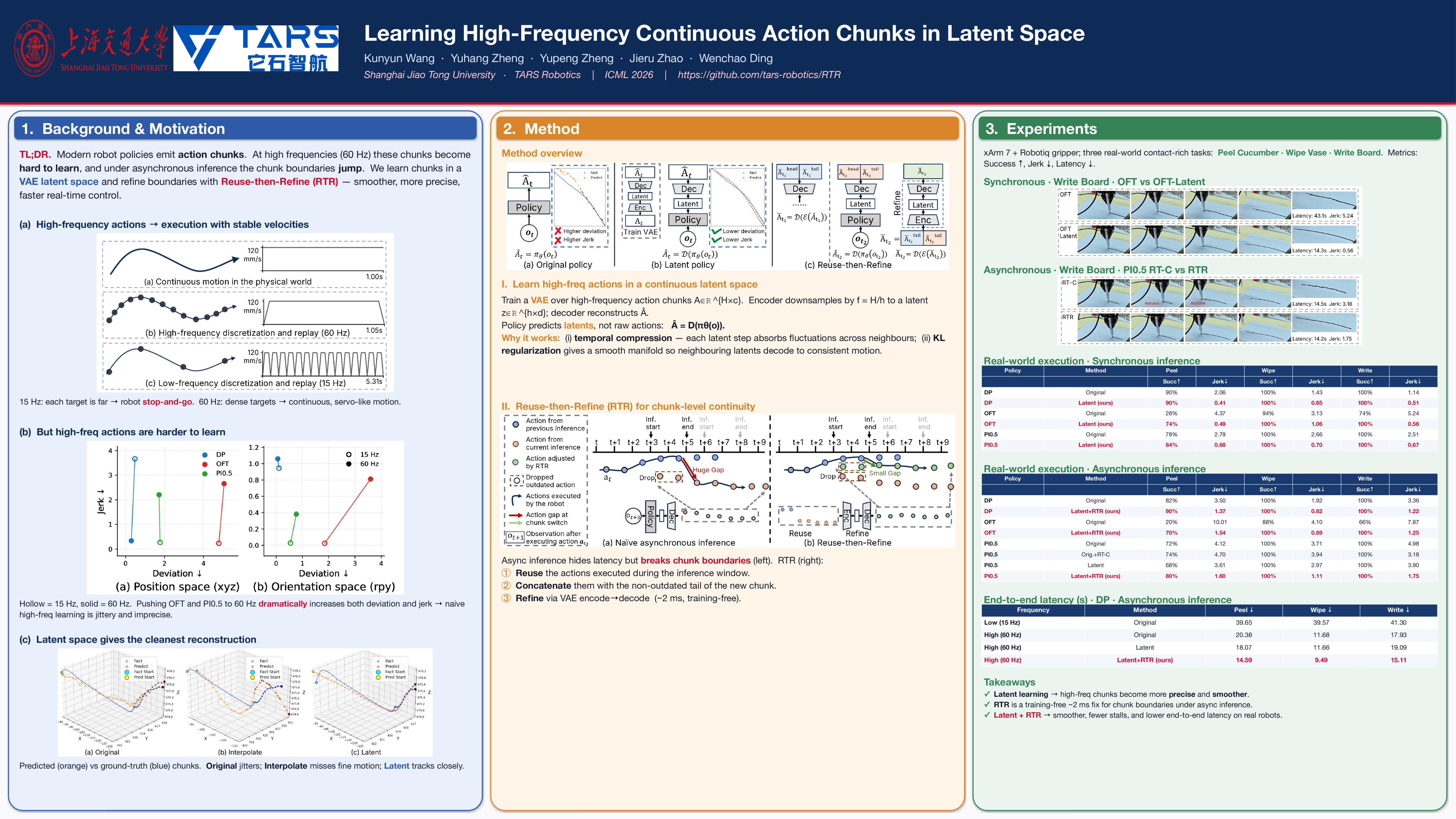
Modern robotic policies increasingly rely on action chunking to execute complex tasks in the physical world. While action chunking improves temporal consistency at moderate action frequencies, it becomes insufficient when the action frequency is further increased (e.g., to 60~Hz). At such high frequencies, policies often fail to generate actions that are both temporally smooth and spatially consistent. We address this challenge by shifting high-frequency action learning from the action space to a latent space with variational autoencoder (VAE). This formulation significantly improves both temporal and spatial consistency of high-frequency control. To enable smooth real-time execution, we further introduce Reuse-then-Refine, a chunk-level refine strategy that improves continuity between adjacent action chunks under asynchronous inference. As a result, robots controlled by our policy can execute complex contact-rich tasks continuously, with less pauses and jerky motions. Experiments on three real-world contact-rich robotic tasks show that our approach consistently completes tasks with smooth motions. Our code and data are available at https://github.com/tars-robotics/RTR.
Lay Summary
Imitation learning policies control robots by predicting short sequences of future actions, known as action chunks, and then executing these actions on the robot. Increasing the action frequency can make robot motion smoother by reducing the stop-and-go behavior often seen in low-frequency execution, allowing the robot to move with more stable velocities. However, high-frequency actions are also harder for policies to learn, because they contain denser temporal information and finer spatial variations. In this work, we propose learning high-frequency action chunks in a latent space, which provides a more compact and structured representation of motion. This helps the policy generate smoother and more consistent action sequences. To further reduce execution stalls caused by model inference latency, we use asynchronous inference, where the robot continues executing current actions while the policy predicts the next action chunk. However, asynchronous inference can introduce discontinuities when switching between chunks. To address this, we propose Reuse-then-Refine, a method that reduces boundary gaps between consecutive chunks and improves execution smoothness. In real-robot experiments, our method reduces jerky motions and execution stalls across several contact-rich manipulation tasks. Overall, this work helps make learned robot policies more reliable for continuous physical interaction.