
Collapsed Effective Operators for Higher-order Structures
Abstract
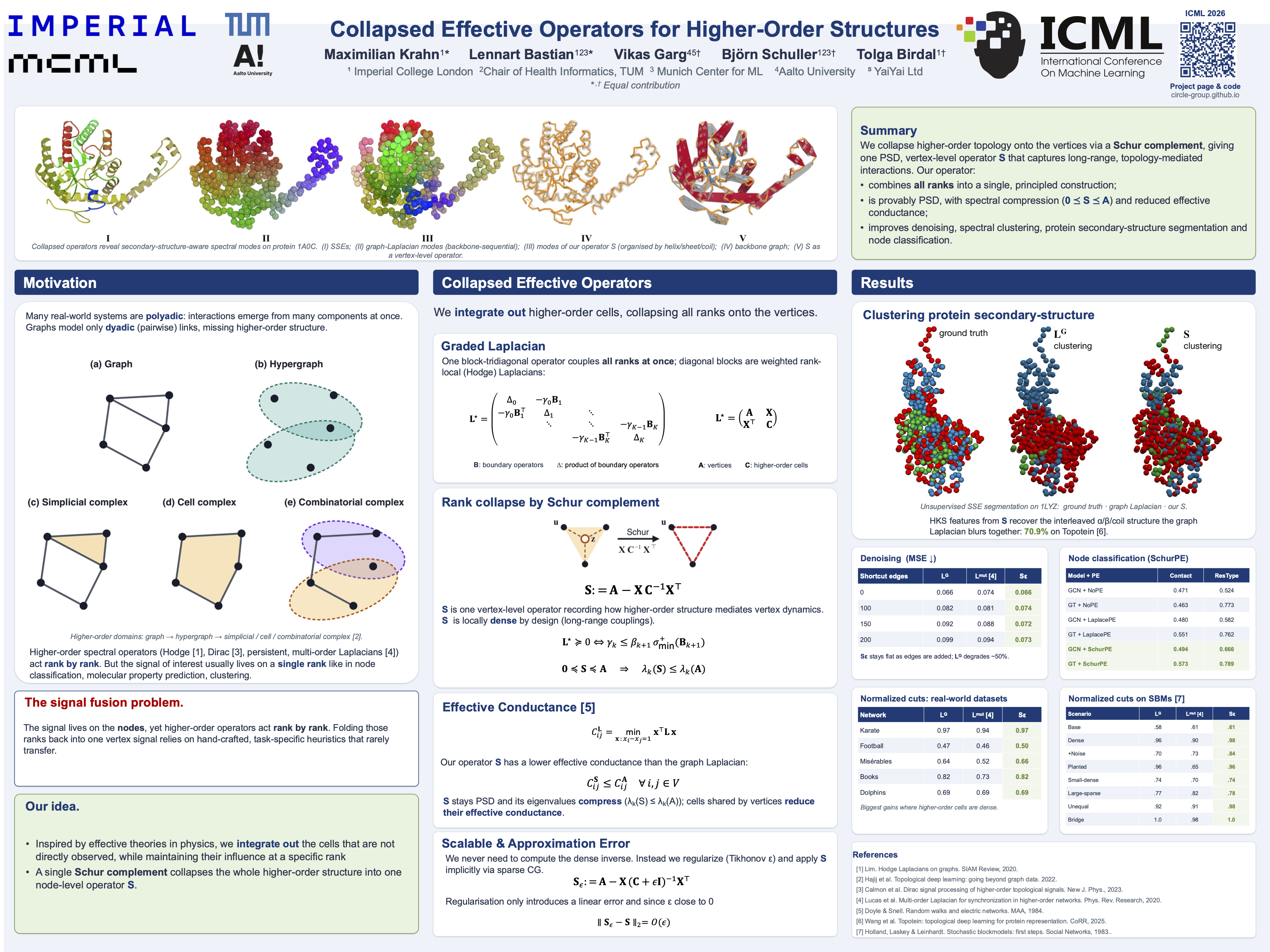
Higher-order structures are powerful relational modeling tools, yet existing spectral operators decompose topology into separate ranks, leaving practitioners to fuse information back to vertices through ad-hoc choices. We introduce Collapsed Effective Operators, which condense higher-order degrees of freedom into a single vertex-level operator via Schur complementation of a graded Laplacian. This yields a (generally dense) operator that encodes long-range interactions mediated by topology and is applicable to arbitrary higher-order constructs. We show it preserves positive semi-definiteness with a strict spectral upper bound relative to the rank-0 Hodge Laplacian, effectively lowering system energy under higher-order connectivity. Empirically, our operator improves spectral clustering, signal smoothing and enables the inclusion of topological features in neural network architectures via positional encoding.
Lay Summary
Many real-world systems are shaped by group interactions, not just pairs. For example, a protein’s shape depends on how groups of amino acids fold together, and a social network’s behaviour depends on communities, not just individual friendship links. Standard network methods usually see only pairwise links, so they can miss this larger group structure. We developed a way to translate group-level information back onto the individual members of a system. The result is a single mathematical tool, similar to the operators already used in network analysis, that can be used with existing methods. Intuitively, instead of tracking every group interaction separately, our method summarises each group’s combined effect as an adjusted relationship among its members. This avoids many of the patchwork choices researchers usually have to make when combining information across groups of different sizes. We tested our approach on tasks ranging from cleaning up noisy network data to identifying structural patterns in proteins. Across these tasks, accounting for group structure produced sharper results than methods that see only pairs. Our work makes it easier to use group-level information for network analysis, with potential applications in biology, chemistry, and the social sciences.