
Delegation and Verification under AI
Abstract
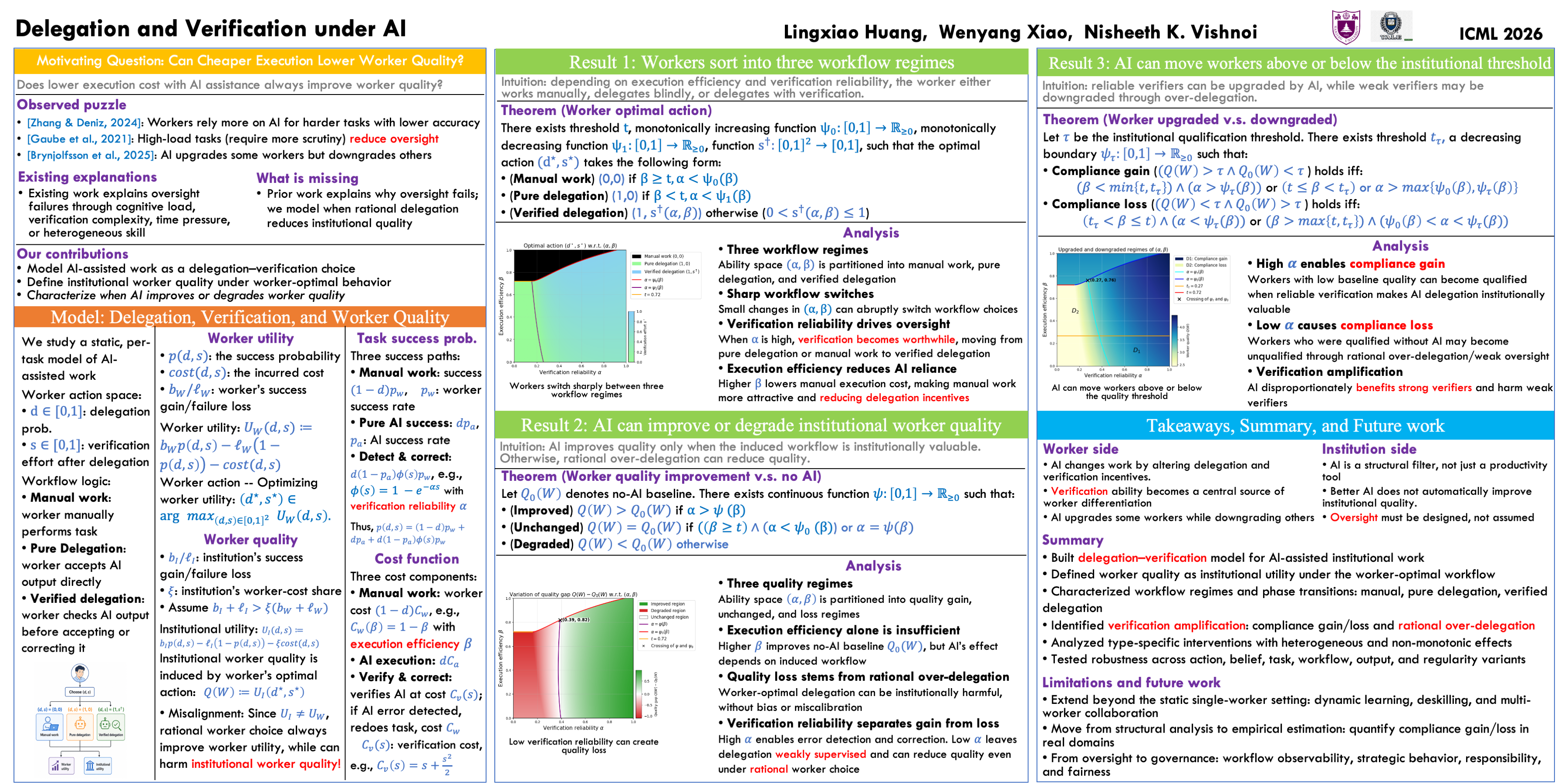
As AI systems enter institutional workflows, workers must decide whether to delegate task execution to AI and how much effort to invest in verifying AI outputs, while institutions evaluate workers using outcome-based standards that may misalign with workers’ private costs. We model delegation and verification as the solution to a rational worker’s optimization problem, and define worker quality by evaluating an institution-centered utility (distinct from the worker’s objective) at the resulting optimal action. We formally characterize optimal worker workflows and show that AI induces phase transitions, where arbitrarily small differences in verification ability lead to sharply different behaviors. As a result, AI can amplify workers with strong verification reliability while degrading institutional worker quality for others who rationally over-delegate and reduce oversight, even when baseline task success improves and no behavioral biases are present. These results identify a structural mechanism by which AI reshapes institutional worker quality and amplifies quality disparities between workers with different verification reliability.
Lay Summary
AI tools are increasingly used in workplaces such as healthcare, finance, and law, where people may hand part of a task to an AI but remain responsible for mistakes. Checking an AI’s answer takes time and effort, and workers may not have the same incentives as the institution that relies on the final output. We develop a mathematical model in which a worker chooses whether to do a task manually, delegate it to AI, or delegate it while verifying the AI’s output. The model shows that AI does not help all workers in the same way. Workers who are good at detecting and correcting AI errors can benefit from AI, while workers with weaker verification ability may rationally rely on AI too much and reduce institutional quality. This can happen even without irrational behavior or overconfidence: it follows from the structure of delegation and costly checking. Better AI systems alone may not always solve the problem, because they can encourage more unchecked delegation. Our results suggest that organizations should design AI-assisted workflows that support and reward verification, rather than evaluating only final outcomes.