
FedVeer: Self-Adaptive Skew Estimation for Robust Federated Learning
Abstract
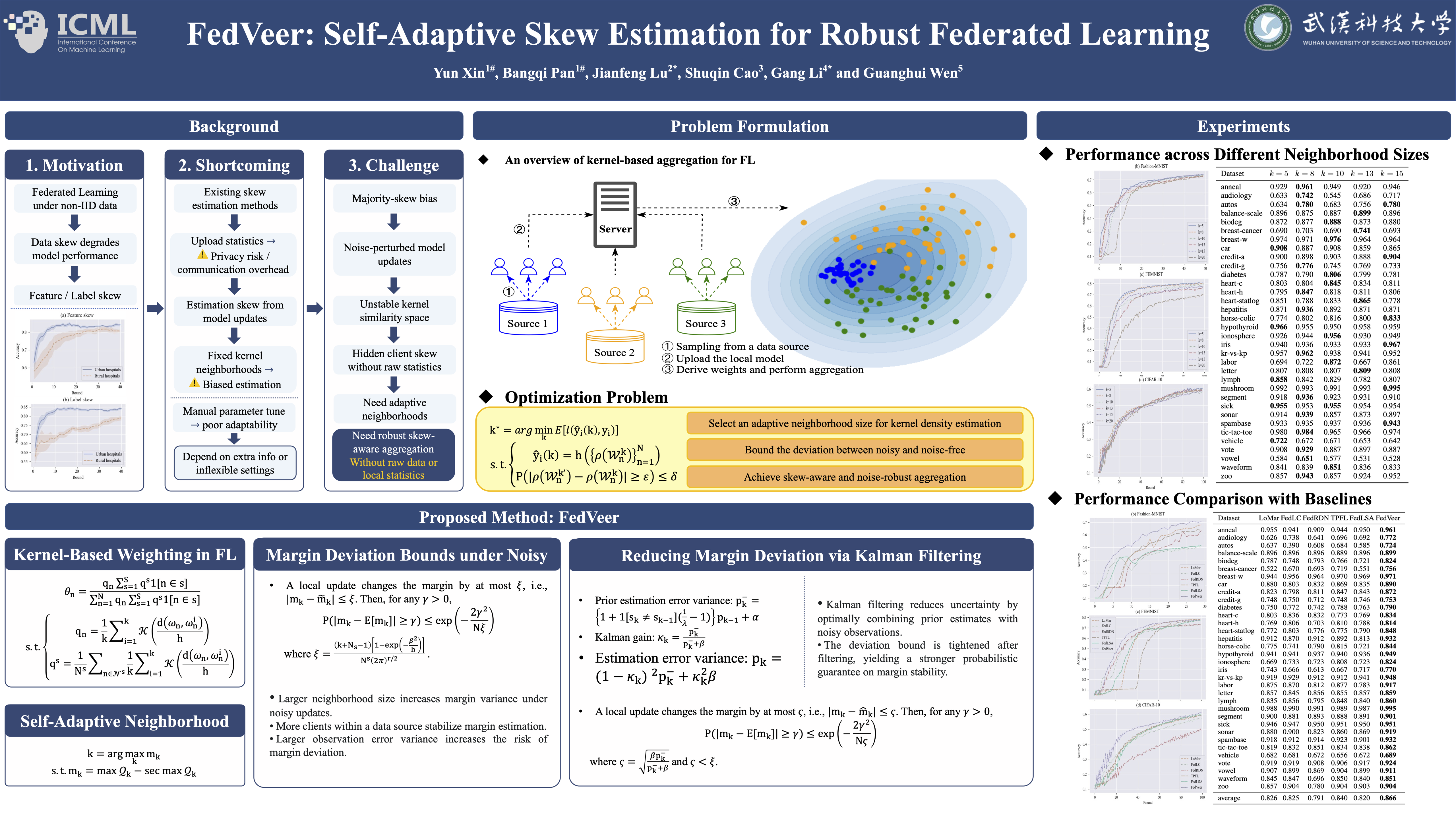
Federated Learning (FL) enables collaborative model training across decentralized clients, but its performance often degrades under non-IID data distributions, particularly in the presence of data skew. Existing approaches mitigate this issue by estimating client skew via kernel density estimation over neighboring model updates, which preserves privacy and reduces communication costs. However, such approaches suffer from two fundamental limitations: bias toward skewed majority clients due to fixed neighborhood structures, and vulnerability to noise-induced perturbation in kernel space. To address these challenges, we propose FedVeer, a skew-aware FL framework based on self-adaptive kernel density estimation with k-free neighborhoods. FedVeer dynamically determines the neighborhood size via max-margin learning to mitigate majority-client bias, and further incorporates Kalman filtering to stabilize margin estimation under noisy updates, with a high-probability theoretical guarantee on margin deviation. Extensive experiments on realworld datasets demonstrate that FedVeer consistently outperforms four baselines, achieving up to 6.36% accuracy improvement and reducing noiseinduced degradation by up to 6.01%.
Lay Summary
Federated learning allows many devices or organizations to jointly train a shared machine learning model without directly sharing their private data. However, this process becomes difficult when different participants have very different types of data. In such cases, participants whose data patterns are more common may dominate the training process, while participants with less common data may be poorly represented. Training can also become unstable when updates from participants are noisy. To address these challenges, we propose FedVeer, a lightweight framework that better identifies how different each participant’s data is without requiring fixed comparison groups. FedVeer adaptively decides which participants should be compared and uses a filtering mechanism to reduce the effect of noisy updates. Experiments on real-world datasets show that FedVeer improves model accuracy and robustness under challenging data differences, while preserving privacy and communication efficiency.