
Plasticity Activation via Polar Operator: A Plug-in Method for Balancing Stability and Plasticity
Abstract
Lay Summary
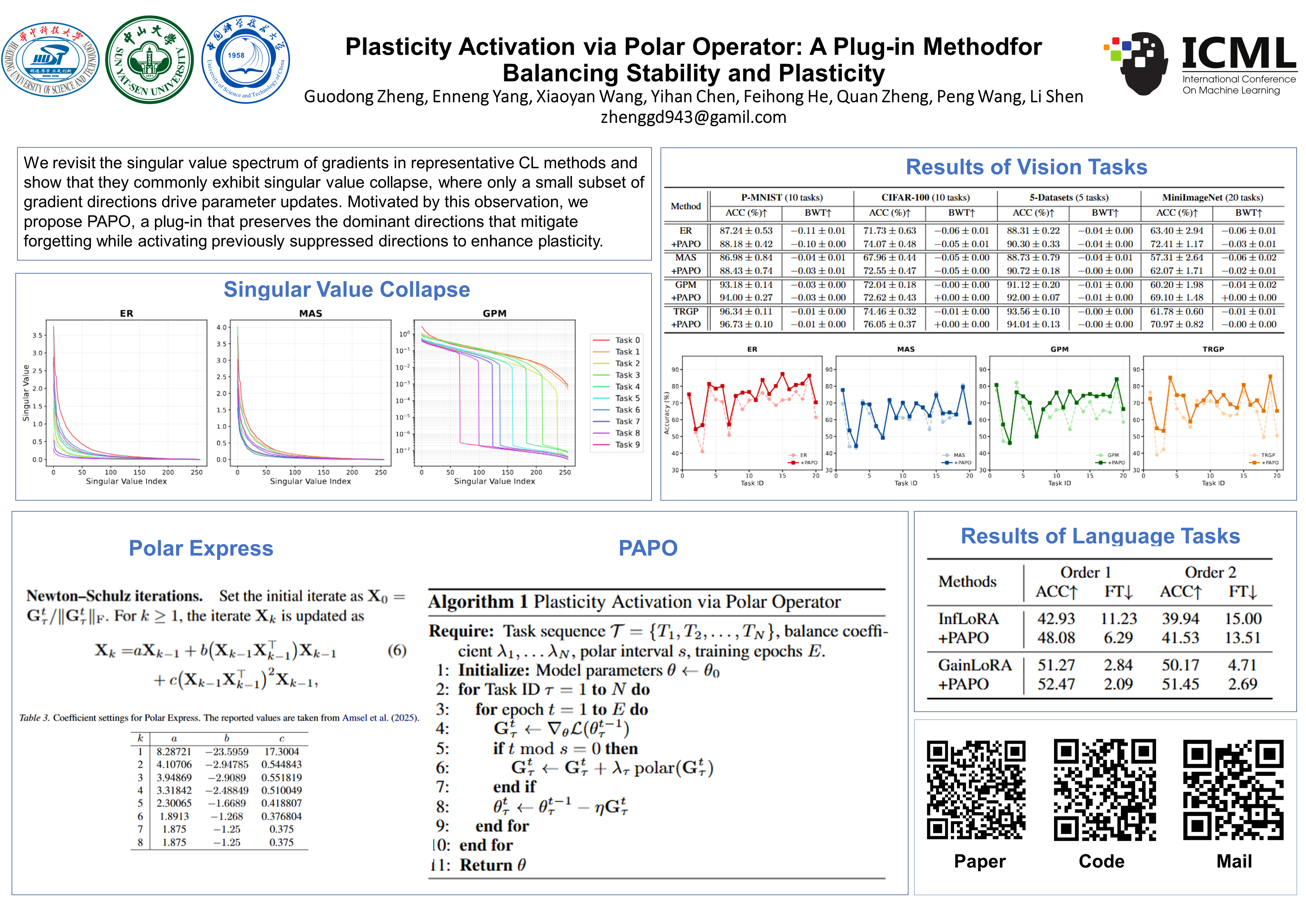
Artificial intelligence models that learn continuously tend to forget earlier skills when picking up new ones, known as catastrophic forgetting. Many existing solutions prevent forgetting by locking down most of the model’s knowledge, but this comes at a cost: the model becomes rigid and struggles to learn anything new. We discovered that these protective methods typically update the model using only a handful of internal directions, leaving many other directions completely idle. To fix this, we developed a simple add-on tool called PAPO that gently wakes up those sleeping directions. It does so by applying a smart mathematical adjustment to the learning signal, spreading the model’s ability to change more evenly without damaging the important directions that safeguard old memories. The adjustment can be computed quickly and does not require heavy, expensive calculations. When we plugged PAPO into several popular continual learning algorithms, it consistently boosted their ability to absorb new information.