
Hugging Carbon: Quantifying the Training Carbon Emissions of AI Models at Scale
Abstract
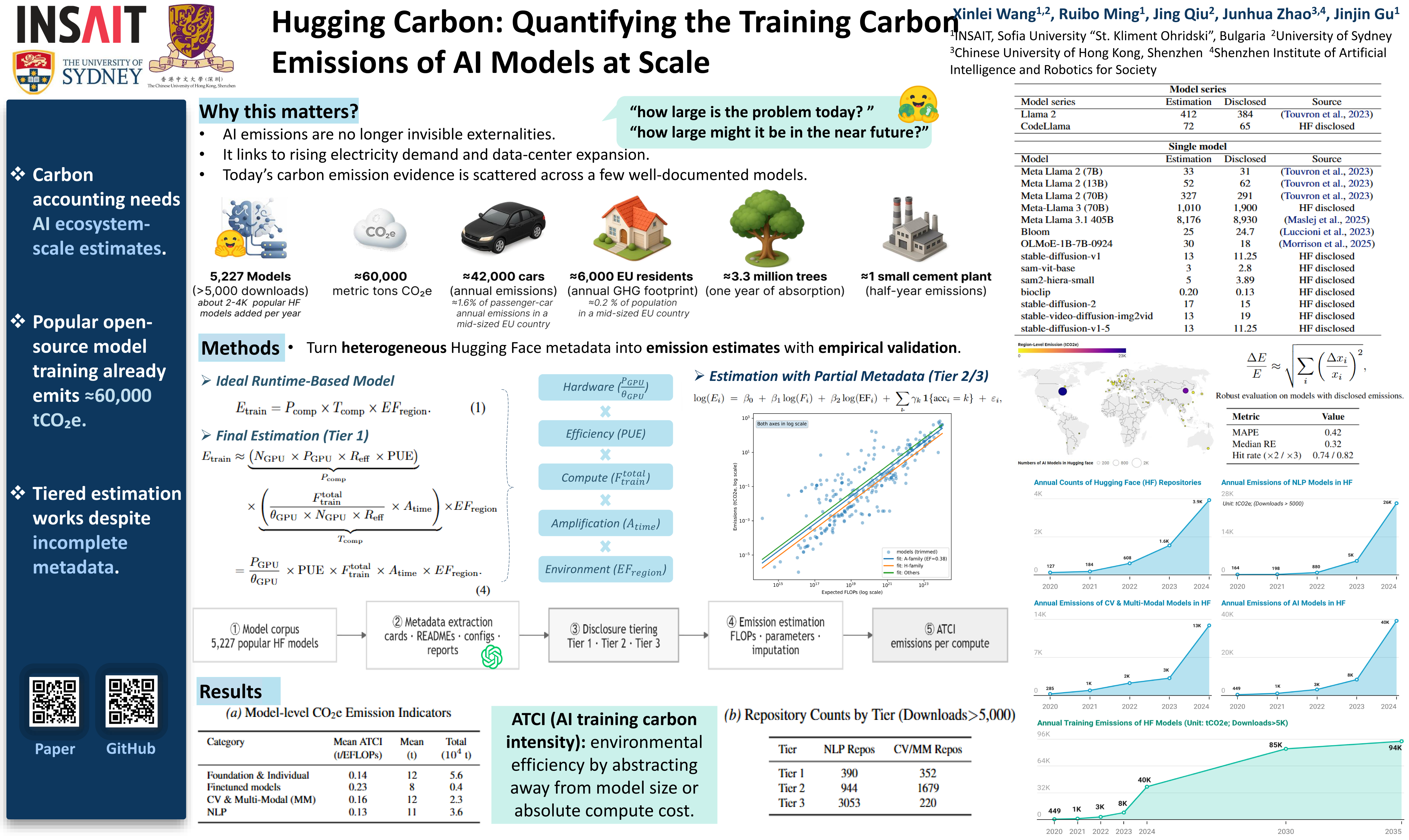
The scaling-law era has transformed artificial intelligence (AI) from research into a global industry, but its rapid growth also raises concerns over energy usage, carbon emissions, and environmental sustainability. Unlike traditional sectors, the AI industry still lacks systematic carbon accounting methods that support large-scale estimates without reproducing the original training process. This leaves open questions about how large the problem is today and how large it might be in the near future. Given its central role in hosting open-source AI models, the Hugging Face (HF) platform provides a large-scale and publicly accessible corpus for carbon accounting. We estimate aggregate training emissions of HF open-source models using available emissions, energy, compute, and model metadata. To address uneven disclosure quality, we introduce a tiered approach to handle incomplete metadata, supported by empirical regressions that assess estimation reliability. We further introduce AI training carbon intensity (ATCI, emissions per compute), a metric to assess the sustainability efficiency of model training. Our results show that training the most popular open-source models (with over 5,000 downloads) has already resulted in approximately 6.0×10^4 metric tons of carbon emissions. Overall, this paper provides a scalable, empirically grounded framework for estimating training emissions from incomplete disclosures and informing future carbon reporting standards in the AI industry. Data and code are available at https://github.com/insait-institute/HuggingCarbon.
Lay Summary
AI is becoming part of everyday life, but training powerful AI models can consume large amounts of electricity and produce carbon emissions. Many models do not clearly report this information, making it hard to understand the environmental cost of AI today or how it may grow in the future. This paper estimates the carbon emissions from training widely used open-source AI models on Hugging Face. The findings show that AI training already has a measurable environmental footprint and highlight the need for more transparent reporting and better sustainability practices in the AI industry.