
EvoEGF-Mol: Evolving Exponential Geodesic Flow for Structure-based Drug Design
Abstract
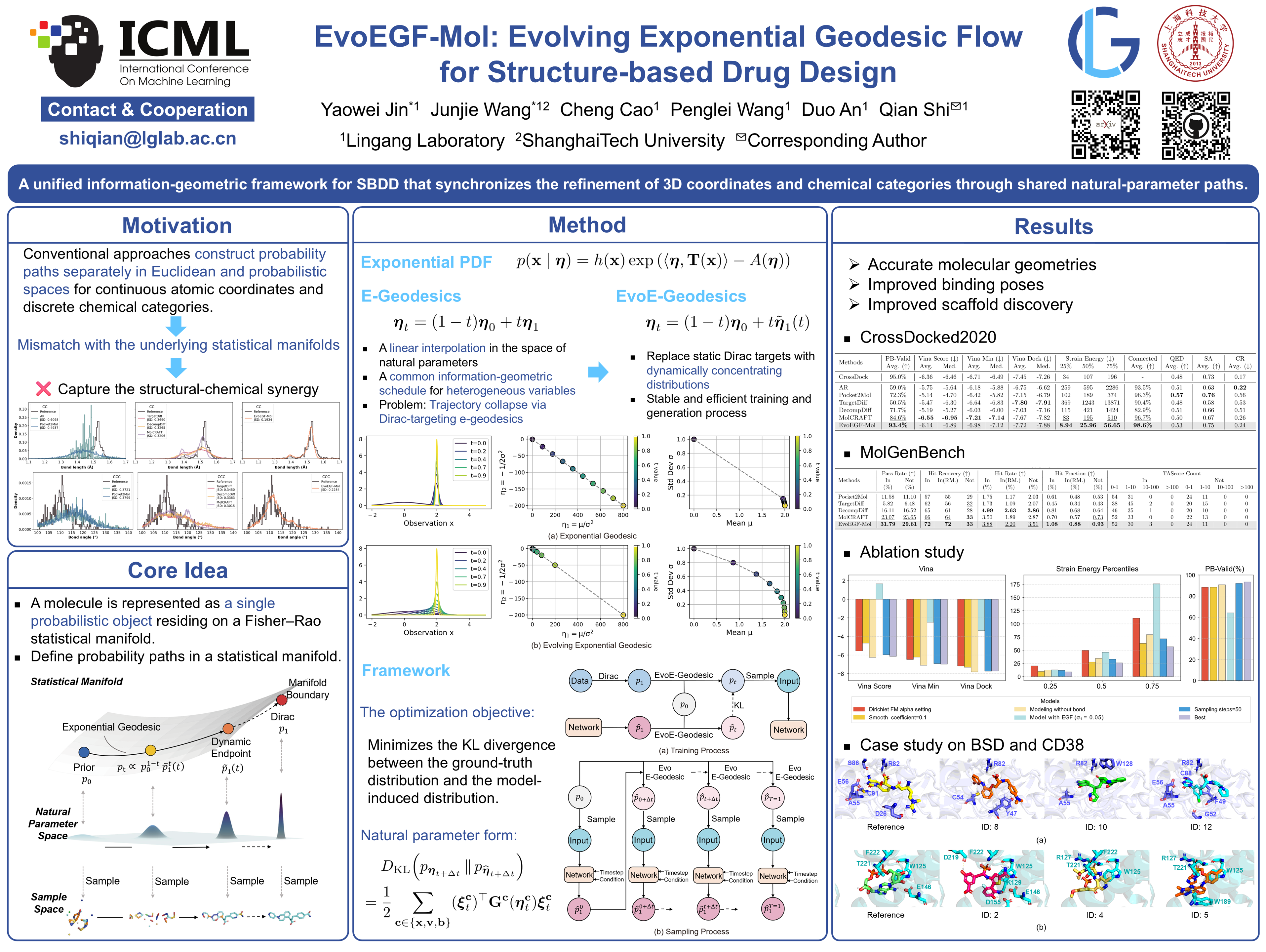
Structure-Based Drug Design (SBDD) aims to discover bioactive ligands. Conventional approaches construct probability paths separately in Euclidean and probabilistic spaces for continuous atomic coordinates and discrete chemical categories, leading to a mismatch with the underlying statistical manifolds. We address this issue by representing molecules using composite exponential-family distributions, where coordinates and categories are represented within a unified natural parameter space to evolve synchronously along exponential geodesics under the Fisher-Rao metric. To avoid the instantaneous trajectory collapse induced by geodesics directly targeting Dirac distributions, we propose Evolving Exponential Geodesic Flow for SBDD (EvoEGF-Mol), which replaces static Dirac targets with dynamically concentrating distributions and is trained with a progressive-parameter-refinement architecture. Our model approaches a reference-level PoseBusters passing rate (93.4%) on CrossDock, demonstrating remarkable geometric precision and interaction fidelity, while achieving superior performance over baseline methods on real-world MolGenBench tasks for bioactive scaffold recovery. Code is available at https://github.com/BLEACH366/EvoEGF-Mol.
Lay Summary
Designing new medicines often involves creating molecules that can bind to specific proteins in the body. Generating 3D molecules is difficult because a molecule has both a 3D shape and chemical identities, such as atom and bond types; many current AI methods handle these parts separately, which can lead to molecules whose geometry and chemistry do not fully agree. We developed EvoEGF-Mol to address this by representing a molecule's spatial coordinates and its chemical identities within a unified natural parameter space. In this space, molecular distributions evolve along exponential geodesics, reducing uncertainty in atom identities and spatial arrangements together so that atom positions, atom types, and bond types are refined in a geometrically consistent manner. EvoEGF-Mol keeps this process stable by using an evolving target, giving the model more opportunity to learn the co-evolution across different modalities. In experiments, EvoEGF-Mol generated molecules with more accurate geometries and more reliable protein-binding poses. This work helps make AI-assisted drug design more reliable and provides a stronger foundation for practical computational drug discovery.