
UCPO: Uncertainty-Aware Policy Optimization
Abstract
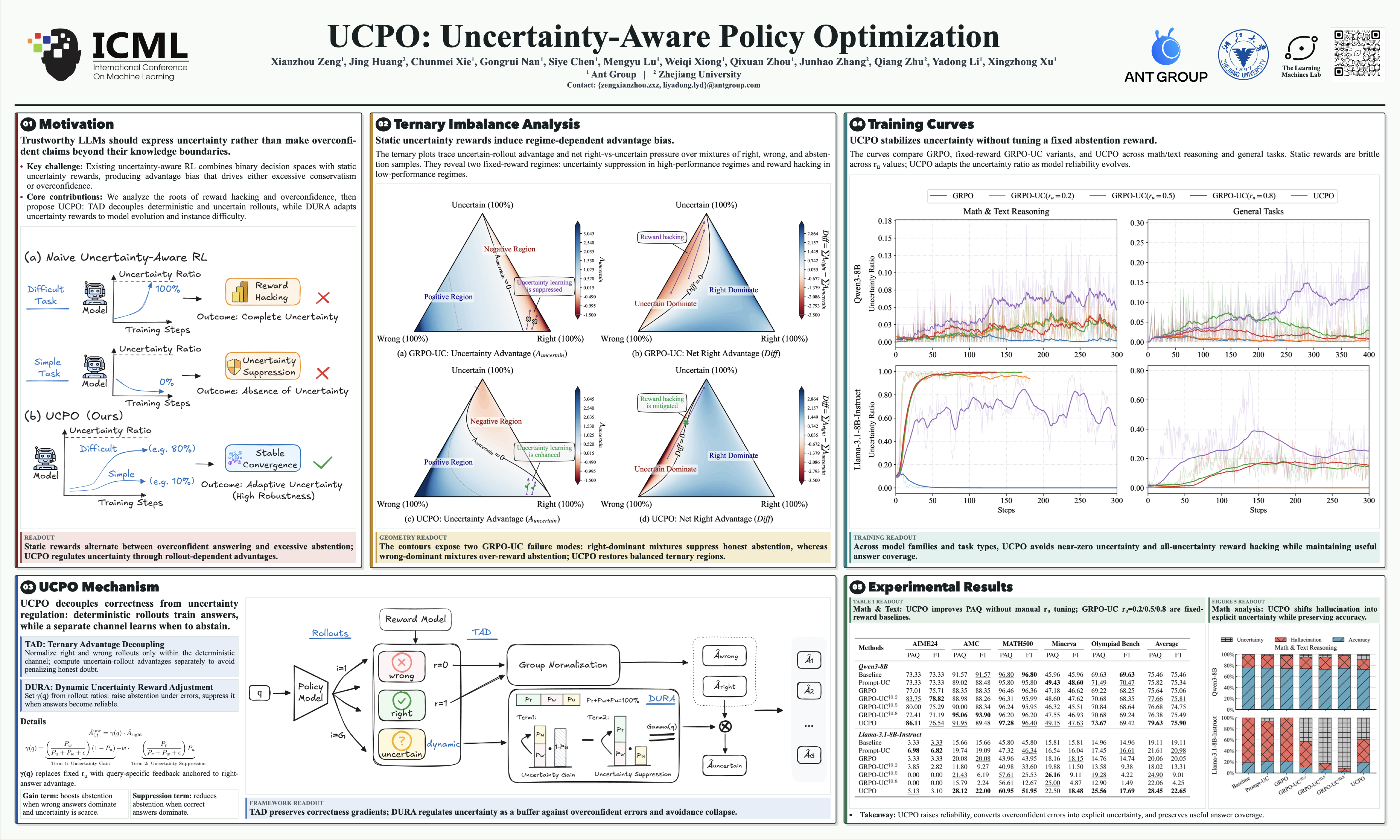
The key to building trustworthy large language models (LLMs) lies in endowing them with inherent uncertainty expression capabilities, thereby mitigating overconfident errors in high-stakes applications. However, existing RL paradigms such as GRPO often suffer from Advantage Bias due to binary decision spaces and static uncertainty rewards, inducing either excessive conservatism or overconfidence. To tackle this challenge, this paper unveils the root causes of reward hacking and overconfidence in current RL paradigms incorporating uncertainty-based rewards, based on which we propose the UnCertainty-Aware Policy Optimization (UCPO) framework. UCPO employs Ternary Advantage Decoupling to separate and independently normalize deterministic and uncertain rollouts, thereby eliminating advantage bias. Furthermore, a Dynamic Uncertainty Reward Adjustment mechanism adapts uncertainty weights in real-time according to model evolution and instance difficulty. Experimental results in mathematical reasoning and general tasks demonstrate that UCPO effectively resolves the reward imbalance, significantly improving the reliability of the model beyond their knowledge boundaries. The code is available at https://github.com/xzhouzeng/ucpo.
Lay Summary
Large language models can give confident but wrong answers, especially when asked questions beyond their knowledge. This is risky when people rely on their responses. Existing reinforcement learning methods struggle to teach models when to answer and when to express uncertainty: they may either guess too much or become overly cautious. We propose UCPO, a reinforcement learning method that helps models balance these choices. Rather than using a fixed incentive to express uncertainty, UCPO adjusts that incentive as the model learns and as questions differ in difficulty. In experiments on math, reasoning, and general knowledge tasks, UCPO made the model’s answered responses more reliable and reduced risky guesses by encouraging appropriate expressions of uncertainty. This helps move language models toward more trustworthy behavior.