
Zooming without Zooming: Region-to-Image Distillation for Fine-Grained Multimodal Perception
Abstract
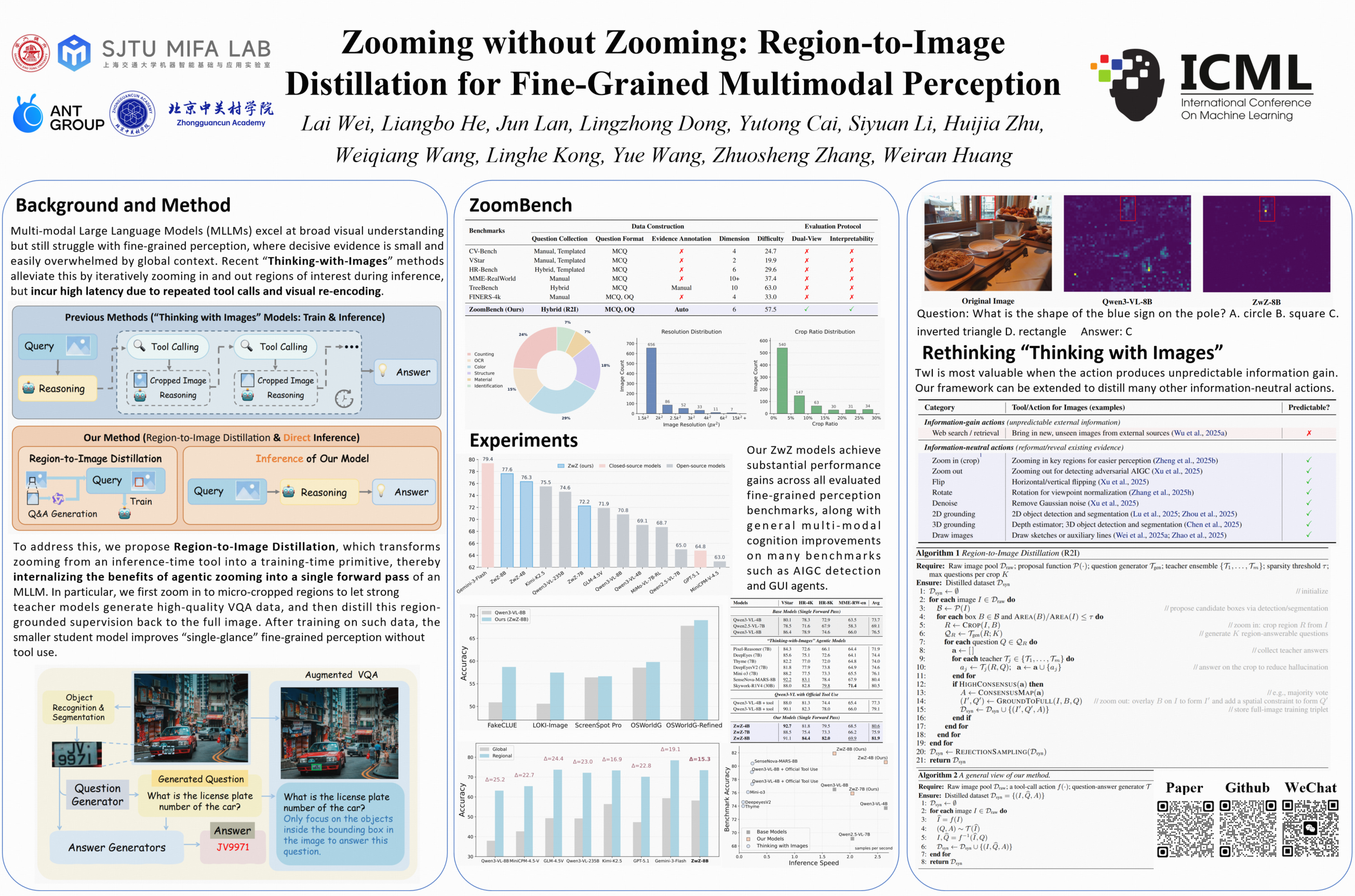
Multimodal Large Language Models (MLLMs) excel at broad visual understanding but still struggle with fine-grained perception, where decisive evidence is small and easily overwhelmed by global context. Recent "Thinking-with-Images" methods alleviate this by iteratively zooming in and out regions of interest during inference, but incur high latency due to repeated tool calls and visual re-encoding. To address this, we propose Region-to-Image Distillation, which transforms zooming from an inference-time tool into a training-time primitive, thereby internalizing the benefits of agentic zooming into a single forward pass of an MLLM. In particular, we first zoom in to micro-cropped regions to let strong teacher models generate high-quality VQA data, and then distill this region-grounded supervision back to the full image. After training on such data, the smaller student model improves "single-glance" fine-grained perception without tool use. To rigorously evaluate this capability, we further present ZoomBench, a hybrid-annotated benchmark spanning six fine-grained perceptual dimensions, together with a dual-view protocol that quantifies the global-regional "zooming gap". Experiments show that our models achieve leading performance across multiple fine-grained perception benchmarks (Figure 1), and also improve general multimodal cognition on benchmarks such as visual reasoning and GUI agents. Our code is available at https://github.com/inclusionAI/Zooming-without-Zooming.
Lay Summary
Current AI vision models struggle to see tiny details in images, like small text or subtle colors. While existing solutions let the AI zoom in on specific parts of the image, this process is slow because the AI must repeatedly stop to adjust its view. We developed a method called "Zooming without Zooming" to solve this. Instead of zooming during use, we teach the AI to zoom in its mind during training. We use a smart teacher AI to generate questions about tiny cropped sections of images. Then, we train a smaller student AI to answer these questions by looking at the full image, using visual highlights to show where the details are. Once trained, the student learns to focus on these small areas automatically without needing to crop the image. Our approach makes AI vision both sharper and faster. It spots small details better than much larger models and beats systems that physically zoom, but works in one quick step. This improves real-time uses like reading small text on screens or spotting fake images, while saving computation time.