
CL-GCL: Comprehensive and Lightweight Graph Contrastive Learning
Abstract
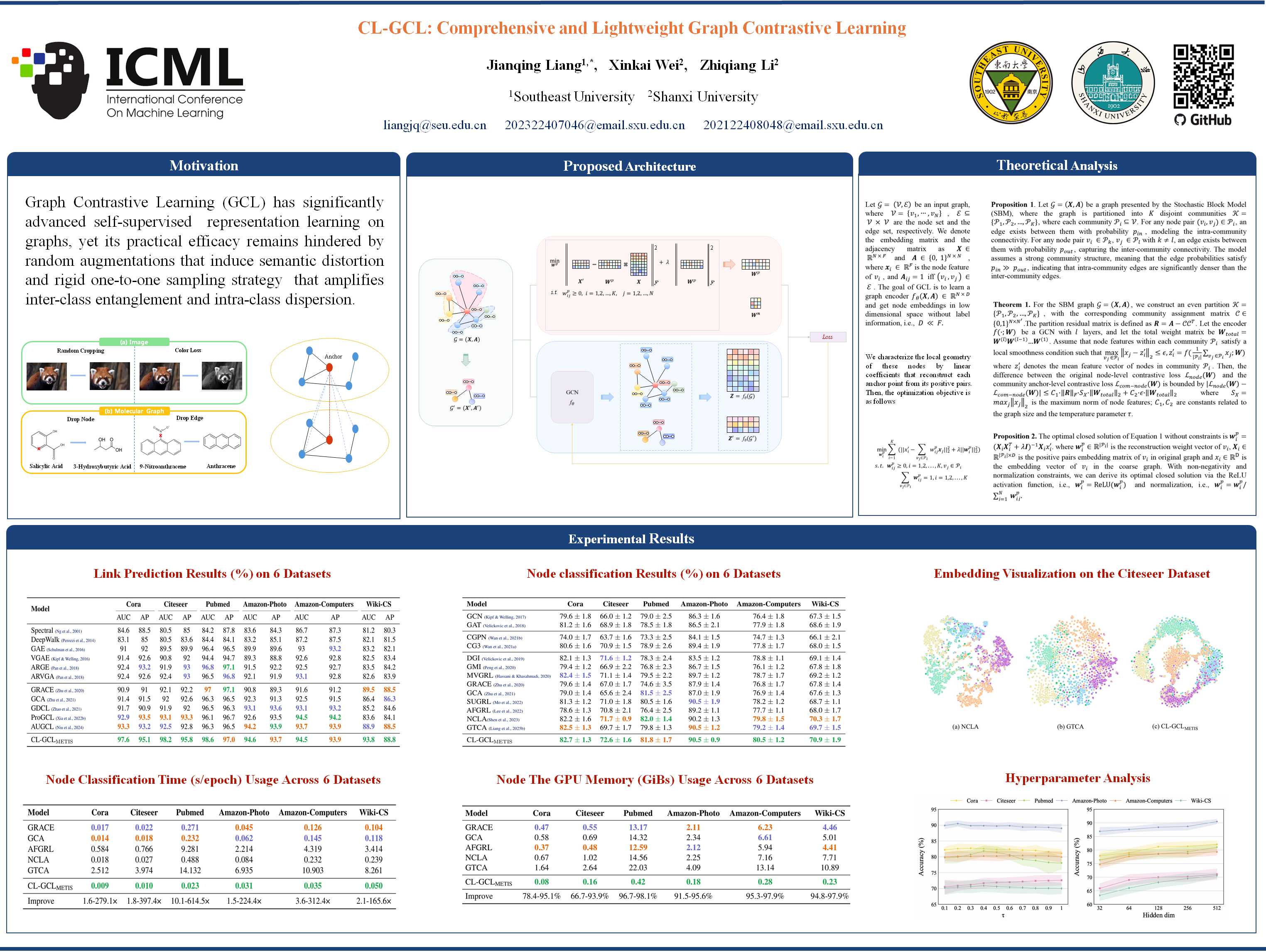
Graph Contrastive Learning (GCL) has significantly advanced self-supervised representation learning on graphs, yet its practical efficacy remains hindered by random augmentations that induce semantic distortion and rigid one-to-one sampling strategy that amplifies inter-class entanglement and intra-class dispersion. To address these limitations, we develop CL-GCL, a Comprehensive and Lightweight Graph Contrastive Learning framework. Specifically, we exploit graph coarsening to preserve structural semantics through community-level representations and manifold learning to capture local geometric relations without costly pairwise distance computations. This design naturally aligns with the neighborhood aggregation principle of Graph Convolutional Networks, enhancing structural consistency while eliminating negative sampling bias. We theoretically prove that CL-GCL approximates node-level contrastive loss under mild conditions. Extensive experiments demonstrate consistent superiority in both accuracy and efficiency over state-of-the-art GCL methods.
Lay Summary
Graph Contrastive Learning (GCL) has struggled with random graph augmentations that distort meaningful structures and rigid sampling that blurs class boundaries. CL-GCL solves this by treating graphs as communities—not isolated nodes—using graph coarsening to preserve high-level topology and manifold learning to capture local geometry without expensive distance calculations. This approach mirrors how Graph Convolutional Networks naturally aggregate neighbor information, making representations more consistent and semantically grounded. Unlike traditional GCL, CL-GCL eliminates biased negative sampling, reducing noise and improving convergence. Theoretically, we prove it approximates the optimal node-level contrastive loss under realistic conditions. Experiments show CL-GCL outperforms state-of-the-art methods in accuracy and speed across multiple benchmark datasets. It scales efficiently to large graphs with millions of nodes, making it practical for real-world applications like social network analysis and molecular property prediction. No manual labeling is needed—CL-GCL learns purely from graph structure, lowering barriers for domains with scarce annotations. Its lightweight design requires no extra parameters or complex architectures, enabling easy integration into existing GNN pipelines.