
From Noise to Intent: Anchoring Generative VLA Policies with Residual Bridges
Abstract
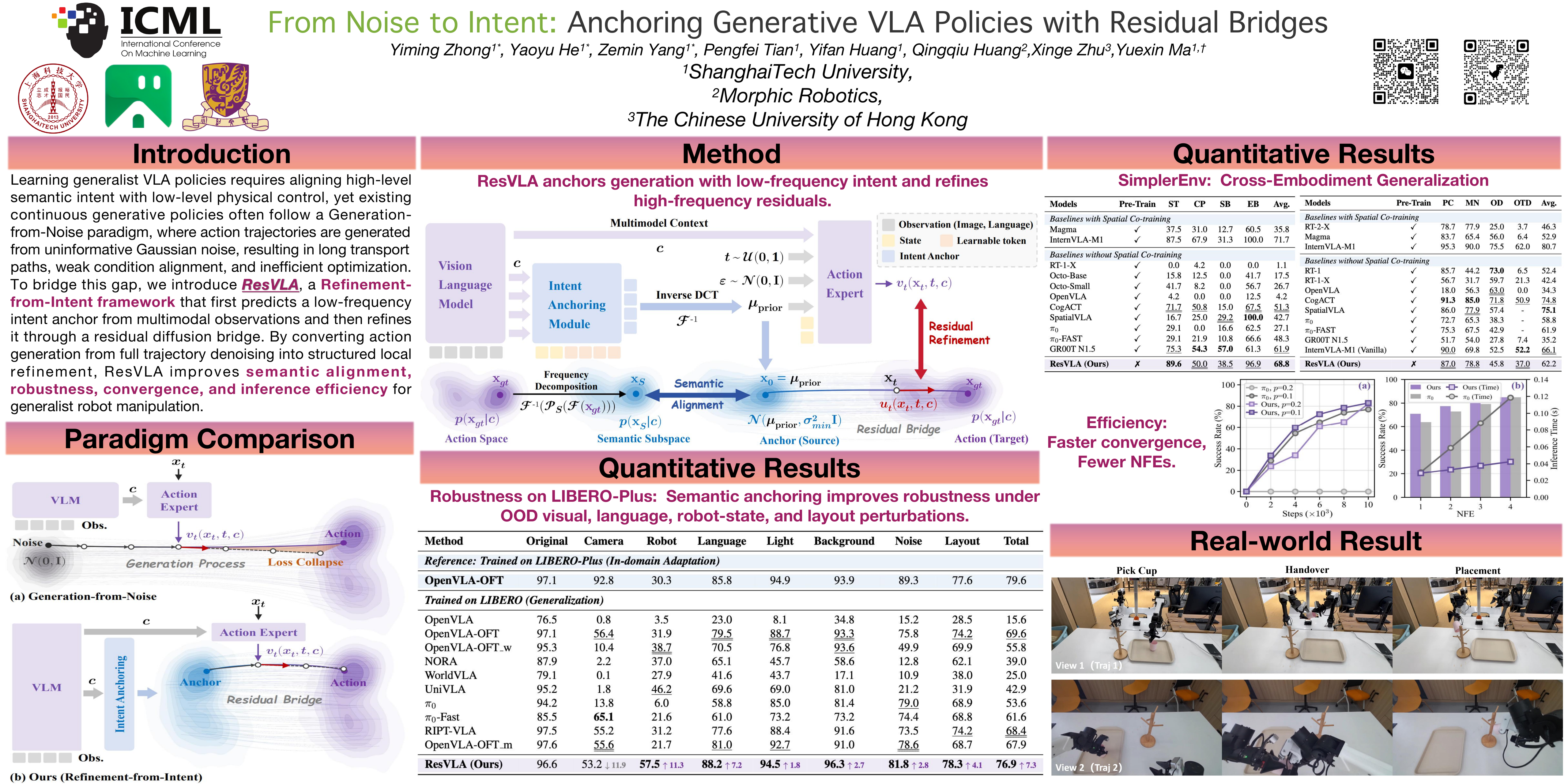
Bridging high-level semantic understanding with low-level physical control remains a persistent challenge in embodied intelligence, stemming from the fundamental spatiotemporal scale mismatch between cognition and action. Existing generative VLA policies typically adopt a "Generation-from-Noise" paradigm, which disregards this disparity, leading to representation inefficiency and weak condition alignment during optimization. In this work, we propose ResVLA, an architecture that shifts the paradigm to "Refinement-from-Intent." Recognizing that robotic motion naturally decomposes into global intent and local dynamics, ResVLA utilizes spectral analysis to decouple control into a deterministic low-frequency anchor and a stochastic high-frequency residual. By anchoring the generative process on the predicted intent, our model focuses strictly on refining local dynamics via a residual diffusion bridge. Extensive simulation experiments show that ResVLA achieves competitive performance, strong robustness to language and robot embodiment perturbations, and faster convergence than standard generative baselines. ResVLA also demonstrates strong performance in real-world robot experiments.
Lay Summary
Robots need to turn visual observations and language instructions into concrete actions, but modern generative policies can be unstable because they often start from noise and must gradually produce precise motor commands. This paper introduces a method that anchors this generation process using residual bridges, allowing the policy to focus on refining actions toward the intended behavior instead of generating them from scratch. The approach improves the stability and effectiveness of vision-language-action policy learning for robotic manipulation tasks. More broadly, the work helps make generative robot policies easier to train and more reliable in embodied AI systems.